

Professional bettors know that relying solely on recent winning streaks can lead to costly mistakes—over 68 percent of successful betting models incorporate historical stats, not just current form. In fast-evolving NBA and NFL betting markets, many American and Canadian players recognize that deep historical data uncovers predictive patterns overlooked by casual wagers. This article cuts through surface trends, showing how comprehensive historical stats provide vital context and strategic advantages for sharper, long-term betting decisions.
Table of Contents
- Defining Historical Stats In Sports Betting
- Core Benefits Of Past Performance Analysis
- Key Metrics: From Team Trends To Player Props
- How Historical Data Drives Positive Ev Opportunities
- Risks, Data Quality, And Common Pitfalls
Key Takeaways
| Point | Details |
|---|---|
| Historical Stats Are Essential | Professional bettors rely on historical statistics to make data-driven decisions rather than instinctive guesses. |
| Advances in Predictive Modeling | Analyzing past performance improves accuracy in identifying value betting opportunities and managing risks. |
| Critical Metrics Matter | Team and player metrics, including situational statistics, enhance understanding and prediction of outcomes. |
| Data Quality Is Crucial | Maintaining high data quality and addressing biases is essential for accurate analysis and reliable betting strategies. |
Defining Historical Stats in Sports Betting
Historical stats represent the foundational data points that professional bettors leverage to make mathematically informed wagering decisions. Unlike casual betting approaches that rely on gut feelings or recent performance, historical statistics provide a comprehensive analytical framework for understanding sports performance patterns. Sports analytics has transformed how bettors evaluate potential outcomes by systematically collecting and analyzing detailed performance metrics.
In the context of sports betting, historical stats encompass a wide range of quantitative information including player performance records, team win percentages, head-to-head matchup results, seasonal trends, and granular data like player efficiency ratings, defensive statistics, and situational performance metrics. These comprehensive datasets allow bettors to move beyond surface-level observations and develop predictive models that identify potential value opportunities in betting markets.
The core purpose of historical stats is to transform raw numerical data into actionable betting insights. Professional bettors understand that past performance contains nuanced patterns that can predict future outcomes with greater accuracy than subjective impressions. By analyzing large datasets spanning multiple seasons, bettors can identify statistical anomalies, understand regression to the mean, and develop sophisticated predictive strategies that account for complex variables like player injuries, coaching changes, and strategic shifts.
Pro tip: Start building your historical stats database by tracking detailed performance metrics across multiple seasons, focusing on comprehensive data sources that provide granular insights beyond basic win-loss records.
Core Benefits of Past Performance Analysis
Past performance analysis revolutionizes sports betting by transforming raw data into strategic decision-making tools. Advanced data-driven insights enable bettors to move beyond intuitive guesswork and develop mathematically precise wagering strategies. By systematically examining comprehensive historical data, professional bettors can uncover nuanced patterns that traditional betting approaches typically overlook.
The primary benefits of past performance analysis include enhanced predictive accuracy, risk mitigation, and strategic opportunity identification. Bettors can analyze complex datasets spanning multiple seasons to understand team and player dynamics, including performance consistency, situational strengths, and potential regression trends. These insights allow for more sophisticated betting models that account for variables like player injuries, coaching changes, and tactical adaptations that significantly impact game outcomes.
Professional bettors leverage historical stats to identify market inefficiencies and develop sophisticated predictive models. By tracking granular performance metrics across different contexts—home versus away games, performance under specific weather conditions, player matchup dynamics—bettors can construct more robust probabilistic frameworks. This approach transforms betting from a game of chance into a more calculated, data-driven investment strategy that systematically minimizes risk and maximizes potential returns.
Pro tip: Develop a comprehensive historical stats tracking system that captures not just basic performance metrics, but includes contextual details like situational performance, player fatigue indicators, and granular matchup data to enhance your predictive modeling capabilities.
Key Metrics: From Team Trends to Player Props
Advanced sports analytics transforms betting strategies by breaking down complex performance metrics into actionable insights that go far beyond traditional statistical analysis. Professional bettors understand that effective metrics must encompass both team-level trends and individual player performance characteristics, creating a comprehensive approach to predictive modeling.
Team trend metrics typically include critical indicators like win percentages, offensive and defensive efficiency ratings, home and away performance differentials, and situational success rates. These macro-level statistics provide context for understanding team dynamics, revealing patterns such as performance consistency, adaptability under pressure, and strategic strengths across different competitive scenarios. Analysts develop sophisticated models that weight these metrics to predict potential game outcomes with increasing precision.

Player prop metrics dive deeper into individual performance data, examining granular statistics like shooting percentages, usage rates, defensive contributions, and performance consistency under various conditions. Modern analytics incorporate advanced tracking technologies that measure not just traditional box score statistics, but also nuanced performance indicators like player movement, energy expenditure, and situational effectiveness. These detailed metrics allow bettors to make more informed predictions about individual player performances, uncovering value opportunities that traditional betting approaches might overlook.
Here is a comparison of key team and player metrics used in advanced sports analytics:
| Metric Type | Example Metrics | Primary Use |
|---|---|---|
| Team Trends | Win percentage, pace, defense rating | Assess team consistency and strengths |
| Player Prop Stats | Shooting %, usage rate, movement | Predict individual player performance |
| Situational Stats | Home/away splits, weather impact | Identify performance in specific contexts |
Pro tip: Develop a systematic approach to tracking metrics by creating a standardized template that captures both team and player performance data, ensuring you collect consistent and comparable information across different games and seasons.
How Historical Data Drives Positive EV Opportunities
Statistical modeling of historical betting data reveals profound insights into identifying positive expected value (EV) opportunities that transform betting from gambling to strategic investing. Professional bettors understand that raw historical statistics are not merely retrospective records, but powerful predictive tools that can systematically uncover market inefficiencies and create mathematically advantageous wagering scenarios.
The core mechanism for driving positive EV opportunities lies in identifying discrepancies between sportsbook-implied probabilities and actual statistical likelihood derived from comprehensive historical performance data. By meticulously analyzing median outcome distributions, performance trends, and situational statistics, bettors can detect subtle market misalignments where the potential return significantly exceeds the inherent risk. These opportunities emerge from nuanced data points that conventional betting approaches typically overlook.
Advanced bettors construct sophisticated predictive models that integrate multiple layers of historical data, including team performance metrics, individual player statistics, situational context, and statistical variance. These models enable a probabilistic approach to betting that moves beyond simplistic win-loss records, instead developing complex algorithms that quantify potential value across different betting markets. The goal is not to predict absolute outcomes, but to consistently identify scenarios where the mathematical expectation favors the bettor over the long term.
Pro tip: Develop a systematic approach to tracking historical data by creating a comprehensive database that captures not just outcomes, but the contextual variables that influence those outcomes, allowing you to build increasingly sophisticated predictive models.
Risks, Data Quality, and Common Pitfalls
Complex challenges in big data sports betting expose sophisticated bettors to multiple potential risks that can undermine their analytical strategies. The most critical danger lies not in data itself, but in how bettors interpret and apply historical information. Statistical models are only as reliable as the underlying data quality, and misunderstanding these nuances can transform potentially profitable insights into costly mistakes.
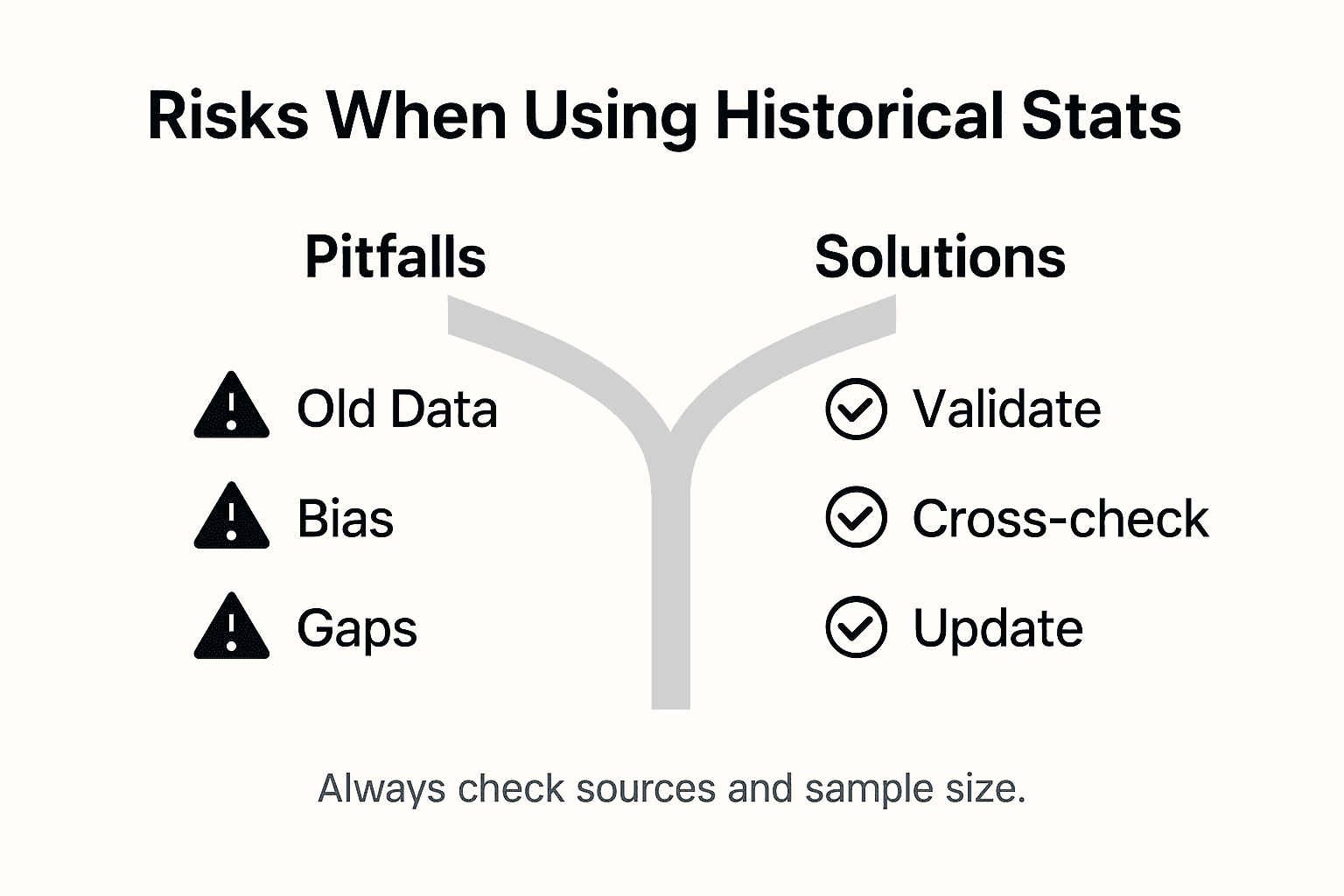
Data quality risks emerge from multiple sources, including outdated information, sampling biases, and incomplete statistical frameworks. Professional bettors must constantly scrutinize their data sources, understanding that not all historical statistics are equally valuable. Factors like player injuries, tactical team changes, and contextual performance variations can render seemingly robust historical trends irrelevant. Successful analysts develop rigorous data validation processes that continuously assess the relevance and accuracy of their statistical inputs.
Confirmation bias represents another significant pitfall in historical data analysis. Bettors frequently fall into the trap of selectively interpreting data that confirms their preexisting beliefs, inadvertently constructing statistical narratives that align with their expectations rather than objective probabilities. Advanced bettors combat this by implementing systematic, objective evaluation methods that challenge their initial hypotheses and require multiple independent data points to validate any predictive model. This approach demands intellectual humility and a commitment to mathematical rigor over personal intuition.
Below is a summary of common data reliability risks and how to counter them:
| Risk Type | Description | Best Practice for Mitigation |
|---|---|---|
| Outdated Data | Stats not reflecting current conditions | Regular data updates |
| Sampling Bias | Skewed sample not representing true trends | Use diverse and complete datasets |
| Confirmation Bias | Favoring data supporting own beliefs | Objective, multi-source data validation |
Pro tip: Implement a strict data validation protocol that includes cross-referencing multiple independent sources, establishing confidence intervals for your statistical models, and regularly reassessing the predictive power of your historical data sets.
Unlock Sharp Betting Insights with Historical Stats and Advanced Models
The article highlights the challenge many bettors face trying to turn historical stats into winning bets without falling into pitfalls like confirmation bias or outdated data. If you want to move beyond guesswork and develop mathematically sound strategies that identify true positive EV opportunities, you need a solution built around comprehensive data and rigorous analytics. Concepts like usage rates, situational performance, and granular matchup details require powerful modeling to reveal hidden market inefficiencies.

Stats Bench bridges the gap between casual gambling and informed investing by analyzing thousands of data points daily, from NBA Player Props to NFL Spreads and NHL Shot Totals. Our models deliver an analytical edge by uncovering value that sportsbooks miss. Take control of your betting future with the precision that only detailed historical stats and predictive analytics can provide. Start mastering sharp picks today by exploring our detailed Stats Bench Cheat Sheet and learn how to systematically turn data into profit.
Frequently Asked Questions
What are historical stats in sports betting?
Historical stats in sports betting are comprehensive data points that bettors use to make informed wagering decisions. They include player performance records, team win percentages, head-to-head results, and more, allowing for a systematic analysis of sports performance patterns.
How can historical statistics improve betting accuracy?
Historical statistics enhance betting accuracy by providing detailed insights into past performances, helping bettors identify patterns and trends that can predict future outcomes more reliably than intuition or recent results alone.
What key metrics should I focus on when analyzing historical data for betting?
When analyzing historical data, focus on team trends like win percentages and defensive efficiency, as well as player prop metrics such as shooting percentages and usage rates. Situational stats that assess performance under specific conditions are also important.
How do I avoid common pitfalls when using historical data for betting?
To avoid pitfalls when using historical data, ensure data quality through regular updates and diverse sources, and combat confirmation bias by objectively evaluating data that challenges your preexisting beliefs rather than aligning exclusively with them.
Recommended
- Why Use Betting Data: Gaining a Sharp Edge
- Betting Trend Insights: How They Influence Wagering Decisions
- Betting Trends Analysis Process for Profitable Wagers
- Why Track Betting Data: Boosting Smart Wagers
Free preview
See today’s MLB player props on StatsBench
Live lines, last-10 hit rates and the best price across about 60 books. No account needed to look.
Open the MLB player props board →
Prefer email? Get the daily picks newsletter.