

Most American sports bettors still believe that betting algorithms are secret formulas for easy riches, yet even the most advanced systems cannot promise guaranteed wins. For NBA and NFL fans focused on analytics and expected value, understanding what these algorithms truly offer—and what the myths get wrong—is key. This overview explains the real science behind betting models and highlights how data-driven approaches separate fact from fiction in a market where over 90% of recreational bettors lose money long term.
Table of Contents
- Defining Betting Algorithms And Common Myths
- Types Of Sports Betting Algorithms Used
- Data Inputs And Model Design Principles
- Positive Expected Value And Betting Edge
- Risks, Limits, And Common Pitfalls
Key Takeaways
| Point | Details |
|---|---|
| Understanding Betting Algorithms | Betting algorithms analyze sports data using advanced statistical techniques to find opportunities with positive expected value. |
| Types of Algorithms | Major types include supervised learning models, unsupervised approaches, and ensemble techniques, each offering unique predictive advantages. |
| Data Inputs Importance | Successful algorithms utilize diverse data sources, including historical statistics and real-time metrics, to enhance predictive accuracy. |
| Risk Management Strategies | Implementing the partial Kelly Criterion helps bettors manage risks and optimize long-term returns, mitigating potential losses from aggressive betting. |
Defining Betting Algorithms and Common Myths
Betting algorithms represent sophisticated mathematical models designed to analyze sports wagering opportunities by processing massive datasets and generating predictive insights. Unlike traditional gambling approaches based on intuition or random chance, these algorithms leverage advanced statistical techniques to identify positive expected value opportunities across various sporting events.
At their core, betting algorithms systematically deconstruct complex variables that influence game outcomes. Researchers from the Wharton School have demonstrated that effective algorithms go far beyond simplistic prediction models. They incorporate nuanced factors like player performance metrics, historical matchup data, injury reports, weather conditions, and real time statistical trends. The goal is not just predicting winners, but calculating precise probabilities that reveal potential mispricing in betting markets.
Common myths about betting algorithms often misrepresent their true nature and capabilities. Many people incorrectly assume these systems guarantee consistent wins or operate like magical money-printing machines. In reality, successful betting algorithms focus on long-term statistical edges and disciplined risk management. They recognize that no prediction is 100% certain and instead aim to identify wagers with statistically favorable expected returns. Advanced neural network models have shown promising results in sports betting by integrating complex machine learning techniques that continuously refine predictive accuracy.
Pro tip: When evaluating betting algorithms, focus on their long-term performance metrics and risk management strategies rather than short-term winning streaks.
Types of Sports Betting Algorithms Used
Sports betting algorithms represent a complex ecosystem of predictive models, each designed to extract unique insights from massive datasets. Systematic research exploring machine learning techniques has revealed several primary algorithm categories that sports bettors and analysts leverage to gain competitive advantages across different sporting contexts.
The primary types of sports betting algorithms include machine learning classifiers, which can be broadly categorized into three main groups: supervised learning models, unsupervised learning approaches, and ensemble techniques. Supervised learning models like support vector machines and neural networks are particularly powerful for predicting match outcomes by training on historical performance data. Random forests, another sophisticated supervised technique, excel at handling multiple input variables and identifying complex nonlinear relationships that traditional statistical methods might miss.
Heterogeneous ensemble classifiers represent an advanced approach where multiple algorithm types are combined to optimize predictive performance. These sophisticated models blend different machine learning techniques to create more robust and accurate predictions, effectively mitigating individual algorithmic weaknesses. Typical ensemble strategies include bagging, boosting, and stacking, which allow sports bettors to leverage the strengths of multiple predictive models simultaneously.
Pro tip: When developing or selecting a sports betting algorithm, prioritize models that demonstrate consistent performance across multiple sports and can adapt to changing competitive landscapes.
Here’s a summary of key differences among major sports betting algorithm types:
| Algorithm Type | Primary Use Case | Data Required | Unique Advantages |
|---|---|---|---|
| Supervised Learning Models | Predicting specific outcomes | Historical performance data | High accuracy with large datasets |
| Unsupervised Learning Approaches | Discovering hidden patterns | Unlabeled sports statistics | Finds unexpected trends and clusters |
| Ensemble Techniques | Combining multiple models | Mixed structured/unstructured | Balances weaknesses, boosts accuracy |
Data Inputs and Model Design Principles
Betting algorithms rely on sophisticated data collection and processing strategies that transform raw information into predictive insights. Advanced analytical frameworks reveal how complex data inputs shape model architecture, demonstrating that successful sports betting models are far more nuanced than simple statistical calculations.
Machine learning models leverage an extraordinary diversity of data sources to generate accurate predictions. These inputs range from traditional historical performance statistics to cutting-edge real-time data points including player fitness metrics, in-game momentum indicators, weather conditions, team psychology assessments, and even social media sentiment analysis. Sophisticated algorithms synthesize these disparate data streams, using advanced statistical techniques to identify subtle correlations and predictive patterns that human analysts might overlook.

The design principles governing betting algorithms prioritize three critical dimensions: data quality, model adaptability, and probabilistic rigor. Successful models implement robust validation protocols that continuously test and refine predictive accuracy, ensuring that algorithmic insights remain relevant across changing competitive landscapes. This approach requires dynamic model architectures capable of rapidly integrating new information, adjusting statistical weightings, and recalibrating predictive probabilities in response to emerging trends and performance shifts.
Pro tip: Develop a multidimensional data collection strategy that goes beyond traditional statistics, incorporating qualitative and real-time information sources to enhance predictive model accuracy.
Here is a comparison of common data inputs for advanced betting models:
| Data Input Type | Example Source | Impact on Prediction |
|---|---|---|
| Historical Statistics | Past game results | Establishes baseline trends |
| Real-Time Metrics | Live player tracking feeds | Adapts to changing conditions |
| Qualitative Insights | Social media sentiment | Captures non-statistical factors |
| Environmental Factors | Weather reports | Adjusts for external influences |
Positive Expected Value and Betting Edge
Positive expected value (EV) represents the mathematical cornerstone of intelligent sports betting, transforming gambling from a game of chance into a strategic investment approach. Strategic bettors meticulously identify opportunities where implied odds diverge from actual outcome probabilities, creating a potential advantage against sportsbook pricing mechanisms.
Research demonstrates that sportsbooks typically maintain only minor biases, which sophisticated bettors can systematically exploit. The concept of betting edge emerges when an individual discovers a statistical discrepancy between the calculated probability of an event and the odds offered by bookmakers. This difference allows mathematically disciplined bettors to place wagers with a statistical advantage, effectively turning sports betting into a probabilistic investment strategy rather than a random gamble.
The partial Kelly Criterion emerges as a critical mathematical framework for managing betting bankroll and optimizing long-term returns. By calculating the precise percentage of one’s bankroll to wager based on the identified positive expected value, bettors can minimize risk while maximizing potential profits. This approach requires continuous refinement, involving complex calculations that assess not just the likelihood of winning, but the potential return relative to the risk undertaken. Successful implementation demands rigorous statistical analysis, deep understanding of sport-specific dynamics, and disciplined emotional control.
Pro tip: Always calculate your precise expected value before placing any bet, focusing on the long-term statistical edge rather than individual game outcomes.
Risks, Limits, and Common Pitfalls
Betting algorithms represent powerful analytical tools, but they are not infallible financial instruments. Research reveals significant risks associated with aggressive betting strategies, particularly those that fail to incorporate robust risk management protocols. The most critical danger lies in the potential for complete bankroll depletion when bettors misapply mathematical models or ignore fundamental statistical constraints.
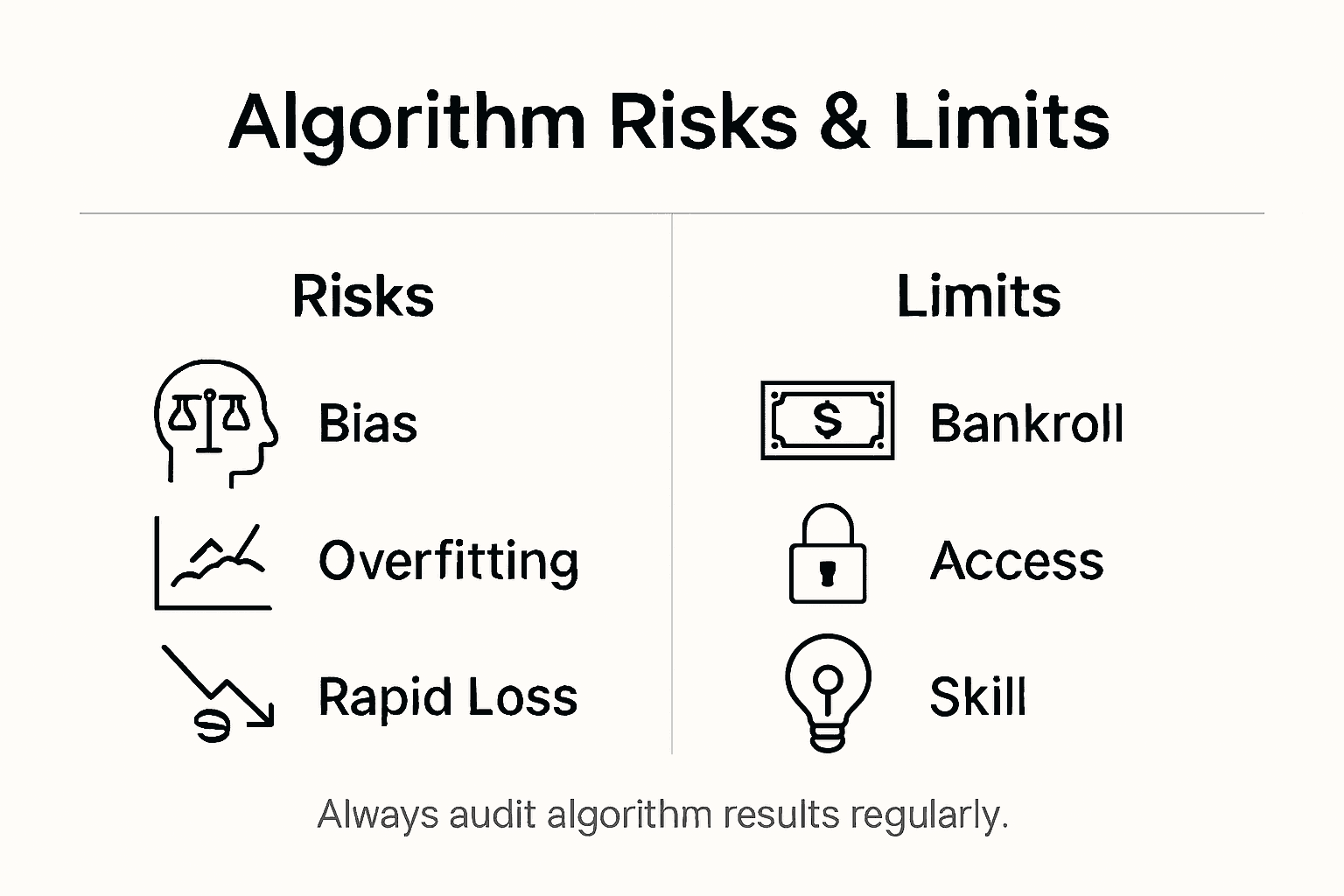
Online betting platforms present complex structural challenges that can amplify potential harm, including rapid betting cycles and continuous wagering opportunities that may encourage compulsive behaviors. Common pitfalls include overconfidence in algorithmic predictions, neglecting variance and standard deviation, and failing to distinguish between correlation and causation in sports performance data. Sophisticated bettors recognize that no algorithm can guarantee consistent wins, and the most successful approaches prioritize long-term statistical edges over short-term emotional gratification.
The partial Kelly Criterion emerges as a critical risk management strategy, helping bettors mathematically determine appropriate bet sizes based on their calculated edge. This approach mitigates the primary risks of algorithmic betting by preventing catastrophic losses and maintaining disciplined bankroll management. Successful implementation requires continuous model refinement, incorporating new data, reassessing predictive accuracy, and maintaining emotional detachment from individual betting outcomes. Bettors must view their approach as a probabilistic investment strategy rather than a guaranteed path to immediate wealth.
Pro tip: Implement strict personal betting limits and regularly audit your algorithm’s performance, treating betting as a disciplined investment strategy rather than a form of entertainment.
Gain the Analytical Edge with Proven Betting Algorithms
The article highlights a critical challenge faced by bettors today: transforming complex betting algorithms and diverse data inputs into a consistent long-term winning strategy. If the concepts of positive expected value and disciplined risk management resonate with you, then you understand that success in sports betting is not about guesswork or short-term luck. It is about applying rigorous mathematical investing principles to uncover overlooked opportunities—in player props, spreads, or shot totals.
At Stats Bench, we bridge the gap between casual gambling and true analytical investing by analyzing thousands of data points daily, including usage rates and defensive matchups. Our models identify Positive EV opportunities that sportsbooks miss by applying the very statistical rigor and adaptive machine learning your research demonstrates. Discover how you can take control of your betting portfolio through data-driven insights and precise bankroll management with Stats Bench Cheatsheet.

Stop relying on gut feelings and start betting smarter today. Visit Stats Bench Cheatsheet to access tools built specifically to harness the power of advanced betting algorithms. Get the edge you need for consistent long-term success by aligning your bets with proven analytical strategies grounded in positive expected value and risk management principles.
Frequently Asked Questions
What are betting algorithms?
Betting algorithms are advanced mathematical models that analyze sports betting opportunities by processing large datasets to provide predictive insights and identify positive expected value opportunities.
How do betting algorithms work?
Betting algorithms work by systematically analyzing various factors that can influence game outcomes, such as player performance, historical data, injury reports, and more, to calculate the probabilities of different outcomes and identify mispriced bets.
What is positive expected value in sports betting?
Positive expected value (EV) indicates a situation where the implied odds from a sportsbook are lower than the actual probability of an event occurring. Bettors use this concept to place wagers that provide a statistical advantage over the bookmaker.
What are the risks of using a betting algorithm?
The risks include potential bankroll depletion if the algorithm is misapplied, overconfidence in predictions, and neglecting important statistical considerations. Implementing robust risk management, such as the partial Kelly Criterion, can help mitigate these risks.