

Most American sports investors miss profit by treating live betting as luck when sharp analysis actually drives results. With over 80 percent of live betting profits coming from data-driven strategies, the opportunity is too big to ignore. Fast NBA and NFL action rewards bettors who value probability, emotional control, and real-time data. This guide breaks down live betting misconceptions, reveals growth tactics, and highlights analytical approaches proven to maximize your returns.
Table of Contents
- Live Betting Defined: Core Concepts And Misconceptions
- Types Of Live Bets And Sports Markets
- How Live Betting Odds Are Calculated
- Hedging And Maximizing Positive Ev In Play
- Risks, Pitfalls, And Data-Driven Strategies
Key Takeaways
| Point | Details |
|---|---|
| Live Betting as a Strategy | Live betting enables real-time decision making based on game dynamics, allowing investors to adjust strategies quickly. |
| Mathematical Approach | Successful live betting relies on a systematic understanding of probabilities, rather than luck, to identify market inefficiencies. |
| Risk Management | Investors must prioritize strict bankroll management and minimize emotional decision-making to enhance their betting success. |
| Adapting Techniques by Sport | Each sport requires unique analytical frameworks for live betting, highlighting the importance of specialized knowledge for effective wagering. |
Live Betting Defined: Core Concepts and Misconceptions
Live betting represents a dynamic approach to sports wagering where investors place bets after a game or match has already started, allowing real-time decision making based on unfolding game dynamics. Unlike traditional pre-game betting, live betting provides opportunities to analyze immediate performance metrics and adjust strategies on the fly. Betting trend insights demonstrate how sophisticated investors leverage these moments to identify strategic value.
The core misconception about live betting is that it’s purely luck-based gambling. In reality, sharp investors treat live betting as a mathematical probability exercise. By tracking instantaneous changes in team performance, player conditions, and momentum shifts, data-driven bettors can identify inefficiencies in real-time betting markets. Professional sports investors understand that sportsbooks adjust odds continuously, creating potential arbitrage opportunities for those with rapid analytical skills.
Successful live betting requires a systematic approach that combines:
- Rapid data processing capabilities
- Understanding of sport-specific performance indicators
- Emotional discipline to make objective decisions
- Advanced statistical modeling techniques
- Bankroll management strategies
Pro Tip: Develop a pre-established decision matrix for live betting scenarios, allowing you to make rapid, unemotional choices based on predefined mathematical thresholds.
Types of Live Bets and Sports Markets
Live betting offers an expansive landscape of betting opportunities across multiple sports, transforming traditional wagering into a dynamic, real-time investment strategy. Types of betting markets range from straightforward moneyline bets to complex, sport-specific propositions that require deep analytical understanding. Professional investors recognize that each sport presents unique live betting dynamics, demanding specialized knowledge and rapid decision-making skills.
In sports like Basketball and Football, live betting markets typically include real-time options such as:
- Next scoring play
- Current quarter/half point spreads
- Total points remaining
- Player-specific performance metrics
- Momentum-based wagering opportunities
More advanced live betting markets emerge in sports like Soccer and Tennis, where continuous gameplay allows for more granular betting scenarios. Sophisticated investors leverage these markets by tracking instantaneous performance shifts, understanding that odds fluctuate based on micro-level game events. The key is developing a systematic approach that converts real-time information into probabilistic betting opportunities.

Each sport requires a unique analytical framework. Soccer might offer bets on next goal scorer, possession percentages, or card probabilities. NFL live betting could focus on quarterback performance, drive success rates, or defensive matchup advantages. Professional sports investors don’t just watch the game – they mathematically deconstruct every potential betting scenario.
Here’s a comparison of live betting market features across popular sports:
| Sport | Typical Live Bet Types | Unique Market Dynamics |
|---|---|---|
| Basketball | Next scorer, quarter spread | Fast momentum shifts |
| Football | Drive result, player props | High scoring variability |
| Soccer | Next goal, possession stats | Continuous action, few pauses |
| Tennis | Game/set winner, point bets | One-on-one, rapid turns |
Pro Tip: Create sport-specific live betting templates that pre-calculate your risk tolerance and decision thresholds for different game scenarios, enabling faster, more disciplined wagering decisions.
How Live Betting Odds Are Calculated
Live betting odds represent a complex mathematical ecosystem where probabilities are continuously recalculated in real-time. Mathematical calculations behind betting odds reveal a sophisticated system that goes far beyond simple guesswork. Bookmakers employ advanced algorithms that instantaneously process multiple data points including team performance, player statistics, momentum shifts, and historical matchup information to generate dynamic odds.
The core components of live betting odds calculation include:
- Baseline pregame probability models
- Real-time event impact assessment
- Instantaneous statistical reweighting
- Predictive machine learning algorithms
- Continuous market liquidity monitoring
Professional investors understand that odds represent probabilistic representations of potential outcomes, not absolute predictions. Each micro-event during a game – a missed shot, an injury, a strategic substitution – triggers immediate recalculations. Sophisticated betting platforms use complex mathematical models that can adjust odds within milliseconds, creating opportunities for sharp investors who can interpret these rapid shifts faster than the average bettor.
The most advanced live betting systems incorporate artificial intelligence and machine learning techniques that go beyond traditional statistical modeling. These platforms analyze thousands of historical data points, current game metrics, and predictive indicators to generate increasingly accurate real-time probability assessments. The goal is not just to set odds, but to create a dynamic market that reflects the most current possible interpretation of game potential.
Pro Tip: Develop a personal odds comparison tool that tracks how different bookmakers adjust their lines, identifying systemic inefficiencies and potential arbitrage opportunities.
Hedging and Maximizing Positive EV in Play
Positive Expected Value (EV) represents the mathematical cornerstone of intelligent sports investing, transforming live betting from a game of chance into a calculated risk management strategy. Betting data analysis reveals that successful investors don’t just bet – they construct probabilistic mathematical models that systematically identify value opportunities across dynamic market conditions.
The core principles of hedging in live betting involve:
- Minimizing potential losses
- Creating risk-mitigated positions
- Exploiting market inefficiencies
- Maintaining flexible betting positions
- Preserving capital through strategic counterbet placement
Professional investors understand that hedging is not about eliminating risk, but optimizing potential returns. This means continuously reassessing your initial position as game dynamics evolve. A sophisticated hedging strategy might involve placing simultaneous bets on different outcomes, creating a mathematical buffer that reduces overall exposure while maintaining potential profit channels. The key is identifying scenarios where your cumulative bet positions generate a positive expected value, regardless of the final game result.
The most advanced hedging techniques leverage real-time data analytics to make split-second decisions. Investors use complex algorithms that instantly calculate potential outcomes, comparing live odds across multiple platforms to identify arbitrage opportunities. These strategies go beyond simple risk mitigation – they transform live betting into a precision investment approach where mathematical modeling trumps emotional decision-making.
Pro Tip: Develop a standardized hedging protocol that automatically triggers counterbet placements when your initial wager’s probability drops below a predetermined threshold.
Risks, Pitfalls, and Data-Driven Strategies
Live betting introduces complex risk profiles that demand sophisticated analytical approaches beyond traditional sports wagering. Emerging regulatory insights into online betting reveal that successful investors must navigate multifaceted challenges involving technological, financial, and legal considerations. The most significant risks emerge not from the betting mechanism itself, but from emotional decision-making and inadequate risk management protocols.
Key systemic risks in live betting include:
- Rapid emotional escalation
- Exponential bankroll volatility
- Technology-induced decision latency
- Cognitive bias amplification
- Inadequate probabilistic modeling
Professional sports investors understand that risk management is fundamentally a mathematical discipline, not an intuitive process. The most dangerous pitfall is believing that individual game outcomes can be predicted with certainty. Instead, successful strategies focus on building robust probabilistic models that generate consistent positive expected value across large sample sizes. This means treating each bet as a statistical opportunity rather than an emotional investment.
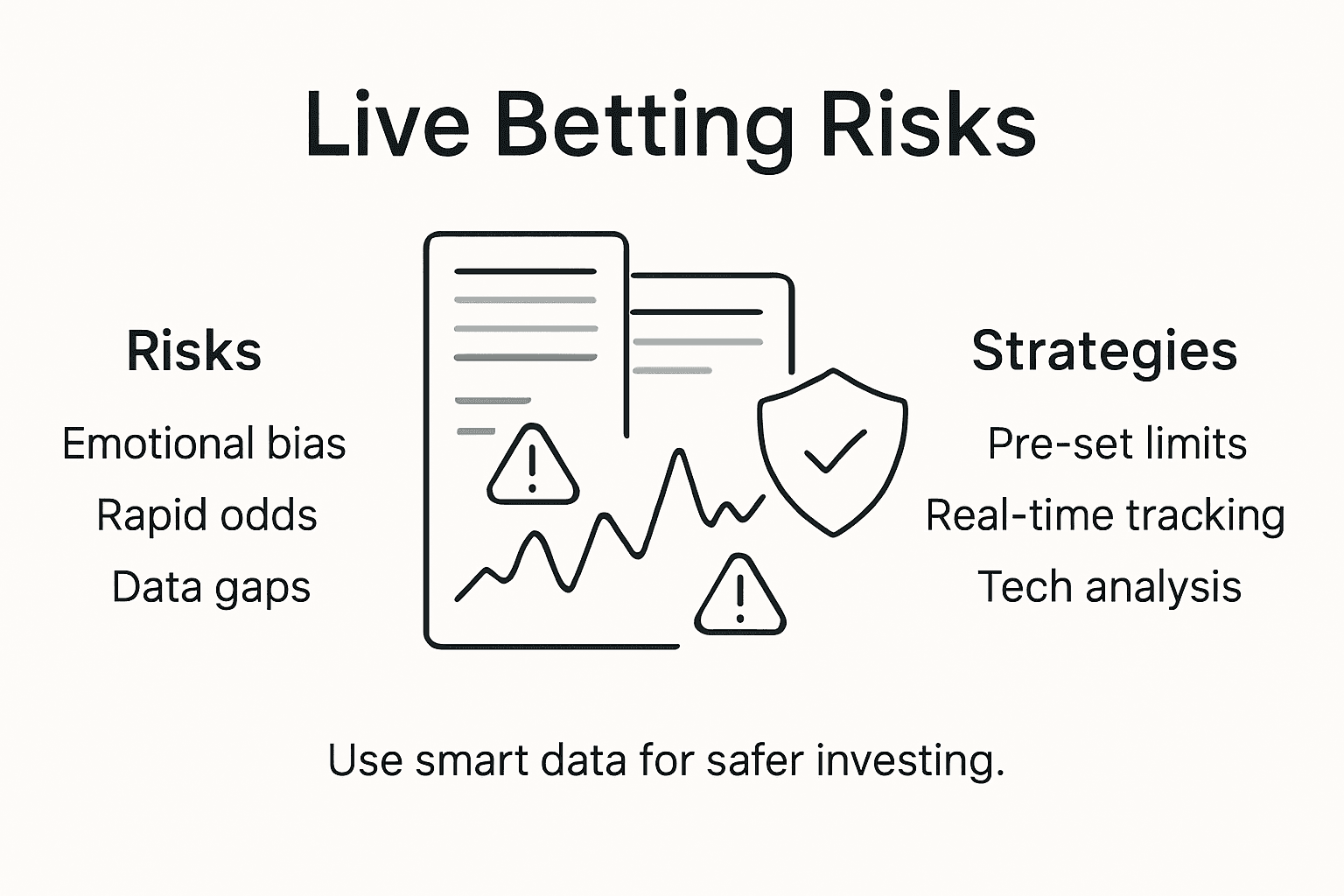
This table summarizes common risks and relates them to their mitigation strategies in live betting:
| Risk Factor | Potential Impact | Effective Mitigation Strategy |
|---|---|---|
| Emotional escalation | Poor decision making | Use automated decision matrices |
| Bankroll volatility | Rapid loss of funds | Strict bankroll management protocols |
| Tech decision latency | Missed opportunities | Invest in faster analytical tools |
| Cognitive biases | Over/underestimating events | Rely on data and probability models |
Data-driven risk mitigation requires developing sophisticated technological and analytical frameworks. Advanced investors deploy machine learning algorithms that can instantaneously assess game dynamics, calculate real-time probability shifts, and automatically execute hedging strategies. These systems transcend human limitations by processing massive datasets, identifying subtle market inefficiencies, and maintaining strict mathematical discipline that eliminates emotional interference.
Pro Tip: Create a comprehensive risk management template that predetermines maximum acceptable loss thresholds for each betting category, ensuring automated exit strategies that protect your long-term investment capital.
Gain the Analytical Edge in Live Betting Today
Live betting offers incredible opportunities but also complex challenges like rapid odds changes and emotional decision traps. This article highlights the critical need for a systematic approach and data-driven strategies to capitalize on positive Expected Value while managing risks effectively. If you are ready to move beyond gut feelings and want to harness the power of real-time analytics, Stats Bench is your essential partner. Our daily models analyze thousands of data points—from player matchups to momentum shifts—helping you make smarter NBA Player Props, NFL Spreads, and NHL Shot Totals wagers.

Take control of your live betting performance now by using our proven mathematical investing tools. Explore our comprehensive Cheatsheet for actionable insights and strategies designed around the very concepts discussed here. Start making informed, unemotional decisions today and unlock your long-term winning potential with Stats Bench. Visit Stats Bench Cheatsheet to get started immediately.
Frequently Asked Questions
What is live betting?
Live betting is a dynamic form of sports wagering where bets are placed after a game has started, allowing bettors to make real-time decisions based on game events.
How are live betting odds calculated?
Live betting odds are determined by advanced algorithms that continuously update based on team performance, player statistics, momentum shifts, and other real-time factors, reflecting the current probabilities of game outcomes.
What are some common strategies for successful live betting?
Successful live betting requires rapid data processing, understanding sport-specific indicators, emotional discipline, and effective bankroll management to make calculated decisions based on real-time information.
What are the risks associated with live betting?
Key risks in live betting include emotional decision-making, bankroll volatility, potential technology-induced delays, and cognitive biases. Effective risk management strategies are essential to navigating these challenges.