

Most American bettors mistakenly view sports betting as pure luck rather than a calculated, data-driven investment. For analytical NBA and NFL veterans, this misconception often leads to missed profit opportunities and poor strategy. Backed by research showing disciplined approaches can flip the odds, this guide challenges common myths and reveals how treating sports betting as a mathematical discipline delivers sustainable returns far beyond random wagering.
Table of Contents
- Defining Sports Betting and Common Misconceptions
- Key Bet Types and Analytical Opportunities
- How Odds, Probability, and Value Interact
- Why Data Beats Gut Feelings Every Time
- Risk Management, Taxes, and Long-Term Profit
Key Takeaways
| Point | Details |
|---|---|
| Sports Betting as a Discipline | Treat sports betting as a data-driven investment strategy requiring rigorous analysis, not as gambling reliant on luck. |
| Analytical Approach to Bet Types | Understand the various bet types and their unique probability landscapes; consistent success requires systematic analysis. |
| Importance of Risk Management | Implement strict bankroll management guidelines, never wagering more than 1-3% of your total bankroll to mitigate potential losses. |
| Data Over Emotion | Rely on data-driven decision making to identify trends and opportunities, minimizing biases and emotional influences on wagering choices. |
Defining Sports Betting and Common Misconceptions
Sports betting represents a sophisticated analytical practice where individuals predict sports outcomes and place calculated financial wagers based on statistical probability. Unlike popular misconceptions, successful sports betting is not gambling but a data-driven investment strategy that requires rigorous mathematical analysis and strategic decision making.
Contrary to widespread myths, sports betting isn’t about luck or random guessing. Research demonstrates that professional bettors approach wagering as a disciplined financial activity, systematically analyzing performance metrics, historical trends, and situational variables. These analysts treat sports betting like stock market investing – seeking positive expected value (EV) opportunities where statistical probabilities provide a mathematical advantage.
Common misconceptions about sports betting frequently stem from fundamental misunderstandings about risk management and probability. Many people incorrectly believe that sports betting always leads to financial losses or represents an uncontrolled form of gambling. However, professional bettors understand that consistent success requires:
- Comprehensive statistical research
- Disciplined bankroll management
- Understanding implied probability in betting lines
- Systematic approach to risk assessment
- Continuous performance tracking and strategy refinement
Pro Tip – Strategic Mindset: Treat sports betting as a mathematical discipline, not an emotional activity. Your goal is to identify consistent, statistically verifiable opportunities where your analysis reveals hidden value that traditional bookmakers might have overlooked.
Pro Tip – Data Discipline: Never place a bet without quantifiable research supporting your decision. Emotional impulses and “gut feelings” are the fastest way to deplete your betting capital.
Key Bet Types and Analytical Opportunities
Sports betting encompasses several sophisticated bet types that offer unique analytical opportunities for strategic investors. Comprehensive statistical research reveals that understanding these bet types goes far beyond simple wagering – they represent complex mathematical models with distinct probability landscapes.
The primary bet types include:
- Moneyline Bets: Direct win/loss wagers without point spreads
- Point Spread Bets: Wagers based on margin of victory
- Totals (Over/Under): Predicting cumulative game scores
- Parlays: Combining multiple individual bets for higher potential returns
- Prop Bets: Specialized wagers on specific player or game events
Each bet type requires a nuanced analytical approach. Successful bettors do not randomly select wagers but systematically evaluate statistical probabilities, historical performance data, and situational variables. The goal is identifying positive expected value opportunities where the potential return mathematically exceeds the inherent risk.

Here’s a quick comparison of popular bet types and the analytical challenges they present:
| Bet Type | Analysis Focus | Risk Level | Common Data Used |
|---|---|---|---|
| Moneyline | Team performance trends | Moderate | Win/loss records |
| Point Spread | Margin prediction accuracy | High | Historical spreads |
| Totals (Over/Under) | Scoring pattern analysis | Moderate | Game scores, averages |
| Parlays | Probability compounding | Very High | Individual bet stats |
| Prop Bets | Event-specific occurrence | High | Player metrics, events |
Pro Tip – Analytical Framework: Develop a standardized analysis template for each bet type that includes performance metrics, situational variables, and probability calculations before placing any wager.
Pro Tip – Risk Management: Never allocate more than 2-3% of your total betting bankroll to a single wager, regardless of how confident your analysis might seem.
How Odds, Probability, and Value Interact
Understanding the intricate relationship between odds, probability, and value is fundamental to transforming sports betting from random chance to strategic investment. Mathematical models demonstrate that successful wagering requires decoding the complex interactions between these three critical components.
Odds represent more than simple numerical representations – they are sophisticated probability translations created by bookmakers. When a sportsbook sets odds at -110 for a particular outcome, they are effectively encoding their assessment of that event’s likelihood. Savvy bettors learn to extract implied probability from these odds, comparing the bookmaker’s calculation against their own independent analysis to identify potential value opportunities.
The concept of expected value (EV) becomes crucial in this analytical framework. Professional bettors calculate EV by multiplying the potential win amount by the estimated probability of winning and subtracting the potential loss multiplied by the probability of losing. This mathematical approach transforms betting from emotional guesswork into a structured probabilistic assessment:
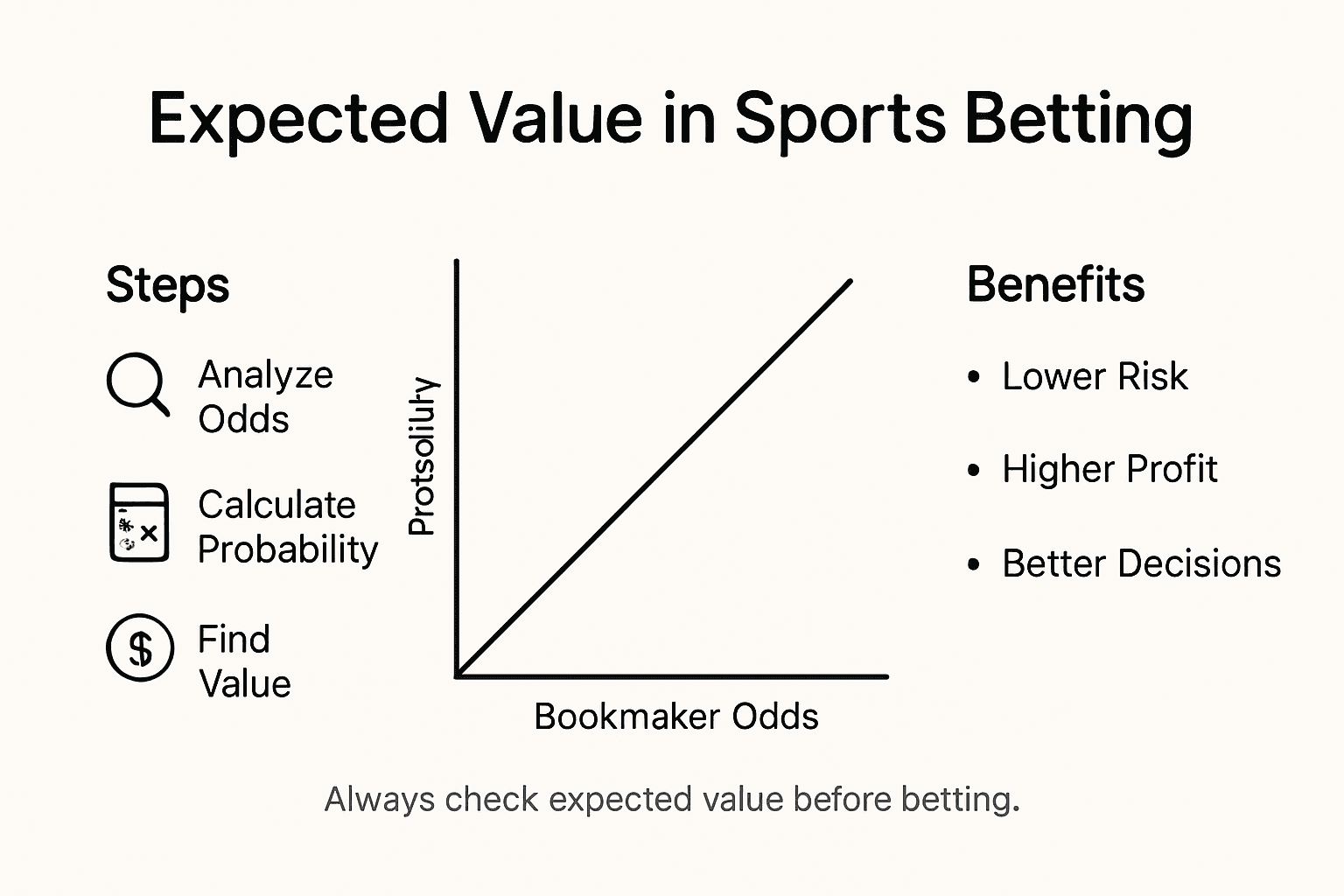
This table illustrates how odds, probability, and expected value interact for strategic decision making:
| Factor | Role in Betting | Strategic Importance |
|---|---|---|
| Odds | Reflect bookmaker prediction | Guides probability conversion |
| Probability | Measures outcome likelihood | Validates analytical models |
| Expected Value | Assesses long-term profitability | Determines bet selection |
- Positive EV (+) indicates a statistically advantageous bet
- Negative EV (-) suggests the bet favors the bookmaker
- Zero EV (0) represents a theoretically break-even scenario
Pro Tip – Probability Decoding: Always convert betting odds to implied probabilities before placing any wager. This simple step reveals the true mathematical landscape of your potential investment.
Pro Tip – Value Hunting: Consistently seek bets where your calculated probability differs significantly from the bookmaker’s implied probability, as these represent your most promising opportunities.
Why Data Beats Gut Feelings Every Time
In the world of sports betting, emotional decision making is the fastest path to financial loss. Comprehensive research demonstrates that data-driven strategies consistently outperform intuition-based approaches, transforming betting from a game of chance to a systematic investment discipline.
Human psychology is fundamentally flawed when it comes to making probabilistic predictions. We are hardwired with cognitive biases that distort our perception – confirmation bias leads us to selectively interpret information that confirms our preexisting beliefs, while recency bias causes us to overvalue recent performance. Professional bettors understand these psychological traps and deliberately replace emotional reasoning with rigorous statistical analysis.
Statistical modeling provides a quantifiable framework for decision making that eliminates emotional interference. By analyzing large datasets, tracking performance metrics, and applying advanced probability calculations, data-driven bettors can:
- Identify genuine performance trends
- Minimize variance in betting outcomes
- Reduce the impact of emotional decision making
- Create repeatable, scalable betting strategies
- Objectively assess risk and potential returns
Pro Tip – Emotional Discipline: Develop a standardized decision-making checklist that requires empirical evidence before placing any wager. Your checklist should include data points, statistical analysis, and a strict requirement for objective confirmation.
Pro Tip – Bias Recognition: Regularly audit your betting decisions by recording your rationale and comparing the actual outcomes. This practice helps expose and eliminate unconscious emotional biases that undermine your strategic approach.
Risk Management, Taxes, and Long-Term Profit
Risk management is the cornerstone of sustainable sports betting, transforming an unpredictable activity into a calculated financial strategy. Rigorous research on household finances reveals that disciplined bettors who implement strict bankroll protection strategies consistently outperform those who approach wagering as a game of chance.
The fundamental principle of risk management involves never exposing more capital than you can afford to lose. Professional bettors typically recommend limiting individual wagers to 1-3% of total bankroll, creating a protective buffer against inevitable losing streaks. This approach prevents catastrophic losses and ensures long-term sustainability, treating sports betting as a strategic investment rather than a speculative gamble.
Tax considerations represent another critical component of professional betting strategy. Different jurisdictions have varying approaches to taxing betting income, which directly impacts net profitability. Successful bettors must understand their local tax regulations and incorporate these considerations into their overall financial planning:
- Track all betting transactions meticulously
- Maintain comprehensive financial records
- Understand your jurisdiction’s specific reporting requirements
- Consider consulting a tax professional specializing in gambling income
- Recognize that consistent profits require more than just winning bets
Pro Tip – Bankroll Protection: Establish a dedicated betting account separate from your primary financial resources. This approach creates a clear psychological and financial barrier that prevents emotional overspending.
Pro Tip – Profit Tracking: Develop a standardized spreadsheet that tracks not just your wins and losses, but calculates your true return on investment, accounting for taxes and transaction costs.
Gain the Analytical Edge to Master Sports Betting
If you are serious about moving beyond misconceptions and gut feelings when it comes to sports betting this article highlights crucial concepts like positive expected value and disciplined risk management. The real challenge is turning raw data into smart wagers that consistently outperform the odds. That is where Stats Bench steps in. We analyze thousands of data points daily—from player performance metrics to defensive matchups—to uncover hidden value opportunities that bookmakers overlook.

Stop guessing and start betting with confidence by leveraging a proven, data-driven strategy. With our detailed analytical models designed for NBA Player Props NFL Spreads and NHL Shot Totals you get the tools to transform probabilistic lines into measurable profits. Explore how our Cheatsheet can empower your next bet and align with the rigorous approach recommended in the article. Begin winning smarter today and experience firsthand how mathematical investing makes a difference.
Frequently Asked Questions
What is sports betting?
Sports betting is an analytical practice where individuals predict the outcomes of sports events and place financial wagers based on statistical probabilities, rather than relying on luck.
How can I improve my success in sports betting?
To improve success in sports betting, focus on comprehensive statistical research, disciplined bankroll management, understanding implied probabilities, systematic risk assessment, and continuously tracking and refining your strategies.
What are the most common types of sports bets?
The most common types of sports bets include moneyline bets, point spread bets, totals (over/under), parlays, and prop bets, each requiring different analytical approaches and risk assessments.
Why is data analysis important in sports betting?
Data analysis is crucial in sports betting because it allows bettors to make informed decisions by identifying genuine performance trends, minimizing variance in outcomes, and eliminating emotional biases that can lead to financial loss.