

Most American bettors still rely on intuition, but studies show that over 80 percent of long-term winners use data analytics to guide their strategies. As sports betting evolves into a high-stakes game of numbers, understanding the science behind the odds has never mattered more. This article breaks down how betting analytics, powered by advanced technology, can give you a measurable advantage over guesswork and emotional wagers.
Table of Contents
- Defining Betting Analytics And The Real Edge
- Emerging Data Sources And Metrics For 2025
- AI Models, Automation, And Player Prop Precision
- Dismantling Gut Instincts—Why Sharps Win
- Avoidable Pitfalls And How To Protect Your Bankroll
Key Takeaways
| Point | Details |
|---|---|
| Data-Driven Approach | Betting analytics shifts wagering from emotional gambling to systematic investment, using data to identify statistical advantages. |
| Emerging Data Sources | Advanced tracking technologies and metrics improve predictive accuracy, integrating various performance factors into betting models. |
| Mathematical Mindset | Successful bettors focus on long-term expected value, treating bets as calculated investments rather than impulsive decisions. |
| Bankroll Management | Effective risk management is crucial; professional bettors apply strict protocols to protect their capital and ensure consistent returns. |
Defining Betting Analytics And The Real Edge
Betting analytics represents the mathematical approach that transforms sports wagering from gambling into data-driven investing. Unlike traditional sports betting built on gut feelings and emotional decisions, data analytics provides a systematic method to identify statistical advantages and predict outcomes with measurable precision.
At its core, betting analytics leverages advanced computational techniques to analyze massive datasets and uncover hidden patterns. Machine learning techniques applied in sports betting demonstrate how complex algorithms can process historical performance data, player statistics, and real-time game information to generate probabilistic predictions far more accurate than human intuition. These models utilize sophisticated techniques like support vector machines and neural networks to transform raw data into actionable betting insights.
The real edge in betting analytics isn’t just collecting data – it’s understanding how to interpret and apply that data strategically. Professional bettors don’t just look at surface-level statistics; they dig deeper into usage rates, defensive matchups, situational performance metrics, and advanced probability calculations. By breaking down games into granular mathematical components, data-driven bettors can identify mispriced odds and create systematic approaches that consistently generate positive expected value.
Understanding these analytics requires a mindset shift from gambling to investing. Successful bettors treat their approach like a quantitative investment strategy, focusing on long-term statistical advantages rather than short-term emotional wins. The goal is mathematical consistency, not miraculous predictions.
Pro Tip: Data Discipline Strategy – Develop a standardized tracking system for every bet, recording detailed metrics about your wagers, including odds, bet size, outcome, and reasoning. This creates a personal statistical database that helps you refine and optimize your betting approach over time.
Emerging Data Sources And Metrics For 2025
The landscape of betting analytics is rapidly evolving, with sophisticated data sources transforming how professionals approach sports wagering. Next Generation Stats (NGS) represent a breakthrough in granular performance tracking, moving beyond traditional statistics to capture nuanced player and team dynamics with unprecedented precision.
Emerging data sources now integrate multiple complex inputs that were previously unavailable or unanalyzed. These include advanced biomechanical tracking, real-time physiological metrics, psychological performance indicators, and hyperdetailed movement analysis. Professional bettors can now access data points like player fatigue indices, precise acceleration metrics, recovery speed, and even predictive injury risk assessments – transforming betting from speculation to scientific prediction.
Technology is driving unprecedented data granularity in 2025. Wearable sensors, artificial intelligence algorithms, and sophisticated tracking systems now capture micro-level performance data across sports. Machine learning models can now correlate seemingly unrelated variables – like a basketball player’s sleep patterns, recovery times, and performance under specific defensive matchups – to generate probabilistic outcome predictions with remarkable accuracy.
The most successful bettors in 2025 will be those who can effectively integrate and interpret these complex, multi-dimensional datasets. Raw data means nothing without the analytical framework to transform it into actionable insights. This requires a combination of advanced statistical knowledge, technological understanding, and strategic interpretation skills.
The table below summarizes how emerging data sources are enhancing betting analytics in 2025:
| Data Source | Type of Information Provided | Analytical Impact |
|---|---|---|
| Biomechanical Tracking | Movement, acceleration, fatigue | Reveals player condition trends |
| Real-time Physiological Data | Heart rate, recovery speed | Detects fatigue and injury risk |
| Psychological Metrics | Stress levels, resilience | Assesses performance under pressure |
| Social Media Analytics | Sentiment, public perception | Gauges player mindset and trends |
Pro Tip: Data Integration Strategy – Build a personal data aggregation system that pulls metrics from multiple sources, allowing you to cross-reference and validate insights across different performance indicators and tracking technologies.
AI Models, Automation, And Player Prop Precision
The frontier of sports betting is being redefined by advanced artificial intelligence models that transform raw data into precise predictive capabilities. Long Short-Term Memory (LSTM) architectures are revolutionizing outcome prediction by analyzing extensive game sequences, capturing nuanced team dynamics with unprecedented mathematical precision.

Automated betting systems now leverage machine learning algorithms that process exponentially more information than human analysts could ever comprehend. These AI models don’t just analyze surface-level statistics; they construct intricate probabilistic models that account for complex interdependencies between player performance, team strategies, environmental conditions, and historical trends. By processing thousands of variables simultaneously, these systems can generate betting recommendations with statistical confidence levels far beyond traditional handicapping methods.
The most sophisticated AI models in 2025 are moving beyond simple predictive analytics into prescriptive analysis. They don’t just forecast potential outcomes but provide granular insights into why those outcomes are likely. Advanced neural networks can now deconstruct player performance into micro-level metrics, analyzing everything from fatigue patterns to psychological resilience under specific competitive pressures. This allows bettors to understand not just the probability of an event, but the underlying mechanical and psychological factors driving that probability.
Precision in player prop betting has reached a new mathematical frontier. Machine learning algorithms can now predict individual player performances with remarkable accuracy by synthesizing vast datasets that include biomechanical tracking, historical performance metrics, real-time physiological data, and even social media sentiment analysis. The days of betting based on intuition are rapidly disappearing, replaced by data-driven strategies that treat sports wagering as a quantitative investment discipline.
Pro Tip: AI Model Validation Strategy – Always cross-reference multiple machine learning models and maintain a rigorous performance tracking system to validate the predictive accuracy of your automated betting tools.
Dismantling Gut Instincts—Why Sharps Win
Sharp bettors operate on a fundamental principle that separates them from recreational gamblers: mathematics trumps emotion. Every betting decision is a calculated investment, not a random guess or an adrenaline-fueled impulse. The moment you rely on “feeling” instead of data, you surrender your statistical edge to the sportsbook.
The psychology of betting creates persistent cognitive traps that most amateur bettors fall into unconsciously. Confirmation bias leads people to seek out information that validates their preexisting beliefs, while recency bias causes bettors to overemphasize the most recent performance instead of analyzing long-term trends. Professional bettors systematically dismantle these psychological barriers by implementing strict, quantitative decision-making frameworks that remove emotional interference.
Successful betting is about consistent probability management, not winning individual bets. Sharps understand that individual game outcomes are inherently unpredictable, but long-term statistical advantages are measurable and exploitable. They treat betting like a mathematical investment strategy, focusing on expected value rather than short-term wins or losses. This means constructing betting models that account for hundreds of variables, create probabilistic outcome simulations, and identify mispriced odds across multiple sports and markets.
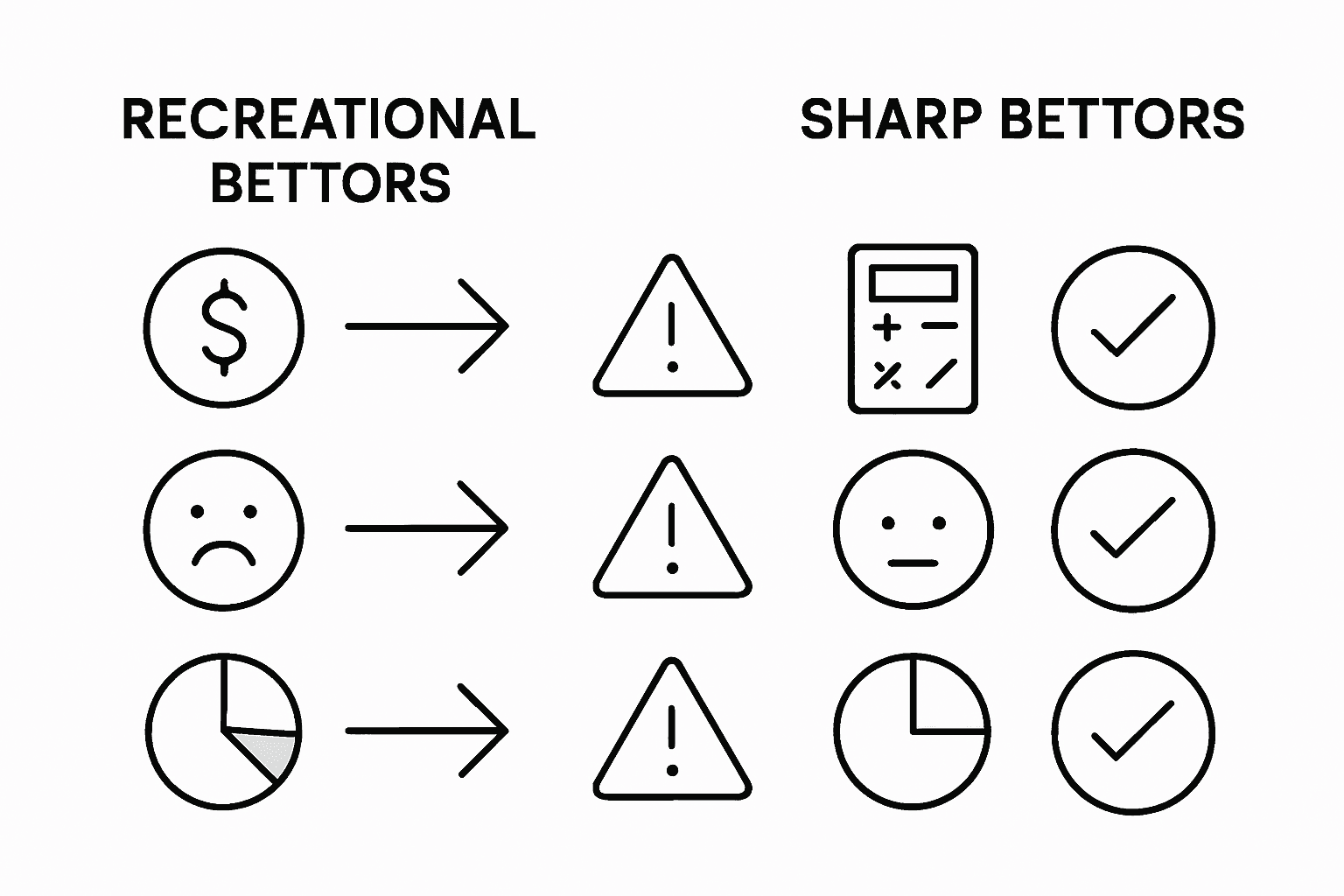
The fundamental difference between a sharp and an amateur is not intelligence—it’s discipline. Amateurs chase losses, bet with their heart, and make emotional reactions. Sharps treat each bet like a precise financial transaction, with predetermined risk parameters, systematic tracking, and a cold, mathematical approach to decision-making. They don’t celebrate individual wins or mourn losses; they analyze performance metrics, adjust models, and maintain unwavering statistical consistency.
Here’s a comparison of recreational bettors and sharp bettors to highlight their key differences:
| Aspect | Recreational Bettors | Sharp Bettors |
|---|---|---|
| Decision Basis | Gut feeling, emotion-driven | Data analysis, mathematical models |
| Risk Management | Inconsistent, reactive | Strict, predefined protocols |
| Focus | Short-term wins | Long-term expected value |
| Emotional Influence | High, often chases losses | Minimized, uses objective evaluation |
| Tracking and Analysis | Rarely tracks bets | Maintains detailed statistical records |
Pro Tip: Emotional Detachment Strategy – Create a standardized betting journal that records every wager’s rationale, statistical basis, and outcome, forcing you to evaluate decisions objectively and remove emotional reasoning from your betting process.
Avoidable Pitfalls And How To Protect Your Bankroll
Bankroll management is the critical difference between professional bettors and gamblers who go broke. The mathematics of bookmaking reveals that without a systematic approach, the house will always maintain a statistical advantage. Successful sports investors treat their betting capital like a calculated investment portfolio, not a lottery ticket.
The most dangerous pitfall for amateur bettors is emotional betting—chasing losses, increasing bet sizes after disappointments, or wagering based on personal bias. Professional bettors implement strict risk management protocols that limit potential losses and protect their long-term capital. This means never risking more than 1-3% of your total bankroll on a single bet, maintaining disciplined stake sizes, and creating mathematical models that objectively assess betting value.
Understanding expected value is crucial to protecting your bankroll. Most recreational bettors focus on win rates, but sharps analyze the mathematical probability of profit across multiple betting scenarios. This requires building comprehensive models that account for variability, calculating potential returns against potential risks, and systematically identifying situations where the betting odds provide a statistical advantage. Your goal isn’t winning every bet—it’s creating a consistent, mathematically sound approach that generates positive returns over time.
Technology has transformed bankroll protection in 2025. Advanced tracking systems now allow bettors to monitor performance metrics with unprecedented precision, automatically calculating risk parameters, identifying problematic betting patterns, and providing real-time portfolio analysis. These tools transform betting from a game of chance into a data-driven investment strategy, allowing professionals to make cold, calculated decisions based on mathematical models rather than emotional impulses.
Pro Tip: Bankroll Defense Strategy – Establish a strict, percentage-based betting system where no single wager exceeds 2% of your total capital, and maintain a comprehensive digital ledger tracking every bet’s statistical rationale and performance.
Gain the Data-Driven Edge in Your Sports Betting Strategy
The article highlights how relying on gut instincts and emotional betting leads to missed opportunities and increased risk. You want to move beyond guesswork and embrace quantitative investing in sports wagering through advanced betting analytics, emerging data sources, and AI-powered predictive models. If your goal is consistent long-term profitability using concepts like expected value, granular player metrics, and precise risk management, you need a trusted analytical partner.
Stats Bench bridges the gap between casual gambling and strategic investing with daily updated models that analyze thousands of data points including usage rates and defensive matchups. We identify positive expected value opportunities that sportsbooks overlook so you can bet with confidence. Whether focusing on NBA player props, NFL spreads, or NHL shot totals, Stats Bench gives you the analytical edge you need to win long term.
Start turning complex data into actionable insights today. Check out our complete Cheatsheet for proven strategies and model-driven picks.

Discover how mathematical discipline wins over emotion and get access to data-driven, statistics-backed betting insights now at Stats Bench. Don’t let outdated gut feelings hold your betting performance back. Visit our Cheatsheet and start maximizing your bankroll with true expected value plays.
Frequently Asked Questions
What is betting analytics and how does it provide an edge in sports wagering?
Betting analytics is a data-driven approach that transforms sports betting into a systematic investment strategy by leveraging mathematical models to identify statistical advantages and predict outcomes with precision.
How can emerging data sources improve sports betting strategies by 2025?
Emerging data sources like biomechanical tracking, real-time physiological metrics, and psychological performance indicators provide granular insights, helping bettors to analyze player dynamics and make more informed betting decisions.
What role do AI models play in sports betting predictions?
AI models, particularly advanced architectures like Long Short-Term Memory (LSTM), analyze extensive game sequences and complex interdependencies to generate highly accurate predictive capabilities and insights for bettors.
How important is bankroll management in betting analytics?
Bankroll management is crucial for maintaining a sustainable betting strategy. Professional bettors implement strict risk management protocols and avoid emotional betting, treating their capital like a calculated investment portfolio.