
Most football bettors focus on who will score the goals.
Smart bettors focus on who will commit the crimes.
Card Betting (Bookings) is one of the fastest-growing markets in sports betting because it relies less on “luck” (like a ball hitting the post) and more on human behavior and matchups.
If you know a specific referee has a short temper, and he is officiating a derby between two aggressive teams, you have a massive edge over the sportsbook algorithm that is just looking at season averages.
Here is the complete guide to mastering the Yellow Card market, moving beyond simple “Over/Unders” into player-specific sniping.
What is Card Betting?
You are wagering on the disciplinary action taken by the referee during the 90 minutes of a match.
- Yellow Card: 1 Booking Point (or 1 Card).
- Red Card: 2 Booking Points (or 2 Cards).
- Total Booking Points: Some books (like SkyBet) use a points system (10 for Yellow, 25 for Red).
The Golden Rule: Extra Time does not count. If a player gets booked in the 94th minute (Stoppage Time), it counts. If he gets booked in the 105th minute (Extra Time in a Cup match), it usually does not count. Always check your book’s house rules.
The 3 Pillars of Card Handicapping
1. The Referee (The Most Important Variable)
You cannot bet on cards without knowing who is holding the whistle.
Referees have personalities. Some are “Let them play” types who only book for violence. Others are “By the book” types who card for dissent and time-wasting.
The Data to Check:
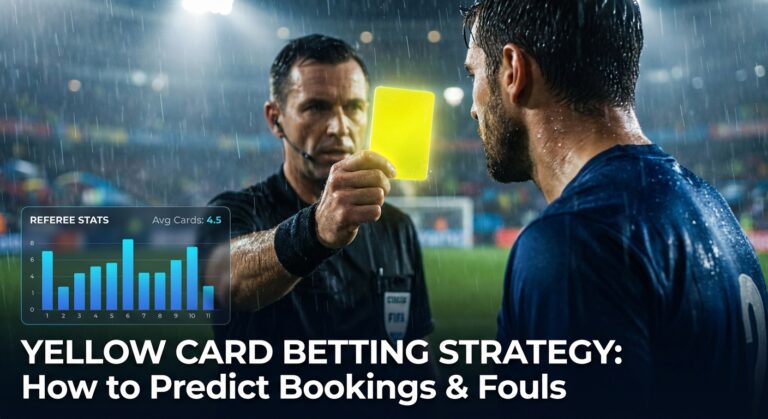
- Cards Per Game: A ref averaging 4.5+ yellows per game is a goldmine for “Over” bettors. A ref averaging 2.8 is a “Stay Away.”
- Home/Away Bias: Some refs are terrified of the home crowd and rarely book the home team. Use this to find value on the “Away Team Total Cards” market.
2. The “Enforcer vs. Dribbler” Matchup
This is the “Player Prop” version of card betting.
You aren’t just looking for players who tackle a lot. You are looking for Tacklers facing Dribblers.
The Perfect Storm:
- The Enforcer: A defensive midfielder or full-back with high “Fouls Per 90” stats (e.g., Casemiro, Joao Palhinha).
- The Victim: An opposing winger with high “Fouls Drawn Per 90” stats (e.g., Jack Grealish, Vinicius Jr., Wilfried Zaha).
If a clumsy full-back is tasked with marking a tricky, high-volume dribbler for 90 minutes, the probability of a mistimed tackle and a yellow card skyrockets.
3. Game Script & Rivalry
Context matters. A meaningless end-of-season game will have fewer cards than a Relegation Scrap or a Derby.
- The “Derby Tax”: Rivalry games (Man Utd vs Liverpool, Arsenal vs Spurs) almost always have inflated card lines because the books expect violence. Sometimes the value is actually on the Under in the first half as teams feel each other out.
- Tactical Fouls: Look for teams that play a “High Line” (like Spurs or Villa). When their press is broken, their defenders are forced to make “Tactical Fouls” to stop the counter-attack. These are automatic yellow cards.
Common Card Markets Explained
Total Match Cards (Over/Under)
Strategy: Only bet the Over if both teams and the referee align. If two aggressive teams play with a lenient ref, the game might be a bloodbath with zero bookings because the ref keeps his cards in his pocket.
Player to be Carded
Strategy: Focus on Game State.
- Time Wasting: If a team is an underdog and likely to try to hold a lead, bet their Goalkeeper to be booked. Refs love booking keepers for time-wasting in the 80th minute.
- Dissent: Captains (like Bruno Fernandes) often get booked for arguing when their team is losing.
Team Cards Handicap
Strategy: Bet the “Underdog” on the Card Handicap.
Teams that have less possession usually have to tackle more. If Man City plays Luton Town, City will have 70% possession. Luton will be chasing the ball for 90 minutes. Luton is statistically much more likely to rack up cards.
How to Research Cards on StatsBench
Stop guessing based on reputation.
- Check the Ref Info: Our dashboard shows the ref’s “Yellows Per Game” average right next to the team stats.
- Check the “Enforcer” Stats: Filter players by “Fouls Committed” and “Cards Received” in the last 5 games.
- Check the “Victim” Stats: See which opponent draws the most fouls per game.
Summary: Read the Ref, Not Just the Team
Card betting is a game of psychology as much as physicality.
If you find a strict referee officiating a desperate team fighting against relegation, you have found an edge. Ignore the “Average” lines set by the books and price in the chaos factor.
See Referee Stats and Card Trends on the Free StatsBench Cheat Sheet
Frequently Asked Questions
It depends on the market. In “Booking Points” markets (like SkyBet), a Red Card is usually worth 25 points (equivalent to 2.5 yellows). In standard “Over/Under Cards” markets, a Red Card typically counts as 2 cards. However, a “Straight Red” is still just one card shown physically. Always check your book’s specific rules.
No. Almost every sportsbook only counts cards shown to active players on the pitch. Cards shown to managers (like Mikel Arteta) or players sitting on the bench do not count toward the total.
If a player receives a second yellow (and thus a red), it usually counts as 3 cards total for the “Total Cards” market (1st Yellow + 2nd Yellow + Red). However, for the “Player to be Carded” market, it simply counts as a win once the first card is shown.