

Most American sports bettors still trust gut instinct, yet sharp analytics consistently outpace hunches at the window. With billions wagered each NBA and NFL season, data-driven strategies are the clear separator between consistent winners and everyone else. Professional bettors relying on analytical models regularly outperform intuition-based approaches by wide margins. This guide explores why objective data, not personal bias, unlocks sustainable returns for those aiming to conquer player prop markets.
Table of Contents
- Analytics Versus Gut Feeling In Betting
- Types Of Betting Data That Drive Value
- How Ev Analysis Exposes Mispriced Odds
- Common Pitfalls Of Ignoring Analytics
- Automating Winning Strategies With Stats Bench
Key Takeaways
| Point | Details |
|---|---|
| Analytical Betting | Relying on data-driven models is more effective than emotional decision-making in betting. |
| Data-Driven Insights | Incorporate comprehensive performance metrics and situational context to uncover hidden betting opportunities. |
| Expected Value (EV) Analysis | Utilize EV analysis to identify profitable betting scenarios with favorable risk-reward ratios. |
| Automation in Betting | Implement automated analytics to process data in real-time, enhancing decision-making accuracy and efficiency. |
Analytics Versus Gut Feeling in Betting
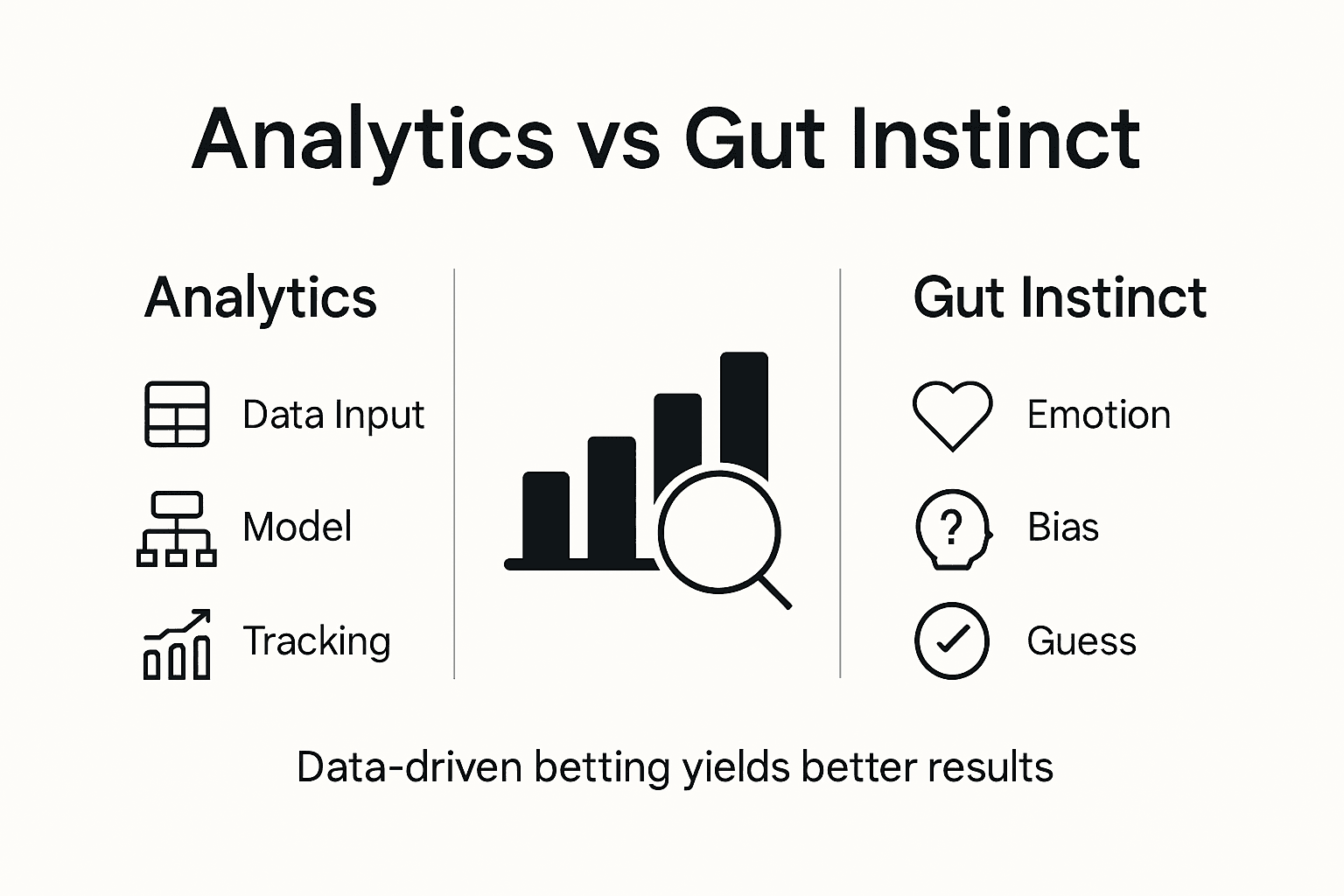
Betting based on intuition is a losing strategy. Professional bettors understand that mathematical analysis trumps emotional decision-making every single time. Research examining sports betting processes reveals that systematic analytical approaches consistently outperform gut-based wagers.
The fundamental problem with gut feelings is their inherent unreliability. Human intuition is riddled with cognitive biases that distort rational judgment. Unlike data-driven models, which process thousands of objective data points, emotional betting relies on limited personal experiences and psychological triggers. Think of gut feeling like driving with your eyes closed – you might occasionally guess right, but the crash is inevitable.
Analytical betting requires a disciplined approach centered on quantifiable metrics:
- Track record performance percentages
- Statistical probability calculations
- Historical matchup data
- Player and team performance trends
- Advanced metrics beyond traditional statistics
Traders and financial professionals demonstrate superior analytical reasoning when making complex decisions. The same principle applies to sports betting: systematic analysis consistently beats random guesswork.
Here’s a concise comparison highlighting the difference between intuition-based and analytics-driven betting approaches:
| Approach | Decision Basis | Risk of Loss | Long-Term Outcome |
|---|---|---|---|
| Intuition-Based Betting | Personal feelings, biases | Extremely high | Inevitable losses |
| Analytics-Driven Betting | Data, models, probabilities | Much lower, measurable | Consistent profitability |
Pro Tip: Emotional Detachment Method: Develop a pre-defined betting strategy based on mathematical models, then execute trades without allowing personal feelings to interfere with your established system.
Types of Betting Data That Drive Value
Successful betting isn’t about luck—it’s about leveraging comprehensive data sources that reveal hidden opportunities. Alternative data strategies demonstrate how sophisticated bettors transform raw information into profitable insights, moving far beyond traditional statistical analysis.
The most powerful betting data falls into several critical categories that provide competitive advantages:
- Performance Metrics
- Individual player statistics
- Team historical win rates
- Detailed injury reports
- Situational Context
- Home/away game performance
- Weather impact analysis
- Rest and fatigue factors
- Advanced Analytics
- Player usage rates
- Defensive matchup effectiveness
- Momentum and psychological indicators
Professional bettors understand that high-frequency data collection allows for near-real-time decision-making, capturing micro-trends that traditional analysis misses. By processing thousands of data points across multiple dimensions, sharp bettors can identify value opportunities milliseconds before market adjustments.

The most successful betting strategies integrate multiple data streams, creating complex models that predict outcomes with remarkable precision. These aren’t guesses—they’re mathematically calculated probabilities refined through continuous analysis and machine learning techniques.
Pro Tip: Data Hierarchy Method: Prioritize your data sources from most reliable to least, creating a weighted scoring system that automatically filters out low-confidence information and focuses on statistically significant indicators.
How EV Analysis Exposes Mispriced Odds
Expected Value (EV) analysis represents the mathematical cornerstone of intelligent betting, transforming random wagers into calculated investment opportunities. The Kelly criterion provides a revolutionary framework for understanding how professional bettors systematically identify and exploit market inefficiencies, turning statistical advantages into consistent profits.
The core principle of EV analysis is simple yet powerful: identify betting scenarios where the potential return significantly outweighs the inherent risk. This requires a multi-dimensional approach that goes beyond surface-level statistics:
- Precise probability calculations
- Comparative market odds analysis
- Identifying systematic sportsbook pricing errors
- Quantifying risk-adjusted potential returns
- Measuring long-term expected performance
Rigorous research on sportsbook inefficiencies confirms that most amateur bettors overlook critical data quality issues that can dramatically impact betting outcomes. Professional analysts develop sophisticated models that continuously scan for mathematical discrepancies, creating opportunities invisible to casual observers.
Successful EV analysis isn’t about winning every bet—it’s about maintaining a statistically positive trajectory. By treating each wager as a calculated investment with measurable risk parameters, sharp bettors transform sports betting from a game of chance into a precision-driven financial strategy.
Pro Tip: EV Scanning Method: Develop a systematic screening process that automatically flags betting opportunities with positive expected value, focusing on markets where your calculated probability differs significantly from the implied odds.
Common Pitfalls of Ignoring Analytics
Ignoring data-driven analytics is financial suicide in modern sports betting. The low-volatility anomaly demonstrates how counterintuitive betting behaviors can systematically destroy long-term profitability, proving that intuition is a dangerous replacement for mathematical precision.
The most critical pitfalls of neglecting analytical approaches include:
- Emotional Decision-Making
- Chasing losses
- Overvaluing recent performance
- Ignoring statistical regression
- Cognitive Bias Traps
- Confirmation bias
- Recency bias
- Overconfidence in personal predictions
- Structural Betting Mistakes
- Inconsistent bet sizing
- Failing to track true performance metrics
- Misunderstanding probability
Neuroscientific research on betting behavior reveals that emotional responses fundamentally compromise rational decision-making. Amateur bettors operate primarily through psychological impulses, while professionals rely on cold, mathematical models that eliminate human error.
Statistical analysis isn’t optional—it’s the fundamental difference between investing and gambling. Every bet without data-driven insight is essentially a random guess, transferring money directly from your pocket to the bookmaker’s bank account. Professional bettors view each wager as a calculated financial transaction, not an emotional rollercoaster.
Pro Tip: Emotional Firewall Method: Develop a strict pre-commitment protocol where every betting decision must pass a quantitative screening process before execution, creating a psychological barrier against impulse wagering.
Automating Winning Strategies With Stats Bench
Automated betting analytics represent the future of intelligent wagering, transforming raw data into precision financial opportunities. Machine learning techniques in sports betting have revolutionized how professional bettors approach statistical modeling, creating systems that process thousands of variables milliseconds faster than human calculation.
The core automation strategy involves multiple sophisticated components:
- Real-time data ingestion
- Live game statistics
- Player performance metrics
- Injury and lineup updates
- Advanced predictive modeling
- Machine learning algorithms
- Probabilistic risk assessment
- Dynamic odds optimization
- Automated betting execution
- Preset risk parameters
- Instant bet placement
- Continuous performance tracking
Model selection criteria research demonstrates that successful automation requires more than raw computational power—it demands intelligent calibration that prioritizes consistent, predictable returns over sporadic high-risk outcomes. Professional systems distinguish themselves by understanding nuanced probability landscapes that human bettors consistently miss.
The most effective automated betting strategies operate like quantitative hedge funds: emotionless, mathematically precise, and relentlessly focused on long-term value generation. Every bet becomes a calculated transaction, stripped of psychological interference and powered by pure statistical probability.
Below is a summary of how automation enhances modern betting strategies:
| Automation Feature | Key Benefit | Business Impact |
|---|---|---|
| Real-Time Data Integration | Immediate response to events | Captures fleeting opportunities |
| Predictive Modeling | Informed probability estimates | More accurate risk management |
| Automated Execution | Instant bet placement | Reduces human error |
Pro Tip: Automation Calibration Method: Regularly test and recalibrate your automated betting models, establishing strict performance thresholds that trigger model retraining or suspension to prevent systemic strategy decay.
Gain the Analytical Edge and Bet Smarter with Stats Bench
The article highlights a critical challenge many bettors face the struggle of relying on gut feelings and emotional decisions instead of proven data and Expected Value analysis. If you want to avoid common pitfalls like cognitive biases and inconsistent bet sizing and truly maximize your edge by leveraging comprehensive betting data and EV calculations then adopting a disciplined, analytical approach is essential. The key concepts of EV analysis, data hierarchy methods, and automation discussed clearly show how mathematical investing can transform your betting results from guesswork to consistent profitability.

Take control of your sports betting journey by using the daily models at Stats Bench. Our platform bridges the gap between casual gambling and mathematical investing by analyzing thousands of data points including player usage rates, defensive matchups, and situational factors. Whether you bet NBA Player Props, NFL Spreads, or NHL Shot Totals, our system identifies Positive EV opportunities that sportsbooks miss. Don’t leave your betting success to chance when you can rely on real data and proven strategies. Visit Stats Bench Cheatsheet to start turning your wagers into long-term wins with precision and confidence.
Frequently Asked Questions
What is the significance of analytics in sports betting?
Analytics in sports betting is crucial as it helps bettors make data-driven decisions, reducing reliance on gut feelings and cognitive biases. This increases the chances of long-term profitability by identifying value opportunities through comprehensive data analysis.
How can expected value (EV) analysis improve betting strategies?
Expected value (EV) analysis identifies betting scenarios where potential returns significantly outweigh risks. This approach helps bettors make informed decisions, focusing on wagers with statistically positive expected outcomes, rather than relying on random guesses.
What are some common pitfalls of ignoring analytics in betting?
Common pitfalls include emotional decision-making, cognitive biases (like confirmation bias), and structural mistakes in bet sizing and performance tracking. These factors can lead to inconsistent results and long-term losses.
How does automation enhance betting strategies?
Automation enhances betting strategies by providing real-time data integration, advanced predictive modeling, and automated execution. This reduces human error, improves response times to market changes, and allows for consistent tracking of performance, maximizing betting efficiency.