

If you spend any time on “Gambling Twitter,” you’ve seen the screenshots. A bettor puts $20 on a player and walks away with $200.
They didn’t hit a crazy 15-leg parlay. They didn’t bet on the Pistons to beat the Celtics.
They played a Ladder.
Ladder betting is the strategy of betting on a player to exceed their stat line by a significant margin. Instead of just betting on them to have an “average” game, you are betting on them to have a monster game.
Here is exactly how to structure a ladder, the math behind the payouts, and how to use StatsBench to find the players capable of climbing the rungs.
What is a Ladder Bet?
In standard betting, you pick a line and hope it hits.
- Standard Bet: Jalen Brunson Over 26.5 Points (-110).
- Result: You bet $10 to win $9.
In a Ladder Bet, you split your investment across multiple “Alternative Lines” (Alt Lines) for the same player.
The “Rung” Structure
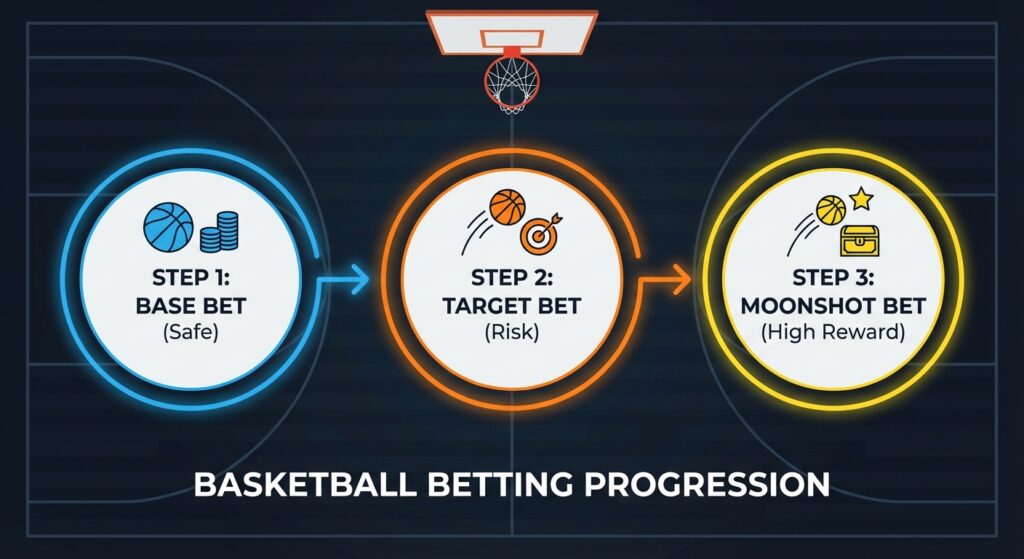
Let’s say you have a $30 budget for Jalen Brunson tonight. Instead of putting it all on one number, you climb the ladder:
- Rung 1 (The Safety): $15 on Over 24.5 Points (-150).
- Goal: This covers your cost if he has just an “okay” game.
- Rung 2 (The Target): $10 on Over 29.5 Points (+180).
- Goal: This is where the profit lives.
- Rung 3 (The Moonshot): $5 on Over 34.5 Points (+450).
- Goal: This is the jackpot.
The Payout: If Brunson scores 35 points, you win all three bets. That $30 investment turns into a massive payday.
The Secret: Which Stats Should You Ladder?
Not all stats are created equal. You need high-variance categories.
1. Points (Best for Beginners)
Scoring is volatile. A player can get hot from three and drop 40 points in his sleep. This is the most common ladder.
2. PRA (Points + Rebounds + Assists)
This is often safer than points. If a player’s shot isn’t falling, they might rack up assists or rebounds to keep the ladder alive.
(Not sure how this stat works? Read our complete guide on PRA meaning here to see why it offers a higher floor.)
3. Three-Pointers Made
This is high risk, high reward. Betting a shooter to hit 4, 5, and 6 threes (+800 odds) is a popular strategy against teams with weak perimeter defense.
How to Find Ladder Candidates on StatsBench
You cannot guess on ladders. You need to know a player’s “Ceiling.”
Just because a player averages 20 points doesn’t mean they are a good ladder candidate. You need “Spike” players.
Here is the 3-step checklist to run on StatsBench before you bet:
1. Check the “Spike Rate”
Don’t look at the average. Look at the last 20 games.
- Good Candidate: Averages 22 points, but has scored 30+ in 25% of games. (This is a “Microwave” scorer).
- Bad Candidate: Averages 22 points, but has rarely scored over 26. (This is a “Low Ceiling” player).
2. The “Blowout” Correlation
Usually, we tell you to avoid blowouts. But in ladder betting, we love blowouts—if our player is the one causing them.
If Steph Curry hits 8 threes, the Warriors will likely blow out the opponent. That’s fine! He hits his ladder before he sits out the 4th quarter.
3. Attack Specific Defenses
Use the StatsBench Matchup tool to find defensive holes.
- Laddering Rebounds? Look for teams that rank Bottom 5 in Rebound Rate.
- Laddering 3-Pointers? Look for teams that allow the Most Corner 3s.
Summary: Climb Responsibly
Ladder betting is volatile. You will lose Rung 3 often.
The key to long-term success is ensuring Rung 1 hits frequently enough to keep your bankroll steady while you wait for the “Moonshot” to land.
Ready to find the highest ceilings on the slate?
Check the Daily Cheat Sheet here to see which players are currently on a “Spike” trend.
Free preview
See today’s NBA player props on StatsBench
Live lines, last-10 hit rates and the best price across about 60 books. No account needed to look.
Open the NBA player props board →
Prefer email? Get the daily picks newsletter.