

Most American sportsbooks process millions of wagers each week, yet many analytical bettors still overlook the impact of a push on their results. Navigating neutral outcomes is essential for anyone focused on long-term profitability, especially those betting on football, basketball, or hockey. This guide reveals the mechanics behind a push, uncovers where these scenarios are most likely, and explains how sharp bettors use push data to refine positive expected value strategies.
Table of Contents
- Defining A Push In Sports Betting
- Where Pushes Occur: Bet Types Explained
- How Pushes Are Handled By Sportsbooks
- Pushes And Positive Ev Betting Strategies
- Avoiding Pushes: Analytical Tips For Bettors
Key Takeaways
| Point | Details |
|---|---|
| Understanding Pushes | A push occurs when the final result matches the betting line, resulting in no financial gain or loss for the bettor. |
| Bet Types and Likelihood | Pushes are most common in point spread and totals bets, with moneyline bets being less likely to result in pushes. |
| Sportsbook Handling | Sportsbooks typically return the original stake in case of a push, ensuring fairness in betting transactions. |
| Avoiding Pushes | Bettors can minimize push probabilities by selecting half-point spreads and analyzing historical data for better betting lines. |
Defining a Push in Sports Betting
In sports betting, a push represents a unique scenario where the final result of an event precisely matches the established betting line, creating neither a win nor a loss for the bettor. Understanding sports betting outcomes reveals that pushes are fundamental to comprehending betting mechanics and strategic decision making.
Typically, a push occurs in scenarios involving point spreads or total point wagers where the game’s final score lands exactly on the predicted line. For instance, if a football game’s point spread is set at 7 points and the final score difference is precisely 7 points, the bet results in a push. In this situation, the sportsbook returns the original stake to the bettor, effectively nullifying the wager without financial penalty or reward.
Push scenarios are more common in sports with structured scoring systems like football, basketball, and hockey, where point differentials can be precisely calculated. The mathematical probability of a push depends on several factors, including the specific sport, the established betting line, and the inherent variability of game outcomes. Sports betting statistical frameworks demonstrate that understanding push dynamics is critical for developing sophisticated betting strategies.
Pro tip: Always review the specific push rules for each sport and betting platform, as push definitions and handling can vary slightly between different sportsbooks and game types.
Where Pushes Occur: Bet Types Explained
Pushes are not uniform across all betting types, with certain wager categories more susceptible to these neutral outcomes. Sports betting platforms reveal that point spread and totals bets are the most common scenarios where pushes frequently occur. In point spread betting, a push materializes when the final game margin exactly matches the predicted line, creating a scenario where neither the bettor nor the sportsbook gains an advantage.

Over/under bets represent another prime environment for push scenarios. When the total combined score of both teams precisely hits the predetermined line, the bet is considered a push. For example, if a basketball game’s total is set at 210 points and the final score adds up to exactly 210, all wagers are returned. This mechanism ensures fairness and prevents either party from gaining an unintended financial benefit from an precisely balanced outcome.
Interestingly, moneyline bets rarely experience pushes since they focus solely on which team wins or loses. The binary nature of these wagers means that sports betting strategies must account for the different push probabilities across betting types. Some sports, like football and basketball with their structured scoring systems, have higher push potentials compared to more variable scoring sports like soccer or baseball.
Pro tip: Always carefully review the specific push rules for each sport and betting platform, as the handling of pushes can vary significantly between different sportsbooks and game types.
Here’s how push scenarios differ across common bet types:
| Bet Type | Push Likelihood | Typical Push Scenario | Financial Outcome for Bettor |
|---|---|---|---|
| Point Spread | Moderate to High | Score margin matches the line | Stake refunded, no profit/loss |
| Totals (Over/Under) | Moderate | Combined score matches the line | Stake refunded, no profit/loss |
| Moneyline | Very Low | Tie in rare cases (some sports) | Rules vary, usually refund |
| Proposition/Parlay | Variable | Complex, depends on bet terms | Leg removed or stake refunded |
How Pushes Are Handled by Sportsbooks
Sportsbooks have standardized protocols for managing push scenarios, with the primary approach being a straightforward return of the original stake to the bettor. Sports betting platforms emphasize that this mechanism ensures fairness and transparency in betting transactions. The refund process effectively neutralizes the wager, creating a zero-sum outcome where neither the bettor nor the sportsbook incurs a financial loss.
The specific handling of pushes can vary depending on the type of bet and the sport involved. Some sportsbooks have nuanced house rules that dictate push resolution, particularly for complex betting scenarios like parlays or proposition bets. When a push occurs in a multi-leg bet, sportsbook mistake resolution typically involves reducing the number of legs in the bet and recalculating the potential payout.
To minimize the frequency of pushes, sophisticated sportsbooks continuously adjust their betting lines and point spreads. This strategic approach helps create more distinct outcomes and reduces the likelihood of exactly matched predictions. Advanced bookmakers use complex mathematical models and real-time data analysis to fine-tune their lines, ensuring they maintain a consistent profit margin while providing attractive betting options for customers.
Pro tip: Always carefully read the specific push rules for each sportsbook, as subtle variations in push handling can significantly impact your betting strategy and potential returns.
Here’s a comparison of sportsbook push handling strategies:
| Sportsbook Approach | Push Handling Process | Impact on Bettor |
|---|---|---|
| Standard Refund | Stake returned | No financial change |
| Parlay Adjustment | Leg removed, payout recalculated | Potential lower payout |
| Custom House Rules | Specific bet resolution | Depends on platform policy |
| Line Adjustment Tactics | Lines set to reduce pushes | More decisive outcomes, fewer pushes |
Pushes and Positive EV Betting Strategies
Expected value (EV) strategies require sophisticated mathematical modeling that carefully accounts for push scenarios. Sports betting statistical frameworks demonstrate that pushes represent neutral outcomes which can significantly impact long-term betting profitability. By treating pushes as zero-gain events, analytical bettors can more accurately calculate potential returns and refine their betting approach.
Advanced bettors utilize complex probabilistic models to minimize push risks and maximize positive expected value opportunities. Optimal betting strategies incorporate push probabilities into portfolio allocation decisions, using techniques like the Kelly criterion to adjust betting fractions. This approach allows bettors to select wagers where push likelihood is minimized, or where potential push outcomes can be absorbed within overall betting performance.
Understanding push dynamics becomes crucial in developing robust betting strategies. Sophisticated bettors analyze historical data to identify betting lines and sports categories with lower push probabilities. By mathematically modeling push frequencies across different sports and bet types, they can design more resilient betting approaches that protect capital and optimize potential returns. Strategic line selection and thorough statistical analysis become key tools in managing push-related risks.
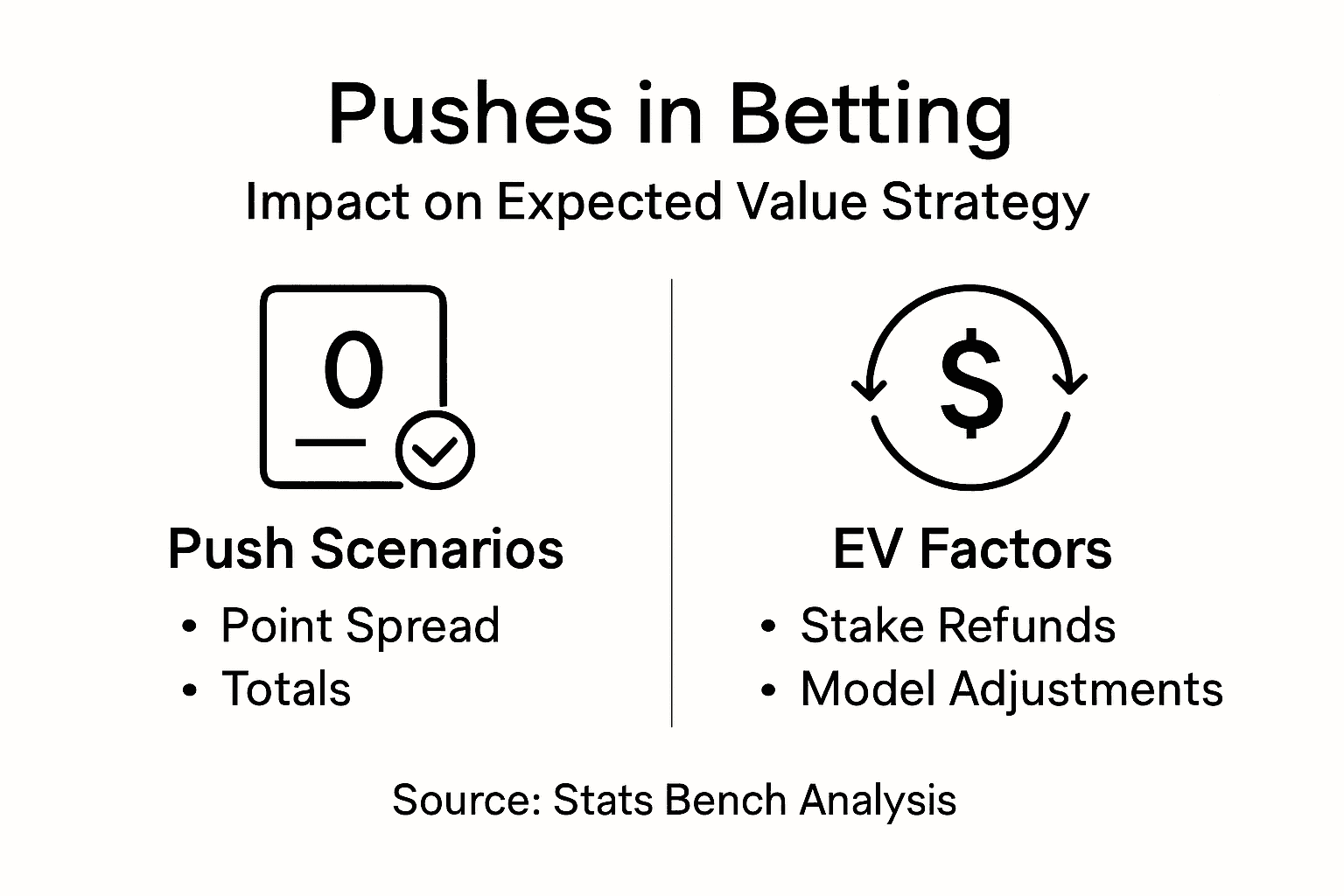
Pro tip: Develop a comprehensive database tracking push frequencies across different sports and bet types to systematically reduce unexpected neutral outcomes in your betting strategy.
Avoiding Pushes: Analytical Tips for Bettors
Mathematical precision is key to minimizing push probabilities in sports betting. Sports betting strategies recommend strategic line selection to reduce the likelihood of neutral outcomes. Experienced bettors actively seek half-point spreads and totals, which eliminate the possibility of exact line matches and effectively neutralize push risks.
Data-driven bettors leverage advanced analytical techniques to predict and avoid push scenarios. Predictive modeling approaches utilize machine learning algorithms to analyze historical scoring patterns, identifying betting lines with higher push probabilities. By understanding granular statistical trends across different sports and competitions, bettors can make more informed decisions that minimize capital stagnation and optimize expected value strategies.
Odds shopping becomes a critical technique in push avoidance. Sophisticated bettors compare lines across multiple sportsbooks, searching for variations that provide more favorable conditions and reduced push potential. This approach requires continuous market monitoring, understanding subtle line movement nuances, and developing a comprehensive database of historical betting outcomes to make statistically informed wagering decisions.
Pro tip: Develop a systematic approach to tracking push frequencies by creating a detailed spreadsheet that logs push occurrences across different sports, bet types, and sportsbooks to continuously refine your betting strategy.
Master Push Scenarios and Boost Your EV Betting Strategy Today
Understanding push outcomes is crucial for bettors dedicated to maximizing long-term profitability. The article highlights the challenge of neutral results that neither win nor lose money, creating frustration and uncertainty in strategic betting decisions. If you want to move beyond basic knowledge and avoid the pitfalls of pushes in point spread or totals bets, it is time to adopt a data-driven approach.
Stats Bench bridges the gap between casual gambling and mathematical investing by delivering daily models that analyze thousands of data points to uncover positive expected value opportunities that sportsbooks miss. Whether you focus on NBA Player Props, NFL Spreads, or NHL Shot Totals, our platform helps you minimize the impact of pushes and align your bets with optimal EV strategies.
Explore how Stats Bench models refine your betting approach.

Stop letting pushes erode your bankroll and take control of your sports betting with a proven analytical edge. Visit Stats Bench now to start leveraging precise mathematical insights designed to protect your capital and enhance your long-term success.
Frequently Asked Questions
What does a push mean in sports betting?
A push in sports betting occurs when the final result of a game matches the established betting line, resulting in neither a win nor a loss for the bettor. The sportsbook returns the original stake to the bettor, nullifying the wager.
How are pushes handled by sportsbooks?
When a push occurs, sportsbooks typically return the original stake to the bettor, ensuring a zero-sum outcome. However, specific handling can vary based on the type of bet and the sportsbook’s house rules.
In which types of bets are pushes most common?
Pushes commonly occur in point spread and totals (over/under) bets, where the final scores precisely match the predetermined lines. Moneyline bets rarely see pushes due to their binary win/lose nature.
How can I minimize the risk of encountering a push in my betting strategy?
To minimize push risks, bettors can focus on half-point spreads and totals, utilize advanced data analysis, engage in odds shopping across sportsbooks, and track historical push frequencies to inform their betting decisions.
Recommended
- 7 Key Stats for Bettors to Maximize Positive EV Edges
- Betting Trends Analysis Process for Profitable Wagers
- Role of Analytics in Betting: Maximizing Your Edge
- 7 Smart Sports Betting Strategies List for Profitable Play
Free preview
See today’s MLB player props on StatsBench
Live lines, last-10 hit rates and the best price across about 60 books. No account needed to look.
Open the MLB player props board →
Prefer email? Get the daily picks newsletter.