

Searching for the best MLB prop bets today usually turns up a list of names with no context. A player “hits the over a lot” doesn’t tell you if the price is worth it. The better question isn’t “who’s hot,” it’s which props are priced in a way that gives you room, and that takes actual data, not vibes from a highlight reel.
This isn’t a picks post. It’s a walkthrough of how to find and evaluate MLB props yourself, using real numbers, so the next time you check MLB games today you know what you’re actually looking at.
How Do You Find the Best MLB Prop Bets Today?
You find them by combining three things: recent hit rate over a real sample, the price you’re being offered, and whether the matchup supports the trend continuing. Any one of those alone is close to useless. A 60% hit rate at -300 odds is a worse bet than a 55% hit rate at +110, once you actually do the math.
That’s the whole idea behind a tool like StatsBench’s player prop research: it pulls hit rate, matchup context, and current market price into one place instead of making you tab between a stats site and a sportsbook app. The free cheatsheet is a decent starting point if you want to see this in practice without building a spreadsheet yourself.
A Real Example from Today’s MLB Slate
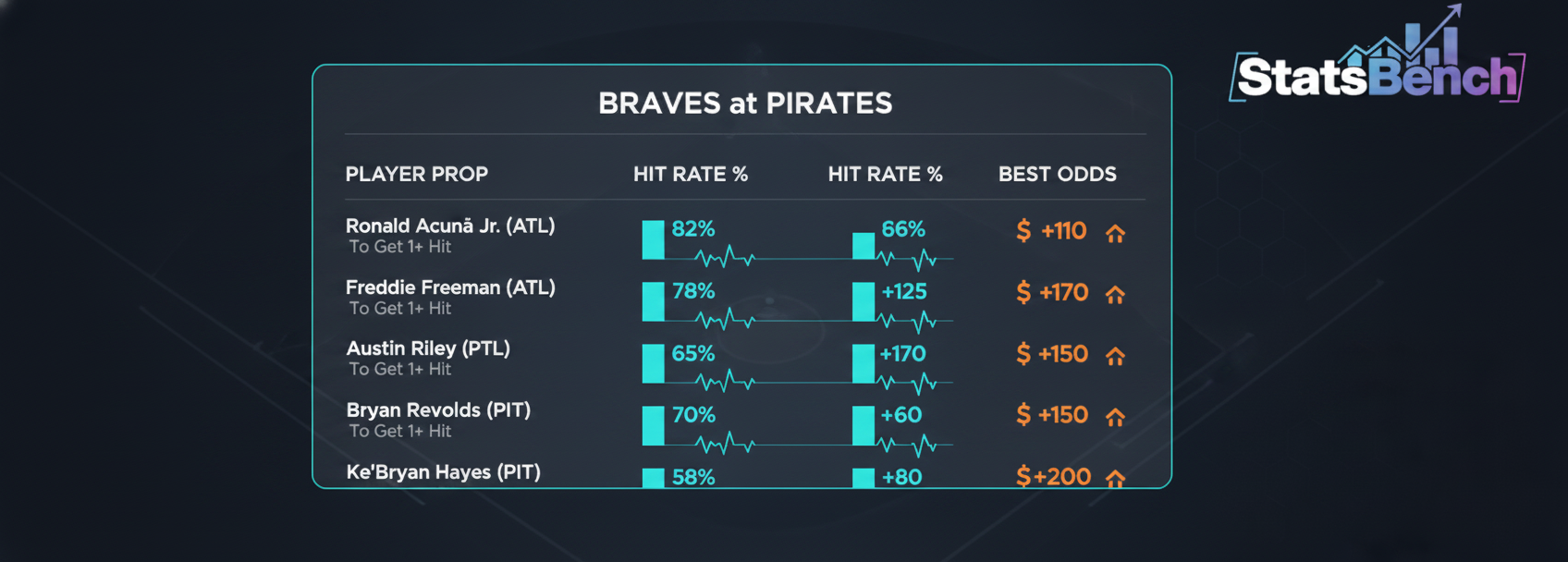
Per StatsBench data pulled July 9, 2026, in the Braves at Pirates game, Matt Olson is 6-for-10 (60%) on his hits+runs+RBIs over 1.5 line, with the best current price at -163. His total bases over 1.5 sits at the same 60% hit rate with better value at -115. Mauricio Dubon shows a similar pattern: 60% on hits+runs+RBIs over 1.5 (-115) and 60% on total bases over 1.5, but priced at +125 at the best book.
That last one is worth sitting with for a second. Two props, same hit rate over the same 10-game sample, and one pays plus money while the other is a coin-flip-or-worse price elsewhere. That gap is exactly what line shopping across books is supposed to catch, and it’s why checking one sportsbook’s app and calling it a day leaves money on the table.
What About Player Props Outside of Today’s Slate?
The same method holds for any date, not just today. Dominic Smith of the Braves is 6-for-10 (60%) on hits over 0.5 (-229) and total bases over 0.5 (-220) against Pittsburgh. Both are short prices, which is typical for low, easily-cleared lines. The hit rate looks nice on paper, but at -220 you need something closer to 69% just to break even long-run. That’s the kind of gut check a raw “hot streak” article never gives you.
If you want this broken down by pitch type and matchup specifically for strikeout props, StatsBench’s MLB Strikeout tool is a stats aggregator built for that: pitch mix, opponent whiff rates, and recent K% form by hand, all in one view. It’s not a projection, it’s the underlying data laid out so you can make the call.
Where Do You Check MLB Games Today and Scores Today?
For live scores and today’s schedule, ESPN’s MLB scoreboard and MLB.com are the standard destinations, and most sportsbook apps mirror the same schedule with betting lines attached. StatsBench isn’t a scores site. It’s a research layer that sits on top of the props once the games and lines are set, so you’d check ESPN or the league site for scores, then bring the matchup into a props tool before betting.
Braves Game Today and Similar Matchup Research
If you’re specifically tracking a braves game today or another team’s daily matchup, the process is identical: pull the confirmed lineup, check recent prop hit rates for the players you’re interested in, and compare that to the best number across books. The Braves-Pirates data above is a live example of exactly that process, not a one-off.
Do You Need an MLB TV Subscription to Bet Props?
No. An MLB.tv subscription gets you the broadcast, not better odds or better research. Watching the game live can help you catch things like a pitcher losing command mid-start, but for pre-game prop research you don’t need to watch anything, you need the hit-rate and matchup data before first pitch.
What About MLB Trade Rumors and How They Affect Props?
Trade deadline season (late July) is exactly when player props get weird. A hitter who knows he might be dealt, a team resting a veteran ahead of a trade, or a pitcher on an innings limit after a rumored deal all shift prop lines fast. If you’re researching props during trade rumor season, check the confirmed lineup and recent role, not just the season-long stat line, since usage can change overnight.
How Should You Weigh Hit Rate vs. Price?
Hit rate tells you how often something happened in a sample; price tells you what the market thinks that same thing is worth. A prop that’s 60% over the last 10 games isn’t automatically a good bet, it’s only a good bet relative to what odds it’s offered at. This is the same math behind how betting odds calculation works in general, and it’s why StatsBench pairs hit rate with an EV percentage rather than showing hit rate alone. The Positive EV Scanner recomputes fair prices from sharp books like Pinnacle and Circa every minute, so when a soft book’s price on a prop drifts out of line with where the sharp market has it, that gap gets flagged. It’s not a guarantee the prop hits, it’s a signal that the price you’re getting is better than the “true” price, which over a large sample is the definition of an edge.
A Quick Word on Sample Size
Every hit rate cited above is a 10-game sample. That’s useful for spotting a live pattern but it’s small in the statistical sense, and a single 0-for-1 or 1-for-1 swings the percentage by 10 points. Treat any 6/10 or 60% figure as a starting point for further matchup research, not a finished conclusion. This is also why long-run variance matters: even a legitimately good process will have losing stretches, and no single game’s outcome proves or disproves an edge.
Building This Into a Daily Habit
Checking MLB scores today and mlb games today is a habit most bettors already have. Layering in a quick props check, hit rate, matchup, and best current price, takes a few extra minutes and is where the actual edge-finding happens. StatsBench’s Pro Cheatsheet does this across every MLB game on the slate in one sortable table, which beats rebuilding a spreadsheet every morning during a long season.
For a broader read on why this kind of research matters more than chasing streaks, StatsBench’s post on why use historical stats in betting covers the reasoning in more depth, and the piece on how to interpret player props is a good companion read if props are new to you.
None of this removes variance from the equation. Betting on baseball props is entertainment with real financial risk attached, and even a well-researched 60% prop will lose 4 times out of 10 over the long run. Bet within your means, treat it as a hobby with a budget, and if it stops being fun, that’s the signal to step back. If you’re in the US, the National Problem Gambling Helpline (1-800-GAMBLER) is there if you need it, and you have to be 21+ to bet legally in most states.
Want to see this kind of hit-rate-plus-price breakdown for tonight’s full MLB slate without building it yourself? Grab the free StatsBench cheatsheet, it’s free, no credit card, and it’s rebuilt continuously as odds move.
Frequently Asked Questions
What is a good hit rate for an MLB prop bet?
There’s no single number, because hit rate has to be weighed against the price. A 55% hit rate at plus odds can be better value than a 65% hit rate at -250. Always check both before deciding a prop is worth it.
Where can I check MLB scores and games today?
ESPN’s MLB scoreboard and MLB.com both post live scores and today’s full schedule. StatsBench isn’t a scores site, it’s a research layer for props once the day’s games and lines are set.
Do MLB trade rumors affect player props?
Yes, especially close to the July trade deadline. A player who might be dealt, or a team managing workload ahead of a trade, can see usage change fast, so check the confirmed lineup and recent role rather than relying only on season-long stats.
Is a 60% hit rate over 10 games a reliable sample?
It’s a real but small sample. One game either way swings the percentage by 10 points, so treat a 10-game hit rate as a starting point for research, not a final verdict, and always look at the matchup behind the number.
Does StatsBench give MLB prop picks?
No. StatsBench surfaces hit rate, matchup data, and pricing across roughly 60 sportsbooks so you can do your own research faster. It’s a data tool, not a picks service, and betting outcomes are never guaranteed.