

The short answer on the most touchdown passes in NFL history
Tom Brady threw the most touchdown passes in NFL history. He finished a 23-season career ahead of Drew Brees and Peyton Manning, the two other quarterbacks in the same tier. Aaron Rodgers is the only other passer who has spent recent seasons climbing toward that group.
That is the trivia answer. The more useful question for anyone who bets football is why those numbers got so big, and what the record chase actually tells you about the touchdown market today. Spoiler: careers get built on longevity and offensive systems, not on any single magic season.
Key takeaway: career touchdown records are a story about volume and health, not about who was best in any given week.
The all-time passing touchdown tier list
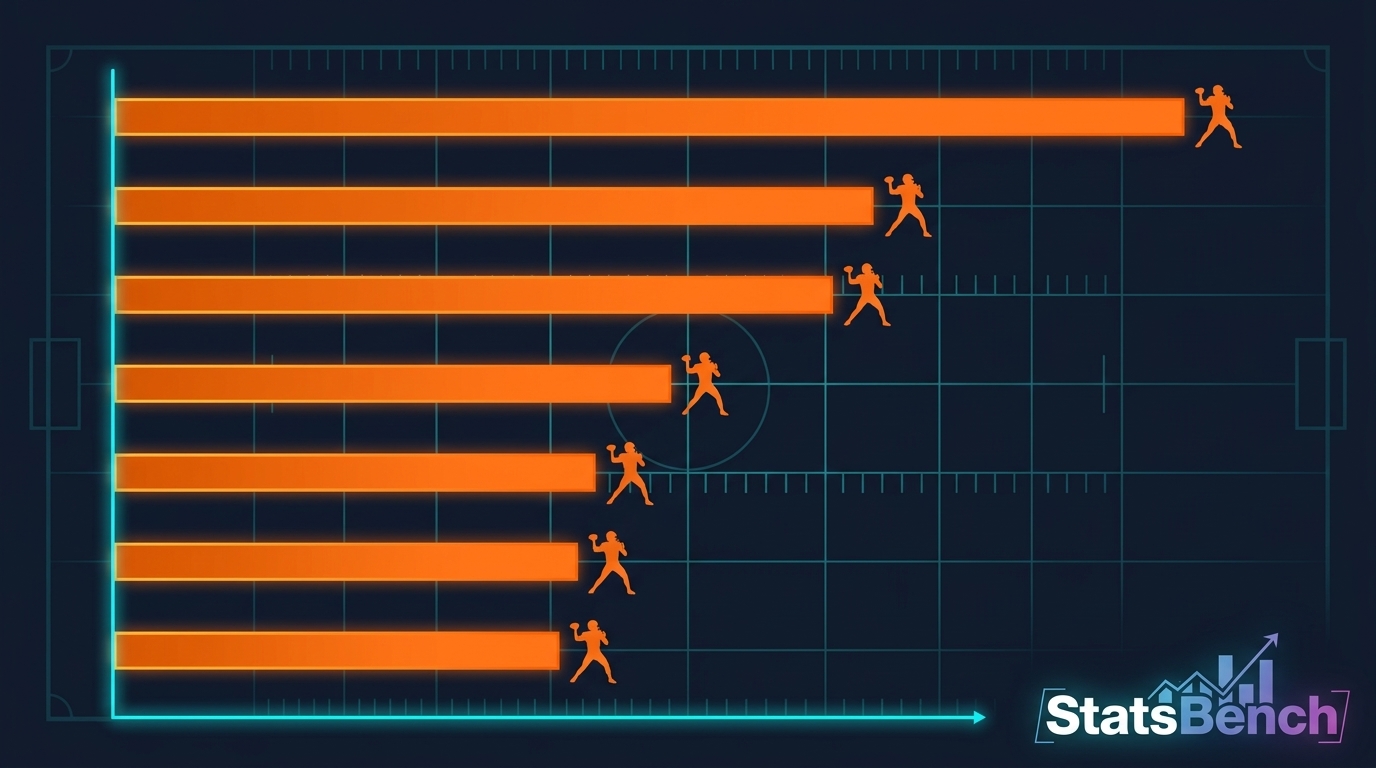
Four names sit clearly above everyone else. Each of them played at least 18 seasons, and each played in an era where rules protected passers and receivers.
- Tom Brady, the career leader, 23 seasons, two franchises, a full decade of playoff football piled on top.
- Drew Brees, 20 seasons, most of them in a pass-first New Orleans offense that threw on early downs.
- Peyton Manning, 17 played seasons, including a 55-touchdown single season in Denver.
- Aaron Rodgers, the highest career touchdown-to-interception ratio of the group.
Behind them you get Brett Favre, Philip Rivers, Dan Marino, Ben Roethlisberger and Matt Ryan. Notice the pattern. Nine of the top ten played primarily after 1990. For confirmed, current career totals, use the NFL’s official player stats pages rather than a screenshot on social media.
Why the leaderboard skews modern
Rule changes did most of the work. Illegal contact enforcement, the tightening of defensive holding and hits on quarterbacks all pushed the league toward more throws and safer passers. Add a 17-game regular season and the math gets easier every year.
Marino throwing 48 touchdowns in 1984 was an outlier of its era. That number now shows up in a good year for a good quarterback and nobody blinks.
What is a passing touchdown, exactly?
A passing touchdown is credited when a passer throws a forward pass and the receiver either catches it in the end zone or catches it and carries it in. The passer records a passing TD. The receiver records a receiving TD. It is one score worth six points, logged twice in two different stat columns.
That double-counting confuses new bettors. If you bet a receiver’s anytime touchdown and a quarterback’s over 1.5 passing touchdowns, those two legs are correlated, because one play can move both. Same-game parlay pricing usually accounts for that, though not always well. We break the mechanics down in our correlation guide for same game parlays.
A few edge cases worth knowing:
- A backwards pass is a run, so a lateral that scores is a rushing touchdown for the ball carrier.
- A two-point conversion pass does not count as a passing touchdown in the stat book.
- Any player can be credited with a passing touchdown. Receiver and running back trick plays count.
What is a rushing touchdown, and who leads there?
A rushing touchdown is a score on a running play, with no forward pass involved. Emmitt Smith leads all NFL players in career rushing touchdowns, followed by LaDainian Tomlinson, Marcus Allen, Walter Payton and Jim Brown.
The rushing side of the leaderboard looks nothing like the passing side. It is older, and it is shrinking as a share of scoring. Committee backfields and shotgun-heavy offenses spread goal line work around, so accumulating 100-plus career rushing scores is much harder than it was in 1995.
The exception is quarterbacks. Cam Newton stacked rushing touchdowns on designed sneaks and power runs, and Josh Allen has followed the same route. If you bet anytime touchdown props, quarterback rushing usage is one of the most consistently underpriced inputs in the market.
For the full historical picture across both categories, our hub piece on NFL touchdown leaders all time covers passing, rushing and receiving in one place.
The three touchdown columns, side by side
| Type | How it’s credited | All-time leader |
|---|---|---|
| Passing TD | Forward pass caught in or carried into the end zone | Tom Brady |
| Rushing TD | Ball carried across the goal line on a run | Emmitt Smith |
| Receiving TD | Catching a scoring pass | Jerry Rice |
Do touchdown records tell you anything about betting?
Directly, no. A career record is a 20-year sample of a player who may be retired. It says nothing about Sunday. But the records do teach three things that carry over to prop research.
First: volume beats efficiency for accumulation. The all-time leaders were not always the most accurate passers in their draft class. They played more games and threw more passes. The same logic works on a weekly prop. A receiver with eight targets and a mediocre catch rate often beats a sharper receiver with four targets.
Second: role changes matter more than talent changes. When Manning moved to Denver he threw 55 touchdowns the next season. Same quarterback, different offense. In props, a running back promoted to goal line duty gets a real bump in scoring probability before any book has ten games of data on him.
Third: small samples lie. A quarterback with three straight multi-touchdown games has a 3-game sample. That is not a trend. We wrote about why the “last 10 games” filter is a trap in basketball, and the same problem applies to a 17-game football season.
How the research actually looks in practice
Touchdown props are low-frequency events, which means hit rates move slowly and prices matter a lot. Here is a real example of what the underlying data looks like when you strip the sport away.
In a StatsBench cheatsheet snapshot from September 1, 2026, the qualifying props clustered tightly. A Tampa Bay baseball slate showed Yandy Diaz over 0.5 total bases at a 60% hit rate on a 10-game sample, with a 0.8% edge and a best price of -285 across books. Same 60% hit rate, same 6-of-10 sample, and yet the edge was under one percent.
That gap is the whole lesson. A 60% hit rate sounds strong until you see the price. At -285 you need roughly 74% to break even. The hit rate was never the edge. The price was.
Touchdown props behave the same way. An anytime TD at -110 and the same player at +100 across two books is a meaningful difference over a season, and it has nothing to do with your read on the matchup. If you want the arithmetic, run any American line through the implied probability calculator and compare it to your own estimate before you bet.
The inputs that actually move a touchdown prop
- Red zone snap share, who is on the field inside the 20, not who leads the team in yards.
- Goal line carries, often a different player than the starter.
- Opponent red zone defense, some teams bend in the middle of the field and stiffen inside the 10.
- Game script, favored teams run more near the goal line, trailing teams throw.
- Price across books, the only input you fully control.
Our anytime touchdown strategy guide goes deeper on red zone usage, and the NFL player stats reading guide shows which columns on a stats page are worth your time.
Records that are actually at risk
The career passing touchdown record is safe for a long time. Brady’s total requires two decades of durability, and no active quarterback is close to that pace-plus-longevity combination.
The single-season mark is a different story. Peyton Manning’s 55 has been approached, and with 17 games it is a live target for the right quarterback in the right offense. The single-game record of seven passing touchdowns is the strangest one. It was first set in 1943 and has only been matched a handful of times since, most recently by modern quarterbacks in blowouts.
Note the pattern in those seven-TD games. They happen when a team is up big and keeps throwing, which coaches increasingly refuse to do. Records like these live in the tails of the distribution, which is exactly why they make bad bets and good stories. If distributions interest you, our post on why averages lie in prop betting is a good next read.
Where to go from here
Career touchdown records are a great way to understand how NFL scoring evolved. They are not a betting model. The gap between “who scored the most ever” and “who scores this Sunday” is filled with role data, matchup data and pricing.
StatsBench compares prices across roughly 60 sportsbooks and grades props on hit rate, consistency and edge, so you can see when a good-looking number is actually a bad price. That’s research, not picks. You still make the call, and touchdown props carry real variance over any short run.
Ready to work an actual slate? Start with the StatsBench research tools and check prop pricing before you lock anything in. Bet 21+ only, stake what you can afford to lose, and if betting stops being fun, call 1-800-GAMBLER.
Historical record context via the NFL annual passing touchdown leaders and official league stats. Live prop figures cited above are from a StatsBench cheatsheet snapshot dated September 1, 2026.
Live board
See today’s NFL player props on StatsBench
Live lines, last-10 hit rates and the best price across about 60 books.
Open the NFL player props board →
Prefer email? Get the daily picks newsletter.
Frequently Asked Questions
Who has the most touchdown passes in NFL history?
Tom Brady holds the career record for passing touchdowns, having thrown more than any quarterback in league history across 23 seasons. Drew Brees and Peyton Manning sit next on the list. The NFL’s official career passing leaders page is the place to confirm the current totals.
What is a passing touchdown?
A passing touchdown is credited when a quarterback (or any passer) throws a forward pass that a teammate catches in the end zone, or catches and carries into the end zone. The passer gets the passing TD and the receiver gets a receiving TD from the same play. It counts as six points once, not twice.
What is a rushing touchdown?
A rushing touchdown happens when a player carries the ball across the goal line on a run, with no forward pass involved. Emmitt Smith leads all NFL players in career rushing touchdowns. Quarterback sneaks and scrambles count as rushing TDs too.
Do all-time touchdown records help you bet player props?
Not directly. Career records tell you who was great, not who is likely to score this week. For props you want current role data: red zone snaps, target share, goal line carries and the price across books.
Is a single-game passing touchdown record likely to fall?
The seven-touchdown single-game mark has stood for decades and has been matched only a handful of times. Modern passing volume is up, but scripted red zone rushing and clock management make seven in one game rare. Treat it as a fun fact, not a betting angle.