
The best prop bet analyzer isn’t the one with the flashiest homepage. It’s the one that shows its work: real hit rates, real sample sizes, and prices you can actually get at a sportsbook. A lot of tools promise an edge and just show you a green checkmark. That’s not analysis. That’s a guess wearing a lab coat.
This guide breaks down what a prop bet analyzer should actually do, the red flags that separate research tools from glorified picks services, and how to test any tool (including StatsBench) before you pay for it.
What Makes a Good Prop Bet Analyzer?
A good prop bet analyzer shows a hit rate with a sample size attached, a price from multiple books, and some way to judge whether the number is actually mispriced. If a site just says “our model likes this” with no numbers behind it, that’s marketing, not analysis.
At minimum, look for these four things:
- Sample size. A 6-for-10 hit rate over 10 games means something different than 60% over 100 games. Both should be labeled clearly.
- Line-shopping. The same prop can differ by 10+ cents across books. A tool that only shows one book’s price is hiding value from you.
- Matchup context. Is the opponent bad at defending this stat? A raw hit rate without matchup data is only half the picture.
- An honest edge number. Expected value (EV%) tells you how far a price sits from fair value. That’s different from a hit rate, and a real tool separates the two.
How Do You Read a Hit Rate the Right Way?
A hit rate tells you how often a prop has cleared its line recently, but it only means something with the sample size next to it. Ten games is a start. It’s not proof.
Take a real example from a StatsBench cheatsheet snapshot in July 2026. Julie Allemand’s points+rebounds+assists prop against Las Vegas was set at 17.5, and she’d gone over that number in 6 of her last 10 games, a 60% hit rate. That’s useful context. It’s not a lock, and a responsible analyzer won’t pretend it is.
Compare that to a pitcher prop from the same day: Chase DeLauter’s runs line at 0.5 also sat at a 60% hit rate, but the best available price was +150, not the -110 to -125 range you’d see on the WNBA props above. Same hit rate, very different value. That gap between hit rate and price is exactly what an EV-focused tool is built to catch.
Hit Rate vs EV%: Why They’re Not the Same Thing
Hit rate tells you how often a bet has landed. EV% tells you whether the price you’re being offered is fair given that probability. A prop can have a great hit rate and a terrible price, or a modest hit rate and a genuinely good number, if the market hasn’t caught up.
This is the part most “analyzer” tools skip. They show a hit rate, slap a green thumbs-up on it, and call it a day. But a 60% hit rate at -300 is a bad bet. A 60% hit rate at +150 might be a real one. You need both numbers side by side to know the difference.
| Player / Prop | Hit Rate | Best Price | EV% |
|---|---|---|---|
| Marina Mabrey, pts+ast o/u 26.5 | 60% (6/10) | -112 | 0.7% |
| Marina Mabrey, pts+reb+ast o/u 29.5 | 60% (6/10) | -115 | 1.0% |
| Brayan Rocchio, hits+runs+rbis o/u 1.5 | 60% (6/10) | -110 | 0.7% |
| Chase DeLauter, hits+runs+rbis o/u 2.5 | 60% (6/10) | +150 | 0.3% |
Notice the small edges here (all under 1.5%). That’s normal and honest. Real mispricings in a liquid market are usually thin. Anyone advertising huge, consistent edges on every prop is either exaggerating or not showing you the vig-adjusted math.
What Should a Prop Bet Analyzer Actually Show You?
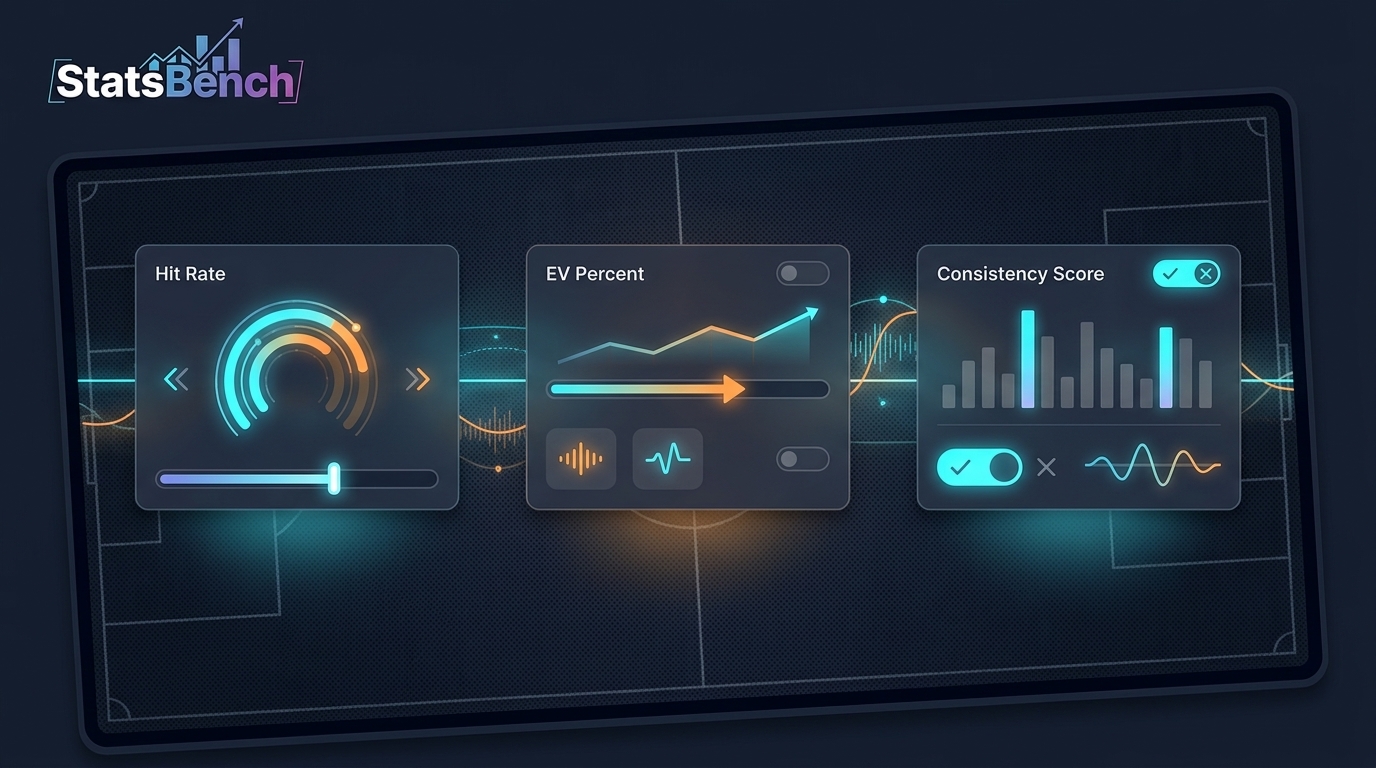
It should show a filterable list of props with hit rate, EV%, and consistency all visible at once, so you’re not toggling between five browser tabs. Consistency matters because a player who hits a line steadily is a different bet than one who’s boom-or-bust with the same average.
StatsBench’s Pro Cheatsheet pulls this together in one sortable table: hit rates, matchup notes, consistency grades, and best available odds across roughly 60 tracked sportsbooks. The free version of the cheatsheet filters to props in the 50-60% hit rate range plus one higher-hit-rate “teaser” player per team, which is a fine way to test the format before paying for anything.
For deeper filtering, the Prop Finder tool lets you sort by SB Score, EV%, hit rate, consistency, trend, home/away splits, back-to-backs, and defensive matchup, then save your own filter presets. That’s the difference between a static list and an actual research tool.
Is a +EV Prop Finder Worth Using?
A positive-EV tool is worth using if you understand it shows a mathematical edge over a large sample, not a guaranteed win on any single bet. StatsBench’s Positive EV Scanner recomputes fair prices from sharp books (Pinnacle, Betfair Exchange, and similar) about every minute, then flags where a soft book is offering a better number.
That’s a real, measurable process. It’s not a promise. Even a legitimate 3% edge loses plenty of individual bets; the math only plays out over dozens or hundreds of wagers, and variance is part of the deal every time you place one.
If you want to see the mechanics before committing to a subscription, the Positive EV page lays out how the de-vig math and Kelly staking work.
Red Flags in a Prop Bet Analyzer
Watch for tools that hide their sample sizes, promise “locks,” or show one inflated accuracy number with no breakdown by sport or bet type. Those are signs of a marketing page dressed up as a research tool.
- No sample size next to a hit rate.
- Language like “guaranteed” or “can’t lose.”
- Only one sportsbook’s price shown, no line-shopping.
- A single overall “accuracy” stat instead of per-prop hit rates.
- No way to see the underlying game log or matchup data.
If a bettor came to you with a great pitch and refused to show their spreadsheet, you’d be skeptical. Apply the same standard to a prop tool.
How Do You Test a New Analyzer Before Paying for It?
Test any analyzer for free first: check its cheatsheet or preview page against a slate you already know, and see if the hit rates and prices actually match what’s posted at the sportsbooks. If the numbers hold up on a free tier, that’s a decent signal the paid tier is built on the same honest foundation.
StatsBench’s free cheatsheet and newsletter are built for exactly this kind of test drive. You get real props with hit rates attached, no card required, and you can compare that against whatever tool you’re currently using.
For a broader look at picking research software generally, our post on the best player prop research tool covers the same evaluation criteria in more depth. If you’re newer to props altogether, start with what a prop bet actually is before you start comparing tools.
Betting Responsibly With Any Analyzer
No analyzer, StatsBench included, turns betting into a sure thing. Props carry real variance, and even a well-priced bet loses sometimes. Bet only with money you can afford to lose, keep records of your results, and treat this as research that informs your own judgment, not a substitute for it.
If betting stops being fun or starts feeling like a problem, the National Council on Problem Gambling helpline (1-800-GAMBLER) is a free resource. You must be 21+ and in a jurisdiction where sports betting is legal to use these tools.
Start With a Free Look
Before you pay for any prop bet analyzer, run it through a free test with our free cheatsheet. You’ll see real hit rates, real prices, and a format built around honesty instead of hype, and you can decide from there whether the full Prop Finder or Positive EV Scanner is worth adding to your process.
Free preview
See today’s MLB player props on StatsBench
Live lines, last-10 hit rates and the best price across about 60 books. No account needed to look.
Open the MLB player props board →
Prefer email? Get the daily picks newsletter.
Frequently Asked Questions
What is a prop bet analyzer?
It’s a tool that scores individual player props using hit rates, sample sizes, and price comparisons across sportsbooks, so you can judge whether a line is fairly priced instead of guessing.
Is a prop bet analyzer the same as a picks service?
No. A picks service tells you what to bet. An analyzer shows you the underlying data (hit rate, EV%, consistency) and lets you make the call yourself.
What hit rate sample size should I trust?
Ten games is a common starting sample and can be genuinely useful context, but treat anything under 15-20 games as early evidence, not proof. Always check what the sample size actually is before trusting a hit rate.
Does a high EV% mean a bet will win?
No. EV% measures whether a price is mathematically favorable over a large sample, not whether any single bet wins. Even a real edge loses plenty of individual bets due to normal variance.
Is StatsBench’s cheatsheet free to try?
Yes. The free cheatsheet includes props in the 50-60% hit rate range plus one higher-hit-rate player per team, with no payment required to start.