

The short answer on a team parlay payout
A team parlay payout is just multiplication. Convert every leg to decimal odds, multiply them together, then multiply by your stake. That product is your total return, stake included.
Most people search for “3 team parlay payout” or “6 team parlay payout” expecting a fixed number. There isn’t one. The payout depends entirely on the price of each leg, not the count of legs.
Same leg count, wildly different payouts. A three-leg parlay of three -110 bets returns about 6.0x your stake. A three-leg parlay of three -300 favorites returns about 2.4x. Same “3 team parlay,” very different money.
How to calculate the payout, step by step
Here’s the whole process in four steps. You can do it on a phone in under a minute.
- Step 1: Convert each American price to decimal. Positive odds: (odds ÷ 100) + 1. Negative odds: (100 ÷ |odds|) + 1.
- Step 2: Multiply all the decimals together.
- Step 3: Multiply that by your stake. That’s your total return.
- Step 4: Subtract the stake to see profit.
Example with four legs at -110. Each -110 is 1.909 in decimal. So 1.909 × 1.909 × 1.909 × 1.909 = about 13.28. A $20 stake returns roughly $265.60, of which $245.60 is profit.
Don’t want to do it by hand? Our parlay calculator handles any number of legs, and the odds converter flips American, decimal and fractional in one click.
What each leg count actually pays at standard juice
Standard prop and spread pricing is -110. Here’s what an all -110 parlay returns per $10, so you can sanity-check any slip a book shows you.
| Legs | Decimal multiplier | Return on $10 | Implied win probability |
|---|---|---|---|
| 2 | ≈ 3.64 | ≈ $36.44 | ≈ 27.5% |
| 3 | ≈ 6.96 | ≈ $69.58 | ≈ 14.4% |
| 4 | ≈ 13.28 | ≈ $132.83 | ≈ 7.5% |
| 5 | ≈ 25.36 | ≈ $253.56 | ≈ 3.9% |
| 6 | ≈ 48.41 | ≈ $484.11 | ≈ 2.1% |
Two things jump out. The payout roughly doubles per leg. The win probability roughly halves.
That trade is fine on its own. The problem is what happens to the house edge as you stack legs.
Why the vig compounds with every leg you add
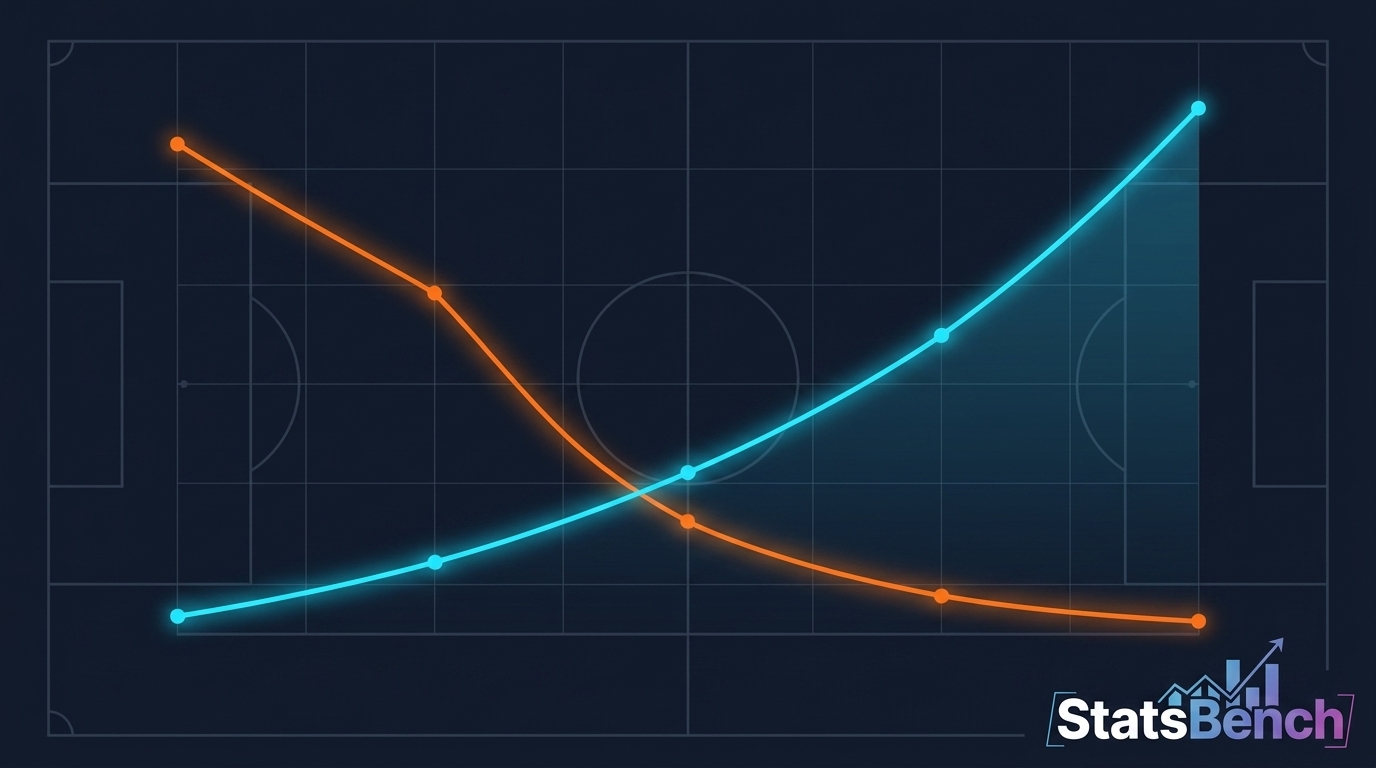
A single -110 bet carries about 4.5% hold for the book. Add legs and that hold doesn’t stay at 4.5%. It compounds, because each leg is priced with its own margin baked in.
Run the math on the true probabilities. Six coin flips hitting is 1 in 64, so a fair six-leg payout would be 64x. The book pays about 48.4x. You’re giving up roughly a quarter of the fair price.
Compare that to a straight bet, where you give up a few percent. The parlay isn’t a scam, it’s just a much more expensive way to buy the same risk.
You can see exactly how much a book is holding with the vig and hold calculator. If you want the fair, no-vig price on each leg first, run it through the devig calculator.
The one thing that changes the math: correlation
Everything above assumes each leg is independent. Real games aren’t independent. A quarterback throwing for 350 yards makes his top receiver’s yardage prop far more likely.
Books know this. That’s why same game parlays get priced with extra margin, or with legs that are quietly correlated in the book’s favor. If you build these, read our correlation cheat sheet for same game parlays before you touch the slip.
Correlation cuts both ways. Positive correlation between your legs raises your real win chance above the naive multiplication. Negative correlation (a pitcher’s strikeouts and the opposing team’s total, for example) quietly destroys it.
Legs that usually correlate positively
- QB passing yards with his WR1 receiving yards
- A team’s moneyline with its star’s scoring prop
- Game total over with multiple player overs in the same game
Legs that fight each other
- Under on a pitcher’s strikeouts plus over on his team’s win probability
- Two players on the same team who share the same usage
- A blowout-dependent leg plus a fourth-quarter minutes leg
Building legs from real hit-rate data instead of vibes
The payout math is easy. Choosing legs is the hard part, and it’s where most parlay tickets die.
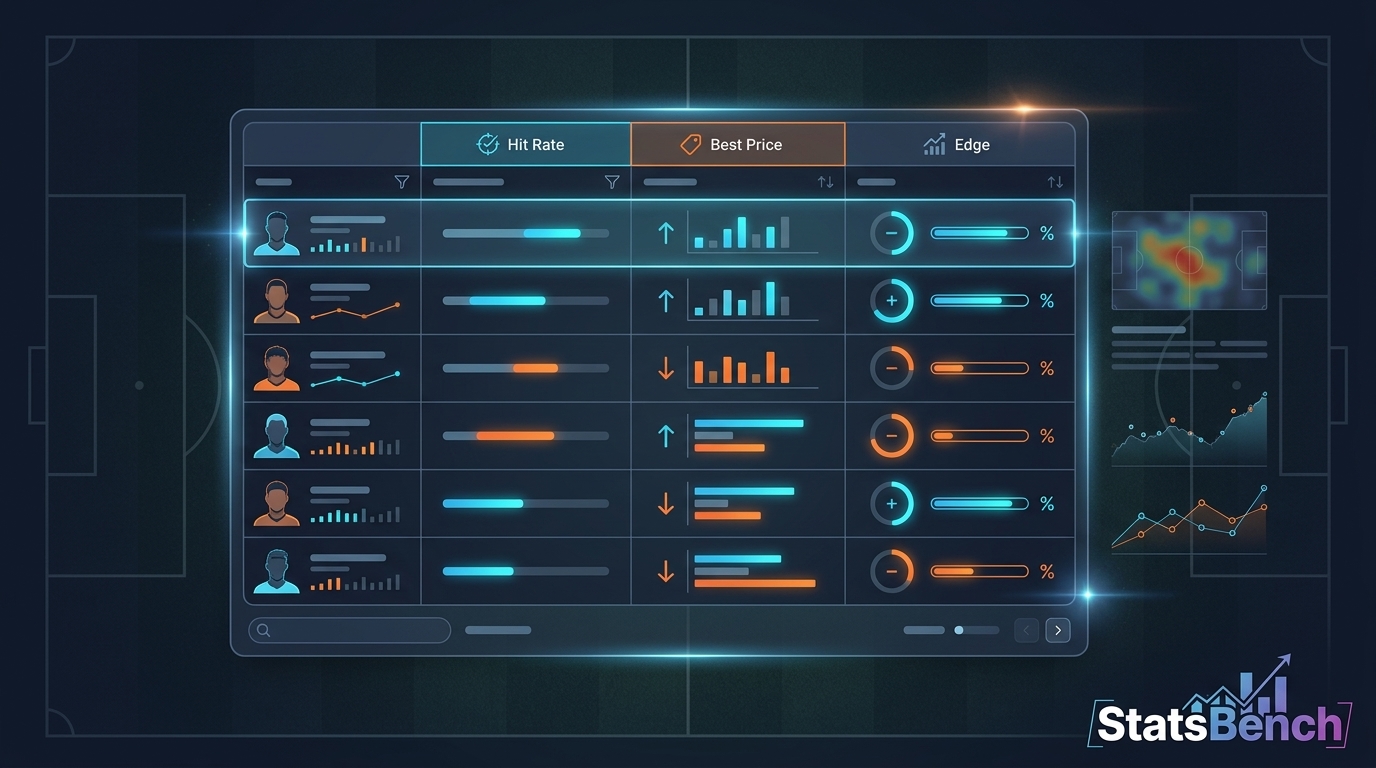
Here’s a concrete example. In a StatsBench cheatsheet snapshot from August 10, 2026, an Atlanta vs Toronto WNBA game showed Allisha Gray’s points + assists over 21.5 hitting in 6 of her last 10 games (60%), with a best available price of -112 and a modeled edge of 0.7%. Her three-pointers made over 1.5 sat at the same 60% hit rate, best price -135, edge 0.6%.
Now do the parlay math on that. Two 60% legs multiply to 36%. Two legs that each carry a sub-1% edge do not become a big edge when combined. They become a small edge stretched across a much lower win rate.
That’s the honest reality of parlays: they amplify variance far faster than they amplify edge.
Same snapshot, MLB side: Alejandro Kirk’s hits + runs + RBIs over 1.5 also showed a 60% hit rate over 10 games at -110 with a 0.6% edge. Good research, thin margin. Stacked four deep, that thin margin gets buried under compounding juice.
How to decide if a parlay is worth it
Ask three questions before you submit. They take 30 seconds and they’ll kill most bad slips.
- Do I have a real edge on every leg? One bad leg poisons the whole ticket. A 60% leg paired with a coin-flip leg is a coin-flip ticket.
- Am I getting the best price on each leg? Small price differences compound. A half-point of juice per leg across six legs is real money.
- Is my stake sized for a 2% win rate? A six-leg ticket loses about 49 times out of 50 at standard pricing. Size it like entertainment, not like a bankroll strategy.
Line shopping matters more here than anywhere else. StatsBench tracks prices across roughly 60 sportsbooks, so the best available number on each leg is right there in the table instead of buried in six open browser tabs.
Expected value beats payout size every time
A big payout number is not the same as a good bet. What matters is expected value: your real chance of winning times what you collect, minus what you risk.
Plug your estimated win probability and the offered price into the EV calculator and you’ll see it immediately. Most long parlays come back negative even when the payout looks life-changing.
If you insist on multi-leg tickets, keep them short and keep the legs genuinely researched. Two or three legs with real, verifiable hit-rate support beat a six-leg lottery slip on almost any measure. For the deeper mechanics, our full breakdown of how parlays work and the odds math behind them covers the derivation.
Also worth reading: why good bets lose. Parlays make that lesson very loud, very fast.
Where to check your numbers
Two habits separate people who track this properly from people who guess:
- Convert everything to decimal before you compare. American odds hide the relationship between price and probability. Wikipedia has a clean overview of odds formats if you want the background.
- Log every ticket. The free Bet Tracker in a StatsBench account records P&L, ROI and hit rate, so your parlay results stop being a feeling and start being a number.
For official schedules and box scores to verify a leg’s actual result, go straight to the source: MLB.com stats or WNBA.com stats.
Bet within your means
Parlays are fun and they’re expensive. Both things are true. Treat a long ticket as the price of entertainment, not as a plan.
Betting is for adults 21+ where it’s legal, and no research tool removes variance. If it stops being fun, call 1-800-GAMBLER.
Run the numbers before you tap the slip
Do the multiplication first. Then check whether every leg actually earns its place. Then decide.
Start with the free StatsBench parlay calculator to price any combination of legs in seconds, and pair it with the implied probability calculator to see what the book thinks your ticket’s real chances are. Then build your legs from the hit-rate and best-price data on the StatsBench research tools, not from a hunch.
Free calculator
Run the numbers with the StatsBench parlay calculator
Instant, free, no account.
Prefer email? Get the daily picks newsletter.
Frequently Asked Questions
How much does a 3 team parlay pay?
At standard -110 pricing on every leg, a three-team parlay returns about 6.96 times your stake, so $10 returns roughly $69.58. The exact number changes with each leg’s price. Heavier favorites pay far less, underdogs pay far more.
What does a 6 team parlay pay on $10?
About $484 total return if all six legs are priced at -110. The fair, no-vig payout on six coin flips would be $640, so the book keeps roughly a quarter of the fair price. That gap is why long parlays are expensive.
Do more legs mean a better bet?
No. Each added leg roughly doubles the payout but roughly halves your win probability, and the book’s margin compounds with every leg. More legs means more variance and a larger house edge, not more value.
How do I calculate parlay odds myself?
Convert each American price to decimal, multiply all the decimals together, then multiply by your stake for the total return. Subtract your stake to get profit. The StatsBench parlay calculator does this for any number of legs.
Are same game parlays priced differently?
Yes. Legs within one game are correlated, so books adjust the price rather than using straight multiplication. That adjustment usually favors the book, which is why same game parlay pricing is typically worse than a cross-game parlay.