
What is a passing touchdown?
A passing touchdown is a scoring play where a quarterback (or any passer) throws the ball and a teammate catches it in the end zone, or catches it in the field of play and then carries it into the end zone. It’s worth six points, and the credit gets split: the passer gets a passing TD, the receiver gets a receiving TD. That’s the short answer to what is a passing touchdown, and it’s the single most important stat in football betting because so many props hang off it.
The play has to end with the ball in the end zone in the receiver’s possession. If a receiver catches a pass at the 8-yard line and runs it in, it still counts as a passing touchdown for the quarterback. The pass only travelled 8 yards. The TD is still full credit.
Key takeaway: one passing touchdown creates two stat lines, a passing TD and a receiving TD, from a single six-point play.
Why the stat gets counted twice
The NFL box score records the play from both ends. Patrick Mahomes throwing to Travis Kelce adds one to Mahomes’ passing TD column and one to Kelce’s receiving TD column. Team touchdowns don’t double up, only the individual stats do.
This matters when you bet. An “anytime touchdown scorer” market pays on the receiver. A “QB passing TDs over 1.5” market pays on the thrower. Same play, two different tickets.
What is a rushing touchdown, and how is it different?
A rushing touchdown happens when a player carries the ball across the goal line without a forward pass being involved on that play. Running backs get most of them. Quarterbacks get a lot too, especially near the goal line.
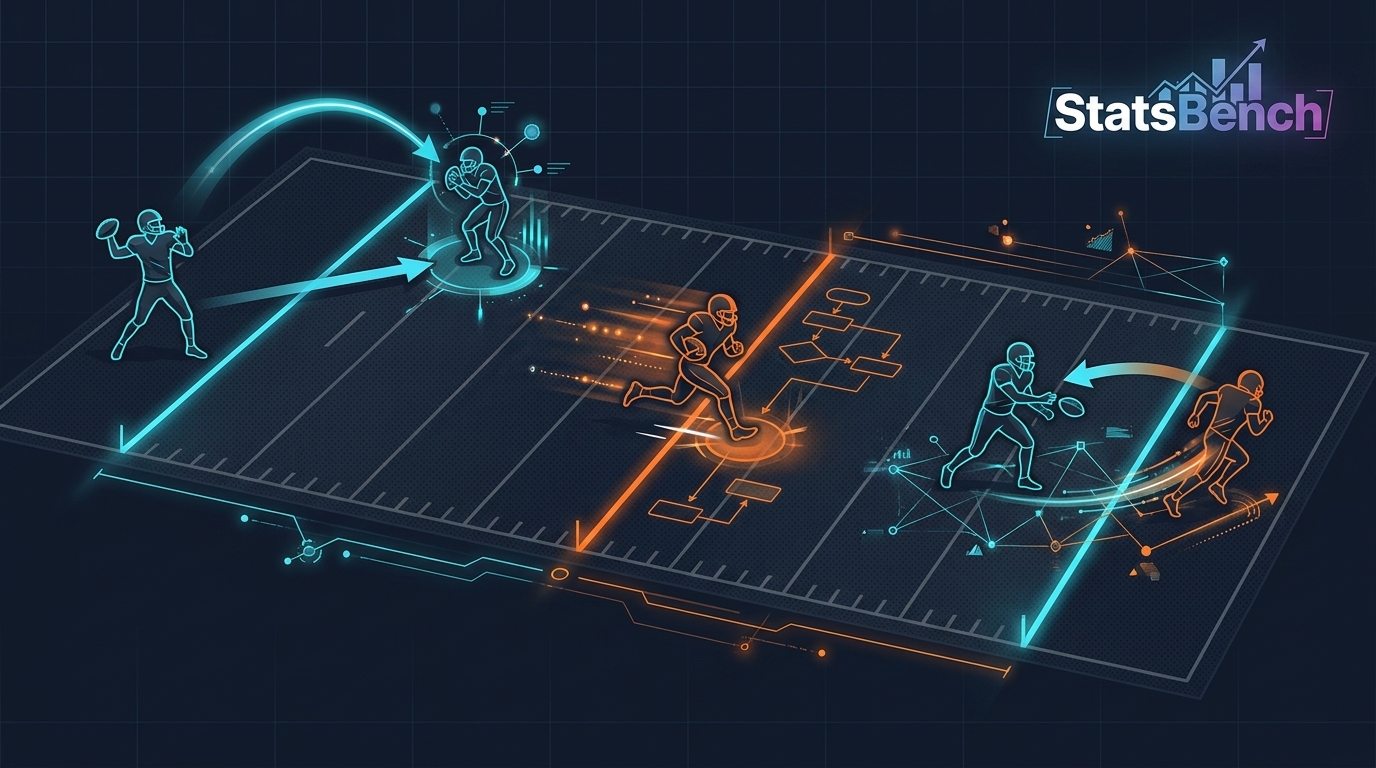
The dividing line is simple: was there a forward pass? If yes, and it scores, it’s a passing TD for the thrower and a receiving TD for the catcher. If no forward pass, whoever crosses the line gets a rushing TD.
- Passing TD: forward pass, caught, ends in the end zone. Credits passer + receiver.
- Rushing TD: ball carried across the goal line, no forward pass. Credits the runner only.
- Receiving TD: the catcher’s half of a passing touchdown.
- Return / defensive TD: kickoff, punt, fumble or interception returned to the end zone. Not credited to any offensive passer.
One common trap: a backward pass (a lateral) is not a forward pass. If a QB pitches it behind the line and the back scores, that’s a rushing touchdown, not a passing one. Our breakdown of NFL rushing touchdown leaders covers who piles these up and why goal-line role beats raw talent.
How does this change what you bet?
Once you know which column a score lands in, the prop menu makes a lot more sense. Books split touchdown markets into a few families, and each one settles on a different definition.
| Market | What settles it | Who gets credit |
|---|---|---|
| QB passing TDs (o/u 1.5, 2.5) | Forward passes that end in the end zone | The quarterback |
| Anytime TD scorer | Any TD scored by that player | Receiver or runner |
| First TD scorer | Game’s first offensive TD | Receiver or runner |
| Player rushing TD | Carries into the end zone only | The ball carrier |
Notice the gap. A tight end who scores on a 3-yard pass hits “anytime TD” but does nothing for a rushing-TD ticket. A QB sneak from the 1 hits nothing on the passing side. If you’ve ever lost a bet you thought you won, this is usually why.
Read the settlement rules before the stat sheet. Books occasionally differ on how return TDs count in “anytime scorer” markets, so check the specific book.
Why passing TD props are volatile
Touchdowns are rare events. A quarterback might throw 35 passes and score twice. Small counts mean big swings, so a great matchup still loses plenty of nights.
That’s why yardage and reception props often carry more predictive signal than TD props. Volume repeats. Six-point plays don’t, at least not on a weekly sample. If you want the math behind why good bets still lose, we covered it in variance in betting.
What the numbers look like in practice
Here’s a concrete example from real StatsBench cheatsheet data, generated September 5, 2026, for a Seahawks at Patriots matchup. These are receiving props, not TD props, and that’s deliberate.
| Player | Prop | Hit rate (L10) | Edge | Best price |
|---|---|---|---|---|
| Cooper Kupp | Receiving yards o/u 30.5 | 60% (6/10) | 5.5% | -110 |
| Hunter Henry | Receiving yards o/u 34.5 | 60% (6/10) | 11.3% | -114 |
| AJ Barner | Receiving yards o/u 25.5 | 60% (6/10) | 2.5% | -110 |
| Rashid Shaheed | Receiving yards o/u 5 | 60% (6/10) | 20.6% | n/a |
| Cooper Kupp | Receptions o/u 2.5 | 60% (6/10) | 0.8% | -132 |
Look at the edge column. Four of those props share the same 60% hit rate, but the modeled edge ranges from 0.8% to 20.6%. Hit rate alone tells you almost nothing about price. We unpack that gap in hit rate vs edge.
The connection to touchdowns is targets. Receivers who see the ball near the end zone are the ones who convert passing TDs into receiving TDs. Yardage and reception volume are the leading indicator; the six-point plays are the lagging, noisy result.
How to build a TD read from volume data
- Start with target share and route participation, not last year’s TD total.
- Layer in red-zone usage. Goal-line looks are where passing touchdowns actually get made.
- Check the defensive matchup by position, since teams leak scores to specific spots.
- Shop the price. A -110 anytime ticket at one book can be -125 at another.
Step four is the boring one that quietly matters most. StatsBench tracks roughly 60 sportsbooks and surfaces the best available price on each prop, which is free closing line value you’d otherwise leave on the table.
Passing touchdown records and context
Career passing TD totals are the headline number in every QB legacy argument. They also tell you something practical: how much a passing offense’s scoring concentrates in the air versus on the ground. Teams with elite passers throw near the goal line more often, which shifts value from running back TD props toward receiver props.
For the historical side, see our guides to the most touchdown passes in NFL history and the broader NFL touchdown leaders all time hub. The official league record book at NFL.com is the source of truth for current-season totals, and Wikipedia’s touchdown entry has a clean history of how the six-point rule evolved.
Two-point conversions don’t count
A quarterback who throws a successful two-point conversion does not get a passing touchdown. Conversions are tracked separately and are worth two points, not six. Same for a receiver: no receiving TD on the stat sheet.
This trips up bettors on “QB total passing TDs” props more than you’d think. The conversion looks like a scoring pass. Statistically, it isn’t one.
Turning the definition into a bet
Knowing what counts is step one. Pricing it is step two. Before you take an anytime TD ticket at +240, convert that to a break-even probability with the implied probability calculator. If your own read says the player scores less often than the number the price implies, pass.
Stacking a QB passing TD with his receiver’s anytime TD is a correlated same-game parlay, and the payout math is not the same as two independent legs. Run it through the parlay calculator first, and read our correlation cheat sheet before you build one.
Touchdown markets carry heavy vig. That’s the tax you pay on every ticket, and the vig and hold calculator shows exactly how much a book is taking on a given market. Anything above the mid single digits and you need a real edge just to break even.
A quick word on discipline
Touchdown props are fun and swingy. That combination burns bankrolls. Bet flat units, keep a record of every ticket, and judge yourself on the price you got rather than the result.
Betting is 21+ in regulated US markets and legality varies by state. It should be entertainment you can afford. If it stops feeling that way, call 1-800-GAMBLER.
Where to research this properly
The fastest way to go from “I know what the stat means” to “I know which side is priced wrong” is a filterable prop board. StatsBench’s Prop Finder lets you sort NFL props by hit rate, consistency grade, defensive matchup and modeled edge, then shows the best available price across the books it tracks. It’s research, not picks. You still make the call.
Explore the NFL player props board on StatsBench and start with target volume before you touch a touchdown market.
Live board
See today’s NFL player props on StatsBench
Live lines, last-10 hit rates and the best price across about 60 books.
Prefer email? Get the daily picks newsletter.
Frequently Asked Questions
Does the quarterback get credit if the receiver runs 40 yards after the catch?
Yes. As long as a forward pass was completed and the play ends in the end zone, the quarterback gets a full passing touchdown. The yardage is credited to the play regardless of how much came after the catch.
What is a rushing touchdown compared to a passing one?
A rushing touchdown is scored when a player carries the ball across the goal line with no forward pass on the play. A passing touchdown requires a completed forward pass that ends in the end zone. Both are worth six points.
Does a two-point conversion count as a passing touchdown?
No. A successful two-point conversion pass is recorded separately and is worth two points. Neither the quarterback nor the receiver gets a touchdown added to their season totals.
Is a lateral that scores a passing touchdown?
No. A lateral is a backward pass, so the score counts as a rushing touchdown for the player who crosses the goal line. Only forward passes create passing touchdowns.
Which touchdown prop should a new bettor start with?
Start with volume markets like receptions and receiving yards rather than touchdown scorer props. Touchdowns are rare events with high variance, so small samples swing wildly even when your read is right.