
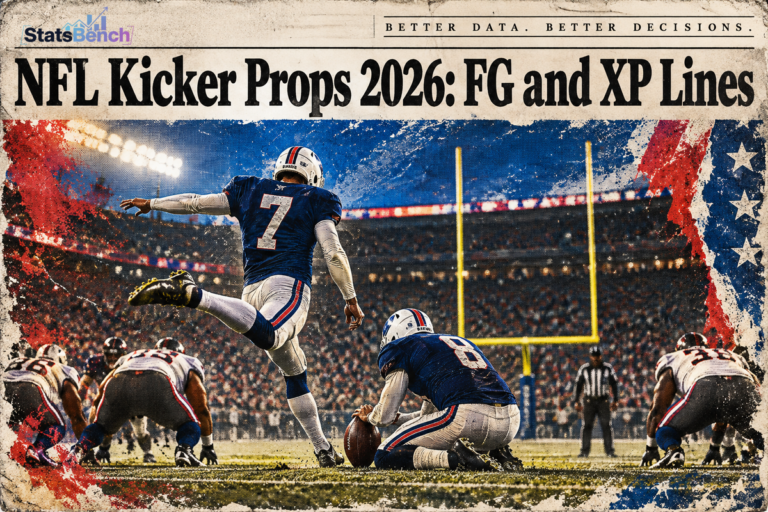
NFL Kicker Props 2026: How FG and XP Lines Work
NFL kicker props are bets on one kicker’s field goals, extra points, or total kicking points. They get a fraction of the attention that passing and receiving markets do. That’s the appeal: fewer eyes on the number, and a line that reacts to coaching decisions as much as to talent.
Here’s how the markets work, what actually moves the line, and where the math punishes lazy bets.
Which kicker markets can you bet?
Kicker markets come in a few shapes, and they behave nothing alike. The counting markets reward a team that stalls in range. The single-event markets reward one deep attempt and punish everything else.
| Market | What you need | Main risk |
|---|---|---|
| Field goals made (over/under) | A set number of made kicks | Coach goes for it on fourth down instead |
| Longest field goal | One make from a set distance or longer | Push rules, and one attempt deciding it |
| Extra points made | Team scores touchdowns and he converts | Two-point tries, blowouts, missed PATs |
| Total kicking points | Field goals (3 points) plus extra points (1) | Two dependent outcomes in one number |
| First field goal / FG in a half | Timing of the first made kick | Small samples and wide book margins |
Pick your market before you pick your kicker. An over on field goals made and an over on longest field goal are almost opposite bets on the same game.
Why NFL kicker props get mispriced
Three things push these lines away from fair value, and none of them are about the kicker’s leg.
- Attention goes to skill positions. Receiving and passing props absorb most of the money, so kicker lines move with less information behind them.
- Coaching decisions swing the ceiling. Fourth-and-2 from the edge of range is a go-for-it call for some staffs and a field goal for others. The kicker has no say in it.
- Small attempt counts hide real differences. Two kickers can share the same make rate over ten games while one has seen twice as many chances.
That last point is why a hit rate alone rarely settles a kicker bet. You need the volume behind it, plus a price that pays for the risk.
The four inputs that move a kicker line
1. Team total and red-zone finishing
Field goal attempts are born from drives that die in range. Team total tells you how often a team moves the ball. Red-zone efficiency tells you whether those drives end in six or three. A team that moves it well and finishes poorly is the ideal field goal over candidate.
2. Fourth-down aggressiveness
This is the input most bettors skip, and it’s the one that erases props. Some coaches kick from the opponent’s 40. Others punt or go for it. Look at the staff’s recent tendencies on fourth and short before you take a field goals over.
3. Venue, wind, and altitude
Dome kickers avoid the variable that kills outdoor legs. Wind matters more than temperature on long attempts, and altitude adds real distance. Check the forecast before you touch a longest field goal over, and check the roof status before you assume a clean number.
4. Kicker range and job security
Official kicking stats on NFL.com list attempts and makes, and game logs show the distances. A kicker with a short leash gets pulled after a bad week, and a kicker without deep range caps your longest field goal bet. The field goal rules are also worth a read if you’re new to yardage lines, since the spot of the kick changes everything.
How to read a longest field goal line
You’re betting on one made kick from a set distance or longer. It’s a single-event market, so the whole bet can be decided by one decision in the third quarter.
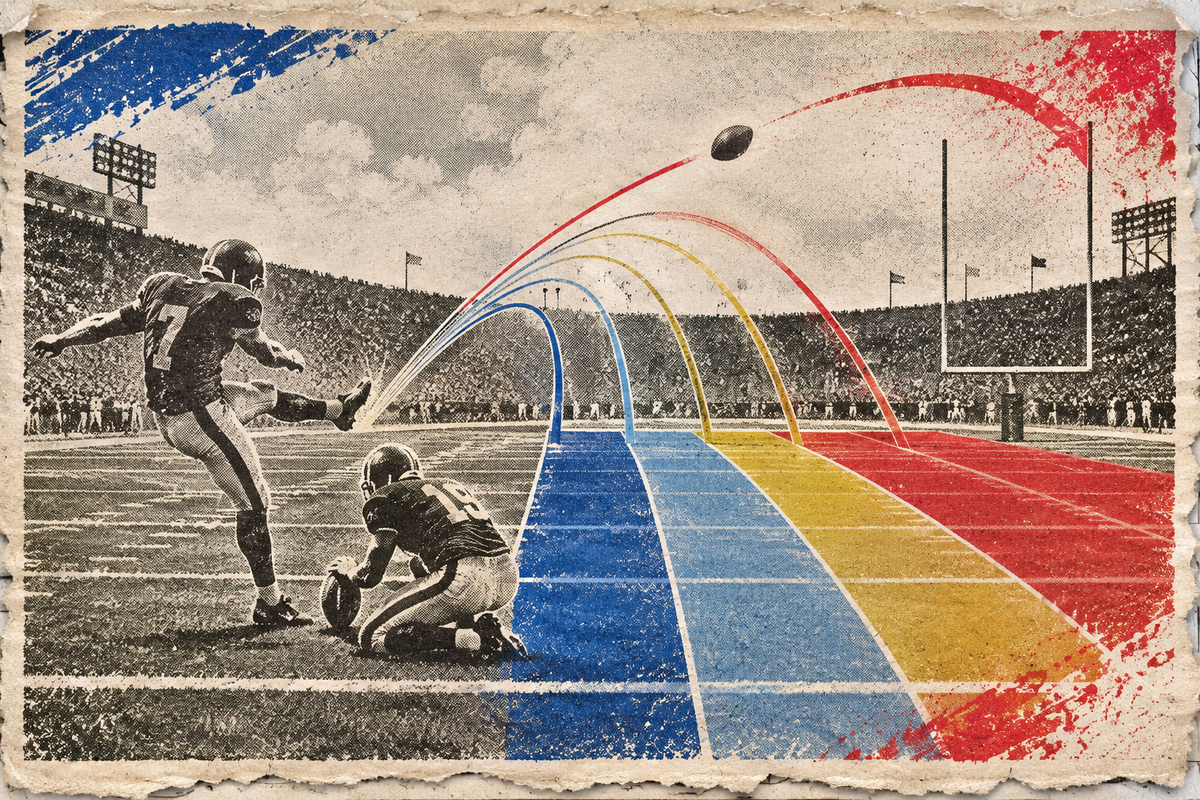
Read the house rule before you bet it. Books handle a kick that lands exactly on the number differently, and some push the bet while others call it a loss. That detail is worth more than any trend you’ll find on social media.
Two things make this market tricky. Long attempts come from trailing teams with nothing to lose, so game script drives your bet more than the kicker does. And a 50-plus yard attempt is a low-percentage event by nature, which means the over is usually priced accordingly. If you want the mechanics of a refund, our guide to what a push is in betting covers the rules and how they hit parlays.
What the board looked like on October 25, 2026
A dated example helps. In a StatsBench cheatsheet snapshot generated on October 25, 2026, Daniel Carlson (NO @ PIT) had his extra points line at 1.5, a 60% hit rate (6 of 10), an edge of 0.6%, and a best available price of -135 across the books StatsBench tracks.
That single row tells you a lot about this market. The hit rate is respectable. The edge is thin. And the price is a heavy favorite, so the room for error is small.
Most rows in that same snapshot sat at 6 of 10. Read that as a reminder, not a signal. A 60% hit rate only pays if the price is right, and a heavy favorite price barely leaves anything on the table.
Price shopping is where the edge lives
The same extra points bet at -135 and at -150 are not the same bet. Convert both to implied probability and the gap shows up immediately.
- -135 needs about 57.5% to break even.
- -150 needs 60%.
That three-cent difference is a couple of percentage points of required accuracy, on a prop where the real edge might be under 1%. Shopping the price isn’t a nice-to-have in kicker markets. It’s most of the strategy.

StatsBench shows the best price across 30+ sportsbooks, DFS apps and exchanges on every prop, plus the +EV % on the over and under. The free NFL props preview shows you how the board is laid out before you commit to a plan.
For the math, the implied probability calculator turns any price into a break-even rate, and the de-vig calculator strips the hold out of a two-way market. If you want the long version, we wrote a full post on how to remove the vig from betting odds.
Sample size will fool you
A kicker might get two or three attempts in a game. Ten games of field goal work is a few dozen events, which is not much to lean on. A 6 of 10 hit rate on extra points is not a trend. It’s a small sample landing one way.
So treat kicker props as a market where the situational read carries more weight than the rolling hit rate. Volume, game script, weather and coaching tendencies are the inputs. The make rate is a sanity check, not the thesis.
We go deeper on the counting problem in sample size in betting.
How to build a kicker bet you can defend
- Name the market and the exact line, including push rules.
- Write down the team total and what it implies for scoring chances.
- Check fourth-down tendencies for that staff.
- Look at the venue, roof and forecast.
- Confirm the kicker’s range from official logs.
- Compare the price across books before you bet.
If you can’t fill in all six, you don’t have a bet yet. You have a hunch with a team logo on it. The same discipline shows up in our NFL player props predictions process, which works fine on kickers too.
Keep it in proportion
Kicker props are a small market with thin edges, and thin edges lose often in the short run. That’s variance, not a broken read. Size these bets like the small plays they are, keep records, and don’t let one bad Sunday rewrite your process.
Bet within your means, treat it as entertainment, and remember it’s 21+ in the places where sports betting is legal. If betting stops being fun, the National Council on Problem Gambling helpline is 1-800-GAMBLER.
Free preview
See today’s NFL player props on StatsBench
Live lines, last-10 hit rates and the best price across 30+ books and pick’em apps. No account needed to look.
Open the NFL player props board →
Prefer email? Get the daily picks newsletter.
Frequently Asked Questions
What are NFL kicker props?
They’re player props on a kicker’s individual stats: field goals made, longest field goal, extra points made, and total kicking points. You’re betting on one player’s attempts and makes, not on the game result.
Is a longest field goal bet a push if the kick lands exactly on the number?
It depends on the book. Some houses push a kick that lands exactly on the line and others grade it as a loss, so read the house rule before you bet. It’s the single most important detail in that market.
Why are kicker props priced as heavy favorites?
Most lines are set below what a typical kicker produces, so the over gets a minus price. That also means the hold eats a bigger share of your expected value, which is why price shopping matters more here than in skill-position props.
Should I use hit rate or matchup data for kicker props?
Both, but in that order of weight: matchup first. Attempt volume, red-zone finishing, fourth-down tendencies and weather drive the number. Hit rates over ten games are a small sample and can mislead on their own.
Do kicker props work in parlays?
They can, but they’re correlated with the same game script as your other legs. Stacking a field goal over with a team total over in the same game doubles the same risk instead of diversifying it.
 Today's NBA picks


 Today's NFL picks

 Today's NHL picks



 Today's College Football picks

 Today's EPL picks



 Today's La Liga picks



 Today's Serie A picks



 Today's Bundesliga picks



 Today's Ligue 1 picks


 Today's EFL Championship picks



 Today's CS2 picks


 Today's LoL picks



 Today's Valorant picks
 Today's Dota 2 picks

 PHI
 DET
 BOS
 ATL
 TOR
 CLE
 NY
 WSH
 MIA
 CHA
 IND
 ORL
 BKN
 CHI
 MIL
 POR
 LAL
 HOU
 OKC
 SA
 MEM
 MIN
 GS
 DEN
 NO
 DAL
 PHX
 LAC
 UTAH
 SAC
 BUF
 DEN
 PIT
 JAX
 KC
 CIN
 NE
 CLE
 LV
 BAL
 HOU
 NYJ
 IND
 MIA
 TEN
 LAC
 SF
 MIN
 NYG
 CAR
 CHI
 DET
 GB
 SEA
 LAR
 TB
 ATL
 ARI
 DAL
 WSH
 NO
 PHI
 CAR
 BOS
 MTL
 OTT
 TB
 NJ
 FLA
 TOR
 BUF
 NYR
 DET
 WSH
 NYI
 CBJ
 PIT
 PHI
 EDM
 MIN
 VGK
 UTA
 DAL
 SEA
 COL
 NSH
 STL
 ANA
 CGY
 SJ
 WPG
 LA
 CHI
 VAN
 MIA
 UGA
 UTAH
 ND
 UCLA
 IU
 BYU
 UK
 ALA
 TEX
 OSU
 MISS
 TTU
 WAKE
 LSU
 TENN
 HOU
 USC
 MIZ
 BOIS
 IOWA
 UNM
 SC
 ARIZ
 FLA
 ARS
 MCI
 BHA
 CHE
 LIV
 BRE
 EVE
 BOU
 TOT
 AVL
 Hull City
 LEE
 NEW
 IPS
 FUL
 Coventry
 MUN
 CRY
 NFO
 SUN
 BAR
 ATM
 RMA
 BET
 RSO
 SEV
 ATH
 DEP
 VIL
 CEL
 ALA
 RAY
 GET
 ESY
 OSA
 RAC
 ELC
 LVT
 VAL
 MAL
 LAZ
 INT
 ROM
 COM
 MIL
 Frosinone
 JUV
 NAP
 BOL
 TOR
 GEN
 CAG
 ATA
 LEC
 PRM
 FIO
 SAS
 MON
 UDI
 VEN
 FCB
 BVB
 SCF
 RBL
 SVW
 B04
 SV Elversberg
 SGE
 M05
 FCA
 VFB
 TSG
 KOE
 SC Paderborn 07
 HSV
 FCU
 FC Schalke 04
 BMG
 PSG
 LOSC
 LYO
 PFC
 REN
 OM
 ASM
 NCE
 LEN
 B29
 LOR
 TOU
 STR
 AUX
 ANG
 Troyes
 Le Mans
 LEH