
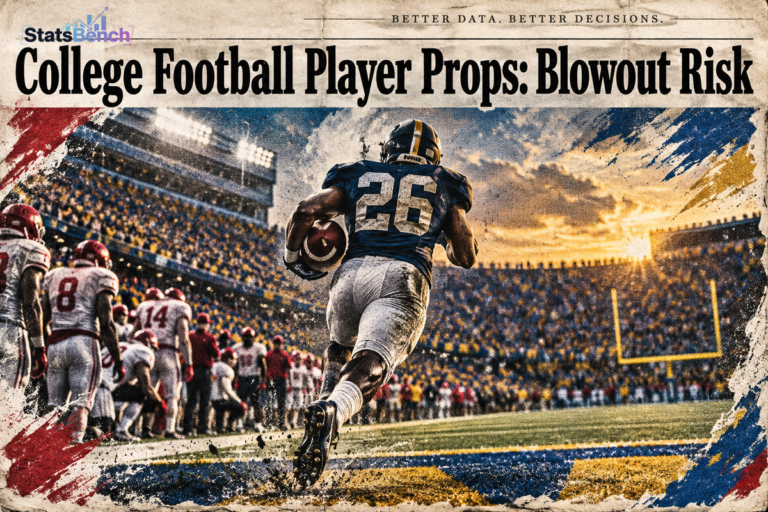
Most prop tickets in this sport don’t lose on a bad read. They lose on the sideline, when a 28-point lead turns a starting running back into a spectator for the fourth quarter. Blowout risk is the structural difference between betting college football player props and betting the NFL version of the same market.
Spreads run wider here, talent gaps are bigger, and coaches pull starters earlier. That means a stat line that looks safe on Tuesday can be dead by the third quarter on Saturday. Here’s how to price that risk before you click a number.
Why blowouts hit this sport harder than the pros
NFL coaches have a rough incentive to keep starters in: seeding, jobs, and a shorter season where every snap matters. College staffs answer to a different set of pressures, and those pressures don’t always point the same direction.
Some programs keep the offense rolling deep into the fourth quarter to impress a selection committee. Others empty the bench the moment a game is in hand, partly to protect players and partly to bank reps for next season. Both approaches are common. The spread doesn’t tell you which one you’re walking into.
Three structural factors make it worse:
- Wider spreads. A three-touchdown line is routine in this sport and rare in the pros, so the fourth quarter often features a completely different roster.
- Bigger talent gaps. When a blue-blood roster meets a smaller program, the favorite’s backups are often still better than the starters across from them. The box score stops describing the players you bet.
- Clock rules. College football keeps the game moving, which caps total possessions and shrinks the window a trailing team has to pile up comeback volume.
None of that is a reason to avoid the market. It’s a reason to research it differently than you would an NFL prop.
Which college football player props survive a blowout
There is no universal safe market. There’s a rough ordering, though, and it’s worth memorizing before you sort a board.
| Market | Blowout exposure | Why |
|---|---|---|
| Leading team QB passing yards | High | Starter often sits by the third quarter, then it’s handoffs |
| Leading team RB rushing yards | Medium to high | Carries dry up once the lead is comfortable and the backup takes over |
| Trailing team QB passing yards | Low to medium | Volume rises, but sacks and hurries rise with it |
| Trailing team WR receptions | Medium to low | Targets keep coming and coverage softens late |
| Kicker points | Mixed | Extra points pile up while field goal attempts disappear |
| Leading team edge rusher sacks | Medium | The opponent becomes one-dimensional, but the starter may be resting |
| Linebacker tackles | Medium | Snap counts fall in a rout, even on the winning side |
Read that as a starting point, not a rulebook. The real question is narrower: does the specific player you’re backing stay on the field?

Read the spread and the total before the prop line
The spread gives you the expected margin. The total gives you the expected points. Together they sketch how each offense will be asked to play.
You can split a total by hand. Take the game total, add the spread for the favorite, then halve it. A 54-point total with a 21-point spread implies roughly 37.5 to 16.5. That’s not a forecast. It’s a sanity check on the game script the market already expects.
If the favorite’s implied team total sits in the high 30s, the fourth quarter probably won’t feature the starting quarterback. If it’s a 45-point total with a three-point spread, both teams will throw for 60 minutes and blowout risk barely matters.
Pace belongs in the same check. Fast teams create more snaps for everyone, which raises every stat ceiling, including the ones whose players only see 45 minutes.
You can pull the whole board, with odds from multiple books side by side, on the free NCAAF props preview.
The depth chart is where these bets are won
Before you touch a college prop, find out who the backup is and how the staff uses him. That one piece of research changes more prop reads than any matchup split.
Ask three questions:
- How many carries or targets does the RB2 or WR3 get once the game is in hand?
- Does this coach pull starters at halftime, or ride the lead back into the fourth quarter?
- Is there a short-yardage or goal-line role that survives the rotation?
Depth charts and injury reports sit next to the prop board on Premium, which is the quickest way to answer the second-string question without opening three team sites. If a starter is a game-time decision, the backup’s line is often the better bet, and it’s usually priced lazily.
The same logic shows up in other sports. We wrote about the NBA version of this problem in spotting garbage time risk before you bet, and the reasoning carries over almost word for word.

Some markets actually gain from a lopsided game
Not every prop dies when the score gets ugly. A few get better, and they’re often the ones the market ignores.
- Trailing team receiver receptions. Losing teams throw. Coverage softens. The clock stops more often.
- Backup quarterback passing volume. Once the starter sits, the backup gets real snaps, and his line is frequently posted as an afterthought.
- Edge rusher sacks on the leading team. A team down three scores becomes one-dimensional, and obvious passing downs favor the pass rush.
Know which side of the blowout you’re on. A receiver on the team getting crushed can be a volume play. His counterpart on the winning side is usually a trap. Our guide to college football receiving yards props walks through how target share changes when the game script flips.
Injuries and roster churn rewrite the board overnight
College rosters move faster than pro ones. A quarterback who was questionable on Wednesday can be scratched on Saturday, and the ripple hits every skill-position line in the game. Receivers lose target share, backs see stacked boxes, and backups inherit roles nobody priced.
That’s why the injury report deserves a look before every CFB prop, not just the marquee names. Our walkthrough on how to read the NCAAF injury report covers how to separate a real absence from a decoy listing.
If you’re new to the market overall, start with the broader college football player props guide and come back here once the basics are second nature.
Price still matters more than any of this
Game script is the interesting part. Price is the part that decides whether you make money. Two books can post the same rushing line at different juice, and across a season that gap is the difference between a thin edge and none at all.
StatsBench shows the best available price across 30+ sportsbooks, DFS apps and exchanges on the same screen as the hit rate, so you can tell whether the number in front of you is the market’s best or just the first one you found. Sorting by SB Score and checking the posted projection takes another ten seconds and often explains why one book is hanging a different number.
If you want to turn a price into a break-even rate, the free implied probability calculator does the math instantly. Compare that break-even rate to the hit rate on the board, and you’ll know whether the bet is worth the risk.
All of it is research, not a promise. Props are long-run math with plenty of variance, and any single Saturday can punish a good process. Bet within your means, 21+ where legal, and call 1-800-GAMBLER if it stops being fun.
A five-minute checklist before you bet a CFB prop
- Check the spread and the total, then work out implied team totals.
- Decide whether your player is on the leading or trailing side.
- Look up the backup and the rotation pattern at his position.
- Confirm he’s healthy and active, not a game-time decision.
- Compare the price across books, then check hit rate and SB Score on the board.
That’s the whole edge, mostly. Nothing exotic. Just the boring question most bettors skip: will this guy still be on the field when the game is decided?
Free preview
See today’s college football player props on StatsBench
Live lines, last-10 hit rates and the best price across 30+ books and pick’em apps. No account needed to look.
Open the college football player props board →
Prefer email? Get the daily picks newsletter.
Frequently Asked Questions
What is blowout risk in college football props?
It’s the chance a game gets decided early, so starters get pulled and the player you bet doesn’t see enough snaps to reach his line. Wider spreads and bigger talent gaps make it more common in college than in the NFL.
Which college football player props hold up best in a blowout?
Markets that benefit from volume on the trailing side, like receiver receptions, plus pass-rush props against a one-dimensional offense. Leading-team passing and rushing lines are the most exposed because those starters are the first ones pulled.
Do starters play the fourth quarter in college blowouts?
It depends entirely on the staff. Some coaches keep starters in to impress the selection committee, while others empty the bench at halftime. That’s why the depth chart matters as much as the matchup.
How do I work out implied team totals from a spread and total?
Take the game total, add the spread for the favorite, then divide by two for the favorite’s implied total. Subtract that from the total to get the underdog’s number. It’s a quick sanity check on the game script, not a prediction.
Does StatsBench cover college football props?
Yes. The NCAAF props preview is free to browse, and Premium adds the Prop Finder, SB Score, projections, depth charts, injury reports and best price across 30+ sportsbooks, DFS apps and exchanges.
 Today's NBA picks
 Today's NFL picks
 Today's NHL picks



 Today's College Football picks

 Today's EPL picks



 Today's La Liga picks



 Today's Serie A picks



 Today's Bundesliga picks



 Today's Ligue 1 picks


 Today's EFL Championship picks


 Today's CS2 picks
 Today's LoL picks



 Today's Valorant picks
 Today's Dota 2 picks

 PHI
 DET
 BOS
 ATL
 TOR
 CLE
 NY
 WSH
 MIA
 CHA
 IND
 ORL
 BKN
 CHI
 MIL
 POR
 LAL
 HOU
 OKC
 SA
 MEM
 MIN
 GS
 DEN
 NO
 DAL
 PHX
 LAC
 UTAH
 SAC
 BUF
 DEN
 PIT
 JAX
 KC
 CIN
 NE
 CLE
 LV
 BAL
 HOU
 NYJ
 IND
 MIA
 TEN
 LAC
 SF
 MIN
 NYG
 CAR
 CHI
 DET
 GB
 SEA
 LAR
 TB
 ATL
 ARI
 DAL
 WSH
 NO
 PHI
 CAR
 BOS
 MTL
 OTT
 TB
 NJ
 FLA
 TOR
 BUF
 NYR
 DET
 WSH
 NYI
 CBJ
 PIT
 PHI
 EDM
 MIN
 VGK
 UTA
 DAL
 SEA
 COL
 NSH
 STL
 ANA
 CGY
 SJ
 WPG
 LA
 CHI
 VAN
 MIA
 UGA
 UTAH
 ND
 UCLA
 IU
 BYU
 UK
 ALA
 TEX
 OSU
 MISS
 TTU
 WAKE
 LSU
 TENN
 HOU
 USC
 MIZ
 BOIS
 IOWA
 UNM
 SC
 ARIZ
 FLA
 ARS
 MCI
 BHA
 CHE
 LIV
 BRE
 EVE
 BOU
 TOT
 AVL
 Hull City
 LEE
 NEW
 IPS
 FUL
 Coventry
 MUN
 CRY
 NFO
 SUN
 BAR
 ATM
 RMA
 BET
 RSO
 SEV
 ATH
 DEP
 VIL
 CEL
 ALA
 RAY
 GET
 ESY
 OSA
 RAC
 ELC
 LVT
 VAL
 MAL
 LAZ
 INT
 ROM
 COM
 MIL
 Frosinone
 JUV
 NAP
 BOL
 TOR
 GEN
 CAG
 ATA
 LEC
 PRM
 FIO
 SAS
 MON
 UDI
 VEN
 FCB
 BVB
 SCF
 RBL
 SVW
 B04
 SV Elversberg
 SGE
 M05
 FCA
 VFB
 TSG
 KOE
 SC Paderborn 07
 HSV
 FCU
 FC Schalke 04
 BMG
 PSG
 LOSC
 LYO
 PFC
 REN
 OM
 ASM
 NCE
 LEN
 B29
 LOR
 TOU
 STR
 AUX
 ANG
 Troyes
 Le Mans
 LEH