
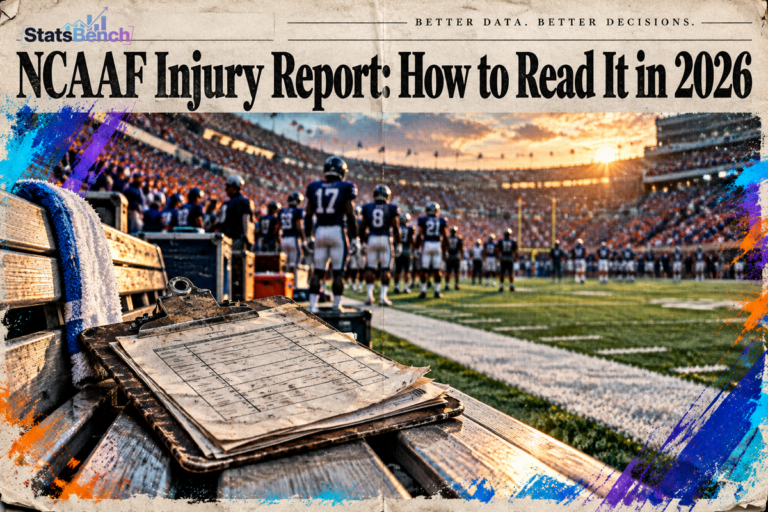
A college football injury report is the list of players who are out, doubtful, or questionable for a game, plus the guys behind them who suddenly matter. Read it properly and you spot a number that hasn’t moved yet. Read it lazily and you bet a “questionable” starter who takes 12 snaps and then watches from the sideline.
College football has no league-wide reporting system the way the NFL does. Availability rules come from conferences and schools, so timing varies and detail is uneven. That gap is the opening. Here’s the process, in order.
What does a college football injury report actually tell you?
It answers four questions, and only one of them is about the injured player.
- Who is out. A hard out is the cleanest signal on the page.
- Who is uncertain. Doubtful and questionable tags are where the value and the traps both live.
- Who is playing hurt. A starter listed as available but limited changes the playbook, not the lineup.
- Who replaces him. This is the part most bettors skip, and it’s the part that moves props.
What it doesn’t tell you: how many snaps a guy will take, whether he’s on a pitch count, or whether the coach is being straight with the media. Staffs have no duty to be precise, and plenty of them aren’t.
| Designation | What it usually means | How to treat it |
|---|---|---|
| Out | Not playing | Reprice the backup’s role right away |
| Doubtful | Very unlikely | Assume out until a beat writer says otherwise |
| Questionable | Genuinely undecided | Wait. Don’t take his over on Thursday |
| Probable / available | Expected to play | Check snap risk, not just the name |
Schools word these differently, and some conferences publish their own availability reports closer to kickoff. Treat the label as a starting point, never a verdict.
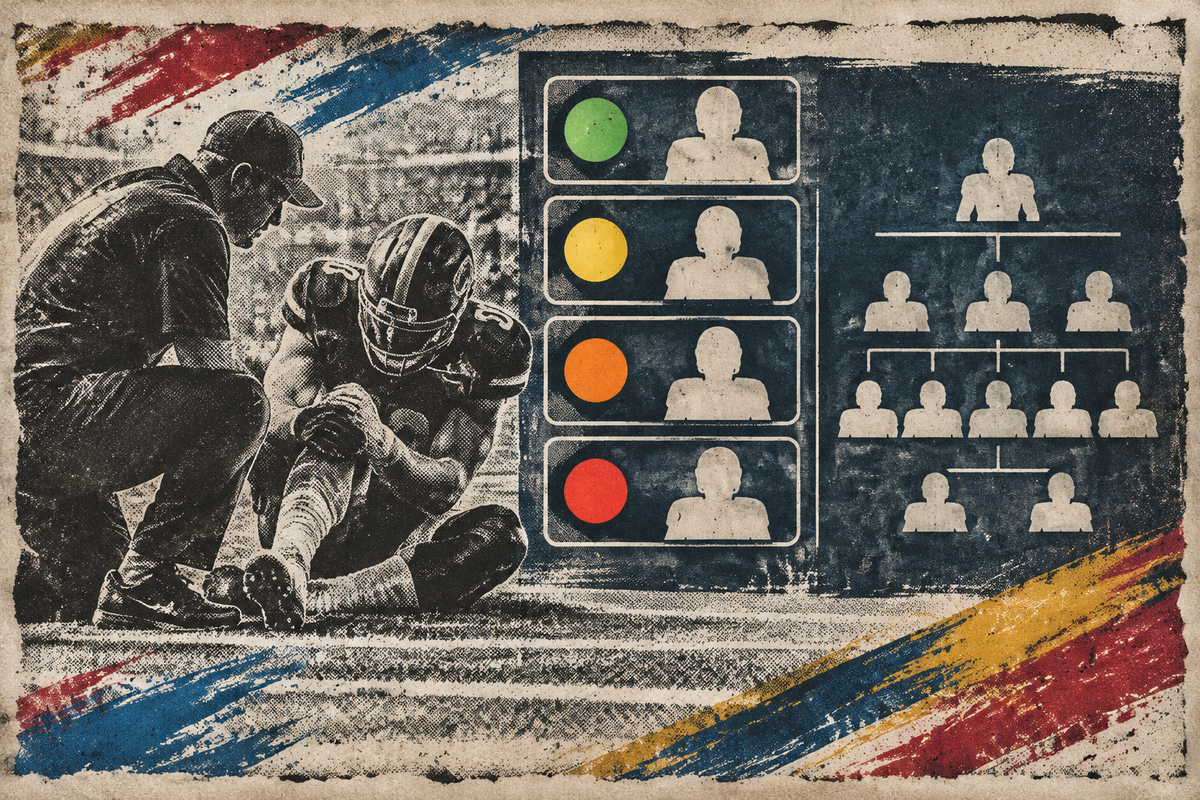
How do you read the NCAAF injury report?
Run the same checklist in the same order every week. The first three steps tell you whether the last two are worth your time.
1. Time-stamp the news
A report from Tuesday is a rumor by Saturday. Ask when it dropped, who reported it, and whether anything changed since. A questionable tag that hasn’t been updated in four days is background noise, not information.
2. Check the position before the name
Availability hits positions unevenly. Rough order of impact:
- Quarterback, obviously. The drop to a backup is usually the biggest on the roster.
- Left tackle and the interior line. Pressure rates and run blocking move together.
- Cornerback one, especially against a receiver who draws eight or more targets.
- Edge rusher, which changes how often a defense has to blitz.
- Running back, where a timeshare can absorb the loss quietly.
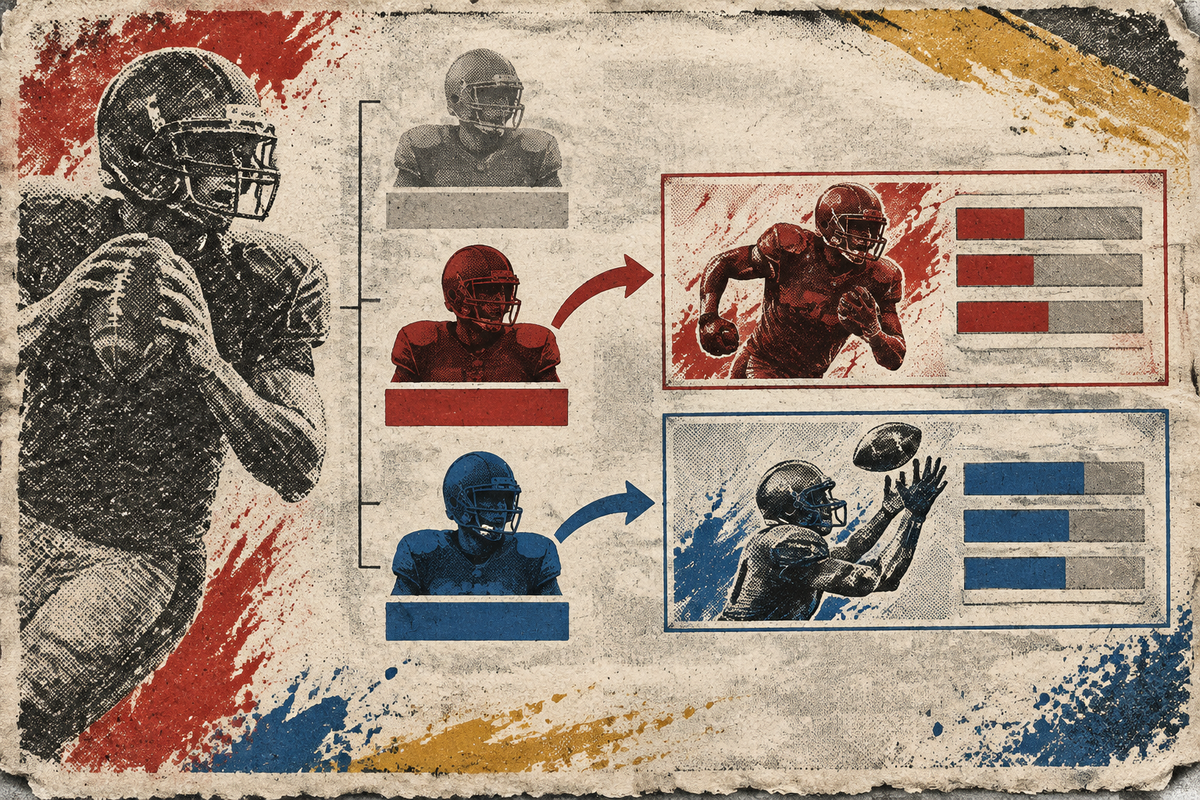
3. Find the replacement, not just the absence
Look at the depth chart and the last two games of the guy stepping in. If the backup has been getting a third of the snaps all year in a rotation, the starter’s absence changes less than the headline suggests. If the backup has barely played, the market tends to overreact to the name and underreact to the inexperience.
4. Check whether the line already moved
Before you build a case, check the price. If the number jumped three points the moment the news broke, you’re late. If it hasn’t moved at all, either the market doesn’t believe the report or you’re reading something stale. Converting the new price to a percentage with an implied probability calculator keeps you honest about what you’re actually getting.
5. Bet the role, not the reputation
A star at 70% health is not the same player as a healthy backup. Project touches, targets, and attempts for the role you expect, then compare that to the line. Reputation is already baked into the price.
Why the backup usually matters more than the starter
Markets are decent at pricing the guy who’s out. They’re slower on the second-order effects, and that’s where the room is.
- The guard who’s out hurts the run game, so the backup runner’s line is worse than it looks.
- A safety out changes the coverage shell, which can mean more quick throws and fewer deep shots.
- A receiver out can mean more targets for the slot, but also more double coverage on the WR1.
When you read a status report, write down the player who’s out, then write down the two guys whose jobs change. Those two are the ones to check against the board. The college football prop board shows which of them actually has a line posted. If the quarterback is the one missing, this guide to college football passing props covers how to reprice the receivers around him.
When should you ignore an injury report?
More often than you’d think. Skip it when:
- The player is a rotation piece under 20 snaps a game. His absence is noise.
- The designation is old and the local beat has moved on.
- The coach has a habit of listing half the roster as questionable.
- The line hasn’t budged on genuinely big news. That usually means the market knows something you don’t.
Injuries are one input, not the whole file. Opponent quality matters just as much, which is why strength of schedule belongs in the same weekly routine.
CFB ATS picks: how does an injury report change the number?
It moves the number two ways: the players who won’t be on the field, and the plays the team will call without them. The first is easy to price. The second is not.
A quarterback change can swing a spread by a couple of points on its own. A linebacker out typically moves it far less, even if he’s the best player on that defense. That asymmetry is the reason you check the position first.
The practical method: note the line before the news, note it after, and compare. The market’s own move is the best estimate you have of what the absence is worth, and it costs nothing. If the line moved and your number didn’t, your number is probably the wrong one.
Then layer in the matchup. A banged-up offensive line facing a front that generates pressure without blitzing is a much bigger problem than the same line facing a soft front that needs extra rushers.
Keep the sample honest, too. One game of backup tape tells you very little, and variance punishes small samples. None of this is a guarantee. It’s research. Bet within your means, 21+, and if it stops being fun, 1-800-GAMBLER is there.
Bowl game picks: why December availability is different
Bowl season breaks the normal read because availability stops being only about health. Opt-outs, transfer portal entries, and draft prep all show up as absences, and they get announced on a different schedule than injuries do.
Three things to check in December that you wouldn’t check in October:
- Who’s already gone. Skill players who declared for the draft or entered the portal usually don’t play.
- Who’s still deciding. A questionable tag in late December can mean a player is weighing risk, not nursing a sprain.
- Roster math. A player can appear in up to four games in a season and still take a redshirt, so a bowl can be the fifth appearance that burns a year. Sometimes a coach sits a healthy freshman for reasons that have nothing to do with the medical report.
That last point is the one most bettors miss. Check the participation log, not just the injury list.
What do NCAAF overtime rules have to do with snap counts?
Overtime gives both teams a possession starting at the opponent’s 25-yard line, and two-point tries come into play from the second overtime on. Those extra snaps inflate raw counts across the board, so when you check how much a banged-up player actually played, look at snap share instead of total snaps. The same logic applies to any game with an unusually high play count.
For official rule language and stats, the NCAA’s FBS football page is the primary source.
A five-minute pre-bet checklist
- Confirm the designation and the time it was posted.
- Rank the position: quarterback, line, corner, edge, running back.
- Name the replacement and check his recent usage.
- Compare the line before and after the news.
- List the two players whose roles change, then look up their lines.
That’s the whole job. It takes less time than a scroll through the timeline, and you can repeat it every week without starting over.
If you want the bigger picture, the NCAAF picks for today guide walks through how to build a full card from scratch, and this one slots in as the availability step.
Free preview
See today’s college football player props on StatsBench
Live lines, hit rates and the best price across 30+ books and pick’em apps. A free preview shows today’s first props; a free account shows more.
Prefer email? Get the daily picks newsletter.
Frequently Asked Questions
What does “questionable” mean on a college football injury report?
It means the team genuinely hasn’t decided whether the player will suit up. Unlike “out” or “doubtful,” it carries no real information on its own. Wait for warmups or a beat reporter’s update before you touch that player’s prop.
When are NCAAF injury reports released?
There is no national rule. Schools and conferences set their own schedules, and some publish availability reports within a day or two of kickoff while others only confirm statuses on game day. Always check the timestamp on whatever you’re reading.
How much does a starting quarterback being out move the spread?
More than any other position, often several points depending on the backup’s experience. The market usually adjusts fast, so the better edge is often in the surrounding props, like receiver targets or rushing volume, where the repricing lags.
Do college football overtime rules affect player props?
They add snaps, and extra snaps mean extra chances for a player to clear a line. Overtime possessions start at the opponent’s 25 and two-point tries are required from the second overtime on, so check snap share rather than raw snap counts when you evaluate usage.
Why do bowl game injury reports look different?
Because they mix in opt-outs, transfer portal departures, and draft prep alongside actual injuries. A player listed as questionable in December may simply be deciding whether to play at all, so check the participation log and roster news, not just the medical line.
 Today's NBA picks

 Today's NFL picks

 Today's NHL picks



 Today's College Football picks

 Today's EPL picks



 Today's La Liga picks


 Today's Serie A picks



 Today's Bundesliga picks



 Today's Ligue 1 picks



 Today's EFL Championship picks


 Today's CS2 picks

 Today's LoL picks



 Today's Valorant picks
 Today's Dota 2 picks


 PHI
 DET
 BOS
 ATL
 TOR
 CLE
 NY
 WSH
 MIA
 CHA
 IND
 ORL
 BKN
 CHI
 MIL
 POR
 LAL
 HOU
 OKC
 SA
 MEM
 MIN
 GS
 DEN
 NO
 DAL
 PHX
 LAC
 UTAH
 SAC
 BUF
 DEN
 PIT
 JAX
 KC
 CIN
 NE
 CLE
 LV
 BAL
 HOU
 NYJ
 IND
 MIA
 TEN
 LAC
 SF
 MIN
 NYG
 CAR
 CHI
 DET
 GB
 SEA
 LAR
 TB
 ATL
 ARI
 DAL
 WSH
 NO
 PHI
 CAR
 BOS
 MTL
 OTT
 TB
 NJ
 FLA
 TOR
 BUF
 NYR
 DET
 WSH
 NYI
 CBJ
 PIT
 PHI
 EDM
 MIN
 VGK
 UTA
 DAL
 SEA
 COL
 NSH
 STL
 ANA
 CGY
 SJ
 WPG
 LA
 CHI
 VAN
 MIA
 UGA
 UTAH
 ND
 UCLA
 IU
 BYU
 UK
 ALA
 TEX
 OSU
 MISS
 TTU
 WAKE
 LSU
 TENN
 HOU
 USC
 MIZ
 BOIS
 IOWA
 UNM
 SC
 ARIZ
 FLA
 ARS
 MCI
 BHA
 CHE
 LIV
 BRE
 EVE
 BOU
 TOT
 AVL
 Hull City
 LEE
 NEW
 IPS
 FUL
 Coventry
 MUN
 CRY
 NFO
 SUN
 BAR
 ATM
 RMA
 BET
 RSO
 SEV
 ATH
 DEP
 VIL
 CEL
 ALA
 RAY
 GET
 ESY
 OSA
 RAC
 ELC
 LVT
 VAL
 MAL
 LAZ
 INT
 ROM
 COM
 MIL
 Frosinone
 JUV
 NAP
 BOL
 TOR
 GEN
 CAG
 ATA
 LEC
 PRM
 FIO
 SAS
 MON
 UDI
 VEN
 FCB
 BVB
 SCF
 RBL
 SVW
 B04
 SV Elversberg
 SGE
 M05
 FCA
 VFB
 TSG
 KOE
 SC Paderborn 07
 HSV
 FCU
 FC Schalke 04
 BMG
 PSG
 LOSC
 LYO
 PFC
 REN
 OM
 ASM
 NCE
 LEN
 B29
 LOR
 TOU
 STR
 AUX
 ANG
 Troyes
 Le Mans
 LEH