

Draw no bet vs double chance is the decision you hit the moment you fancy a side but can’t face losing to a 0-0. Both markets let you back a team while softening the draw. They do it in different ways, and the gap between their prices is bigger than most people expect.
Here’s the short answer. Draw no bet returns your stake if the match ends level. Double chance counts the draw as a win and pays you at a shorter price. That’s the difference in two sentences. The rest of this piece is about which one leaves you better off.
What Each Market Actually Does
Both are football (soccer) markets, though the same logic applies anywhere a draw is a possible full-time result. Bookmakers label them differently, and the labels hide a fairly simple structure.
Draw no bet: stake back on the draw
You back a team. If they win, you get paid at the DNB price. If the game ends level, the bet is void and your stake comes back. If they lose, you lose. That’s it. Some books call it tie no bet or draw no bet, and the meaning is identical.
Worth knowing early: draw no bet is the same bet as level ball, or Asian handicap 0. Two names, one market. If you can read an Asian line, you can already read DNB.
Double chance: the draw counts as a win
Double chance wraps two of the three outcomes into one price. Back 1X and you win if the home side wins or draws. Back X2 and you win if the away side wins or draws. Back 12 and you win if either team wins, which is really a bet against the draw.
Because you’re covering two results, the price is short. A 2.00 (+100) home side becomes roughly 1.26 (-385) on the 1X. You’re paying for the draw branch, whether you want it or not.
Draw No Bet vs Double Chance: The Practical Difference
The clearest way to see it is a payout table. The prices below are a worked illustration, not a real match: home win 2.00 (+100), draw 3.40 (+240), away win 3.60 (+260).
| Result | Home win 2.00 (+100) | Draw no bet 1.48 (-208) | Double chance 1X 1.26 (-385) |
|---|---|---|---|
| Home win | Win | Win | Win |
| Draw | Lose | Stake returned | Win |
| Away win | Lose | Lose | Lose |
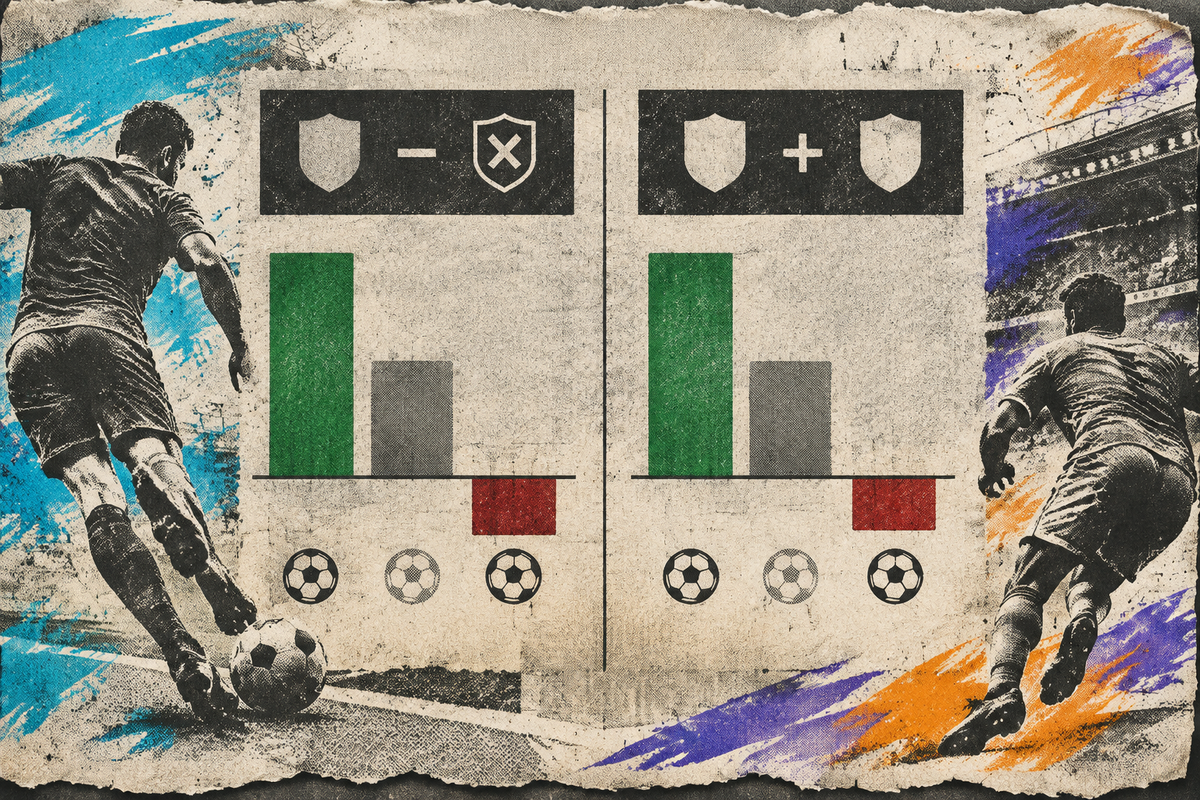
A worked example on a 10 unit stake
Put 10 units on the draw no bet at 1.48 (-208). If the home side wins you collect 14.80, a profit of 4.80. If it ends level you get your 10 back and nothing more.
Now put the same 10 units on the 1X double chance at 1.26 (-385). You collect 12.60 whether the home side wins or draws. Profit is 2.60 either way.
So the double chance buys you 2.60 on the draw branch and gives up 2.20 on the win branch. Whether that trade is good depends entirely on how often you think the draw lands. Backing a side you expect to win comfortably means paying for cover you didn’t need. In a tight game between two cautious teams, that cover is cheap.
The price link worth memorising
There’s a rough conversion between the two. Fair draw no bet is about the win price divided by the double chance price. Here that’s 2.00 ÷ 1.26 = 1.59. Books post a touch shorter than fair because both prices carry margin, which is why the DNB above sits at 1.48.
Run that sum on your book’s own numbers before you bet. If their DNB is well below win price ÷ DC price, the double chance is the better buy on relative value. If the DNB sits close to that number or above it, take the DNB. Treat it as a quick smell test rather than gospel, because the margin muddies it.
When the Stake Comes Back
A void leg feels harmless in a single bet. It gets messier in an accumulator. Bookmakers handle a pushed leg in different ways: some recalculate the bet on the remaining selections at the reduced odds, others void the whole thing. Check the rules before you build, because the difference changes your return.
There’s a mental trap too. A stake returned is not a win. Across a season of DNB bets, the draws you got out of are the reason the price sits shorter than the win price. The book has already charged you for that protection.
Which Market Fits Your Read?
Neither market is better in the abstract. They suit different reads of the same match.
- Backing a short favourite. A double chance on a 1.30 (-333) shot barely adds anything to your bankroll. The DNB keeps a price worth taking.
- A tight, low-scoring game. If the draw is a genuine co-outcome in your read, double chance covers the result you fear most.
- You actually expect a stalemate. Then neither. Both markets are built for people backing a winner. If your read is 0-0, the draw price is the bet.
- An accumulator leg. A 1X at 1.26 hardly moves the acca price. A DNB at 1.48 does more work, with the draw turning the leg into a push.
The mistake most people make
They reach for double chance because it sounds safer, then take 1.26 on a match they’ve capped at 65% for the home side. Safer isn’t the same as better value. Once you’ve paid for the draw branch, you need the draw to land often enough to justify the price you gave up, or the protection was just a cost.
Ask yourself what you’d pay for that cover. Then check whether the market is charging more or less than your number.
The Asian Handicap Shortcut
If you already bet Asian lines, you don’t need these markets at all. Draw no bet is Asian handicap 0. Double chance 1X is the home side at +0.5. Same bets, different labels, and the handicap version is often priced with a tighter margin. The Asian handicap explainer on Wikipedia is a decent primer if the terminology is new to you.
That gives you a third place to shop. Compare the DNB price, the 1X price, and the equivalent handicap price, then take the best of the three. One caution: the handicap version settles on the same results but follows that book’s handicap terms, including how a push is treated.
How to Price Both Before You Bet

Prices are probabilities in disguise, and the conversion takes seconds. Every decimal price turns into an implied chance by dividing 1 by the price. From the example above:
- Home 2.00 → 50.0%
- Draw 3.40 → 29.4%
- Away 3.60 → 27.8%
Add those up and you get 107.2%. The extra 7.2% is the book’s margin. Strip it out and the fair prices land near 2.14 for the home win, 3.64 for the draw and 3.86 for the away win. That puts fair DNB at about 1.59 and fair 1X at about 1.35.
Those two numbers are your benchmark. Anything above them is a better price than fair; anything below is the book charging extra for the same risk. The implied probability calculator handles the division, and the devig calculator strips the margin so the two markets can be compared on equal terms.
Fitting These Markets Into a Football Research Routine
Result markets need the same groundwork as any prop bet: who’s likely to score, how the game projects to be played, and what the price says about all of it. Football is low-scoring, so the draw is never a small outcome. In a tight match it can be the most likely single result, which is exactly why books charge for covering it.
A game projected for few goals pushes you toward draw cover. A game with two open sides pushes you toward the straight win, where DNB keeps more of the payout. Official team data from Premier League is the cleanest starting point for scoring and conceding, and our over 2.5 goals predictions plus both teams to score predictions pages give you a fast read on which kind of match you’re looking at. If you want the scoreline view, correct score predictions shows where the draw sits in the distribution. The football predictions page covers win chances across the day’s fixtures.
StatsBench’s own coverage is built on player props, and those numbers feed a result read just as well. The Serie A prop board is a good example: the player-level detail that tells you whether a side creates enough to break a game open, or whether it grinds toward a draw.
A closing note on method. These markets trade price for protection, and the book always charges for the protection. Bet only where it’s legal, at the legal age where you live, and with money you can afford to lose. Variance doesn’t care how good your read was.
Free account
See today’s football player props on StatsBench
Live lines, last-10 hit rates and the best price across 30+ books and pick’em apps. A free account opens the board.
Open the football player props board →
Prefer email? Get the daily picks newsletter.
Frequently Asked Questions
Is draw no bet the same as double chance?
No. Draw no bet pays you if your team wins and returns your stake if the game is drawn. Double chance counts the draw as a win too, which is why its price is much shorter. Draw no bet is identical to Asian handicap 0, while double chance 1X matches the home side at +0.5 on the handicap.
Does draw no bet pay out on a 0-0?
It doesn’t pay a profit. The bet is void and your stake comes back. That refund is what you’re giving up price for, and it’s why a DNB sits shorter than the plain win price.
Which is better value, draw no bet or double chance?
Check the book’s own numbers rather than the label. Fair draw no bet is roughly the win price divided by the double chance price. If the posted DNB sits well below that figure, the double chance is the better buy, and if it sits at or above it, the DNB is. Both prices carry margin, so strip the vig before you trust the comparison.
Can you use draw no bet and double chance in any sport?
Only where a draw is possible at full time. That mainly means football, plus 1X2 markets in a few other sports. In games that always produce a winner, such as most basketball and tennis markets, these two bets simply don’t exist.
What happens to a draw no bet in an accumulator?
It depends on the bookmaker. Some recalculate the acca on the remaining legs at reduced odds, while others void the whole bet. Check the terms before you build, because a push can change your return noticeably.
 Today's NBA picks


 Today's NFL picks



 Today's NHL picks


 Today's College Football picks


 Today's EPL picks



 Today's La Liga picks



 Today's Serie A picks



 Today's Bundesliga picks



 Today's Ligue 1 picks



 Today's MLS picks



 Today's EFL Championship picks



 Today's CS2 picks



 Today's LoL picks



 Today's Valorant picks
 Today's Dota 2 picks


 PHI
 DET
 BOS
 ATL
 TOR
 CLE
 NY
 WSH
 CHA
 MIA
 IND
 ORL
 BKN
 CHI
 MIL
 POR
 LAL
 HOU
 OKC
 SA
 MEM
 GS
 MIN
 DEN
 NO
 DAL
 PHX
 LAC
 UTAH
 SAC
 BUF
 DEN
 JAX
 PIT
 KC
 CIN
 NE
 CLE
 LV
 BAL
 HOU
 NYJ
 IND
 MIA
 TEN
 LAC
 SF
 MIN
 NYG
 CAR
 CHI
 DET
 GB
 SEA
 LAR
 TB
 ATL
 ARI
 DAL
 WSH
 NO
 PHI
 CAR
 BOS
 MTL
 TB
 NJ
 OTT
 FLA
 NYR
 TOR
 BUF
 DET
 WSH
 NYI
 CBJ
 PIT
 PHI
 MIN
 EDM
 VGK
 UTA
 DAL
 COL
 SEA
 NSH
 ANA
 STL
 CGY
 WPG
 SJ
 LA
 CHI
 VAN
 MIA
 UGA
 UTAH
 ND
 UCLA
 IU
 BYU
 UK
 ALA
 TEX
 OSU
 MISS
 TTU
 WAKE
 LSU
 TENN
 HOU
 USC
 MIZ
 BOIS
 IOWA
 UNM
 SC
 ARIZ
 FLA
 ARS
 MCI
 BHA
 CHE
 LIV
 BRE
 EVE
 BOU
 TOT
 AVL
 Hull City
 LEE
 NEW
 IPS
 FUL
 Coventry
 MUN
 CRY
 NFO
 SUN
 BAR
 ATM
 RMA
 BET
 RSO
 SEV
 ATH
 DEP
 VIL
 CEL
 ALA
 RAY
 GET
 ESY
 OSA
 RAC
 ELC
 LVT
 VAL
 MAL
 LAZ
 INT
 ROM
 COM
 MIL
 Frosinone
 JUV
 NAP
 BOL
 TOR
 GEN
 CAG
 ATA
 LEC
 PRM
 FIO
 SAS
 MON
 UDI
 VEN
 FCB
 BVB
 SCF
 RBL
 SVW
 B04
 SV Elversberg
 SGE
 M05
 FCA
 VFB
 TSG
 KOE
 SC Paderborn 07
 HSV
 FCU
 FC Schalke 04
 BMG
 PSG
 LOSC
 LYO
 PFC
 REN
 OM
 ASM
 NCE
 LEN
 B29
 LOR
 TOU
 STR
 AUX
 ANG
 Troyes
 Le Mans
 LEH