
Most CS2 bettors check the wrong number first. They pull up a player’s rating, see something in the 1.1s, and take an over. The line doesn’t care about rating. It cares about how many kills that player gets on the map being played, against the team in front of them.
That’s the whole job of CS2 player stats for betting: turning a career stat line into a per-map expectation you can compare to a posted number. Get the translation right and the prop becomes a math problem. Get it wrong and you’re paying vig for a vibe.
Which CS2 player stats actually matter?
Six numbers do most of the work. Everything else is decoration.
- Kills per map. Not per series. A player with 30 kills across two maps is a 15-kill-per-map player, not a 30-kill player.
- Headshot share. Headshot props settle on headshots only. A player at 14 kills per map with a 55% headshot rate expects roughly 7 to 8 headshots, not 14.
- Rounds played. Kills scale with rounds. A 13-11 map gives both teams more chances than a 13-4 blowout.
- ADR (average damage per round). The best leading indicator of kill volume. High ADR with low kills usually means a player is doing damage without finishing.
- Opening kills. First bloods extend rounds, and longer rounds mean more kill chances. A low opening-kill share caps a player’s ceiling.
- Map pool. The same pro can average 16 kills on Mirage and 11 on Ancient. No map, no bet.
Utility damage, flash assists, KAST and trade percentage explain why kill totals move. They rarely tell you where the line should sit. CS2 (still searched as CS:GO by plenty of people) has a decade of public match data, so the temptation is to use all of it. Don’t. Use the six numbers above and ignore the noise.
Why “per map” beats “per series” for CS2 props
Every CS2 row in the StatsBench cheatsheet snapshot from October 30, 2026 is a map-level market: map 1 kills, map 1 headshots. Not series totals. That’s not a coincidence. A map 1 line settles on one known map, so the sample you’re comparing against actually applies. A series total depends on the veto and on whether the match ends 2-0 or 2-1.
Series props are messier for a simple reason. A sweep gives you two maps of data. A decider gives you three. You can’t know which before the veto, so you’re pricing an unknown number of rounds.
Here’s the arithmetic that matters. Kills per round times rounds. A player at 0.70 kills per round expects about 17 kills in a 24-round map and about 14 in a 20-round map. Same player. Two very different lines. If a book posts 15.5, knowing the pace is the whole edge.
How to read a CS2 player prop in four steps

This is the workflow that replaces gut feel. It takes about three minutes per player.
- Get the map. Check the veto or the posted map for map 1 lines. Without it, stop and move on.
- Convert to per-map. Use kills per map from the last 10 to 20 maps. If a cheatsheet says 60% hit, find out whether that’s 6 of 10 maps or 6 of 10 series. They are not the same sample.
- Adjust for pace and opponent. Slow, utility-heavy teams play fewer rounds. A top-five opponent suppresses entries and opening kills. Both push a kill line down.
- Price it. Convert the odds to implied probability and compare that to your own estimate. If your number is 55% and the price implies 52%, you have a bet. If the price implies 58%, you don’t.
Step four is where most people quit early. The implied probability calculator does the conversion in one click. If you want the market’s fair number instead of the juiced one, run both sides through the de-vig calculator first.
A real read: the October 30, 2026 CS2 slate
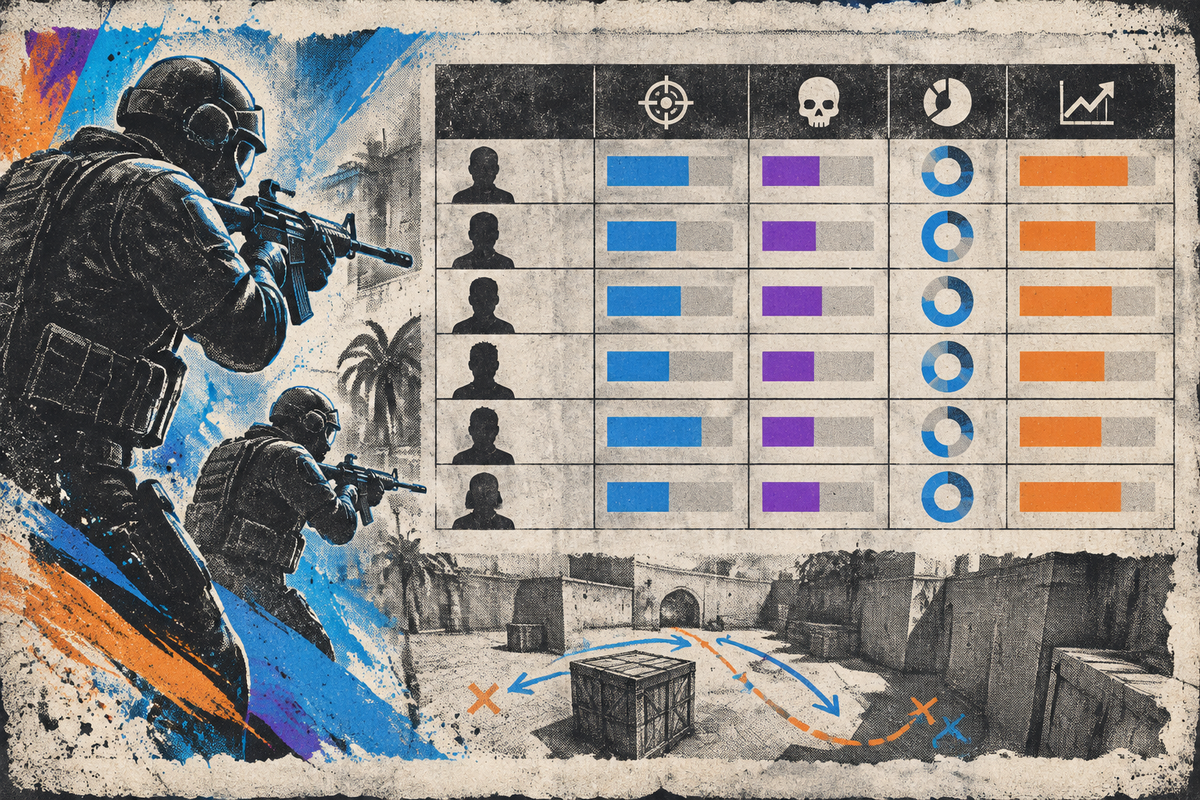
Here’s a dated snapshot from the StatsBench CS2 cheatsheet, generated the morning of October 30, 2026. Hit rate is the last-10 sample on that exact line. Price is the best available across the sportsbooks, DFS apps and exchanges StatsBench tracks.
| Player | Match | Market | Line | Last-10 hit rate | Best price |
|---|---|---|---|---|---|
| Spinx | MOUZ vs FURIA | Map 1 kills | 14.5 | 6/10 (60%) | -128 |
| PR | MOUZ vs FURIA | Map 1 kills | 13.5 | 6/10 (60%) | -133 |
| xelex | MOUZ vs FURIA | Map 1 headshots | 9.5 | 6/10 (60%) | -114 |
| molodoy | FURIA at MOUZ | Map 1 headshots | 5.5 | 6/10 (60%) | -125 |
| khaN | Nemiga vs Vitality | Map 1 kills | 13.5 | 6/10 (60%) | -118 |
| SYPH0 | Nemiga vs Vitality | Map 1 headshots | 7.5 | 6/10 (60%) | -109 |
Prices are American odds, so -128 means you risk $128 to win $100.
Start with the price spread, not the hit rate. Spinx needs 15 kills at -128. PR needs 14 at -133. That’s a one-kill difference in the line for five cents of price, on the same team, on the same map, in the same match. The market is telling you something about their roles and about how the two players are likely to be used.
Then look at the headshot rows. molodoy’s line is 5.5. SYPH0’s is 7.5. Headshot lines sit low, so a single lucky spray can flip the result in either direction. Low lines are not automatically safer. They’re higher variance relative to the number, which is a different thing.
One more thing about this table: every row is 6 of 10. That’s what a cheatsheet surfaces, lines where recent form sits close to a coin flip. Read it as a list of questions worth asking, not as a slate of 60% winners.
How much should a 6-of-10 hit rate move you?
Less than you think, and more than nothing. Ten maps is a small sample. A player who truly wins 50% of the time will go 6 of 10 pretty often. So will a player who truly wins 65%. The hit rate narrows your range. It doesn’t hand you a probability.
Three fixes. Look at 20 or 30 maps when you can. Weight recent maps more heavily, since roster changes and role swaps reset the baseline. And check who the last 10 came against. A run of maps versus tier-two opposition doesn’t transfer to a map against Vitality.
If you want the statistics version of that argument, the sample size guide walks through how many observations a hit rate needs before it means anything.
Which CS2 stats lie to you?
Three of them, mostly.
- HLTV rating. Great for comparing players across a tournament, bad for projecting a single map. It blends impact, survival and KAST into one number, and no prop settles on it.
- K/D ratio. Inflates on winning teams and in soft groups. A gaudy ratio against weak opposition says little about a map against an elite side.
- Highlight clips. The AWP ace gets remembered. The 11-kill map does not.
For the long version of why rating is a summary stat and not a forecast, the HLTV rating explainer covers it. For raw match data and demos, HLTV.org is still the reference point, and Liquipedia’s Counter-Strike wiki is the fastest place to check a roster change or a team’s map pool.
Do pick’em apps price CS2 the same as sportsbooks?
Not always, and that’s the point of shopping. PrizePicks and Underdog set their own CS2 lines. They don’t have to match FanDuel or DraftKings, and sometimes they’re a full kill off in either direction.
StatsBench lists those pick’em apps next to the sportsbooks and exchanges in the same odds feed, so one CS2 line can be checked across 30+ sources without opening six tabs. That’s the boring part of betting, and it’s usually where the value hides.
Where to find CS2 player stats for betting
Two free starting points, neither of which needs an account.
- The CS2 prop board shows hit rates and game logs on the current board.
- The Pistol Lab shows both teams’ pistol-round rates, which shape early map control and how many rounds a map actually runs.
On the blog, the CS2 player props breakdown covers market types, and the kills per map piece gives you the baseline for what a normal number looks like. Read that one before you argue with a line.
What’s the honest bottom line?
CS2 player stats are good at telling you what a player usually does. They’re bad at telling you what happens in one map. That gap is the game: build a per-map expectation, compare it to the price, and accept that a good read loses plenty of individual bets.
Bet small relative to your bankroll, keep a record, and treat a 6-of-10 hit rate as a question to investigate rather than an answer. It’s 21+ only, it should stay fun, and 1-800-GAMBLER is there if it stops being fun.
Free preview
See today’s CS2 player props on StatsBench
Live lines, hit rates and the best price across 30+ books and pick’em apps. A free preview shows today’s first props; a free account shows more.
Prefer email? Get the daily picks newsletter.
Frequently Asked Questions
Which CS2 stats matter most for player props?
Kills per map, headshot share, rounds played, ADR and opening-kill rate. Map pool ties them together. Rating and K/D ratio are summary stats that blend contexts a single prop line doesn’t care about.
Are map 1 kill props better than series totals?
Usually yes, because map 1 settles on one known map, so the sample you compare against actually applies. Series totals depend on the veto and on whether the match ends in a sweep or a decider.
How many maps make a reliable sample?
Aim for 20 to 30 maps when the data exists. Ten maps is a starting point, not proof, because both a 50% player and a 65% player will go 6 of 10 fairly often.
Do PrizePicks and Underdog CS2 lines differ from sportsbook prices?
They can, since the pick’em apps set their own numbers. That’s why price shopping matters: the same kill line is often available at different odds depending on the source.
What hit rate do you need to break even on a CS2 prop?
At -110 you need to win about 52.4% of the time to break even, and more at shorter prices. A 6-of-10 recent sample doesn’t prove you have that, so convert the odds to implied probability and compare it to your own estimate.
 Today's NBA picks



 Today's NFL picks

 Today's NHL picks


 Today's College Football picks

 Today's EPL picks



 Today's La Liga picks


 Today's Serie A picks



 Today's Bundesliga picks



 Today's Ligue 1 picks


 Today's EFL Championship picks



 Today's CS2 picks
 Today's LoL picks



 Today's Valorant picks
 Today's Dota 2 picks


 PHI
 DET
 BOS
 ATL
 TOR
 CLE
 NY
 WSH
 MIA
 CHA
 IND
 ORL
 BKN
 CHI
 MIL
 POR
 LAL
 HOU
 OKC
 SA
 MEM
 MIN
 GS
 DEN
 NO
 DAL
 PHX
 LAC
 UTAH
 SAC
 BUF
 DEN
 PIT
 JAX
 KC
 CIN
 NE
 CLE
 LV
 BAL
 HOU
 NYJ
 IND
 MIA
 TEN
 LAC
 SF
 MIN
 NYG
 CAR
 CHI
 DET
 GB
 SEA
 LAR
 TB
 ATL
 ARI
 DAL
 WSH
 NO
 PHI
 CAR
 BOS
 MTL
 OTT
 TB
 NJ
 FLA
 TOR
 BUF
 NYR
 DET
 WSH
 NYI
 CBJ
 PIT
 PHI
 EDM
 MIN
 VGK
 UTA
 DAL
 SEA
 COL
 NSH
 STL
 ANA
 CGY
 SJ
 WPG
 LA
 CHI
 VAN
 MIA
 UGA
 UTAH
 ND
 UCLA
 IU
 BYU
 UK
 ALA
 TEX
 OSU
 MISS
 TTU
 WAKE
 LSU
 TENN
 HOU
 USC
 MIZ
 BOIS
 IOWA
 UNM
 SC
 ARIZ
 FLA
 ARS
 MCI
 BHA
 CHE
 LIV
 BRE
 EVE
 BOU
 TOT
 AVL
 Hull City
 LEE
 NEW
 IPS
 FUL
 Coventry
 MUN
 CRY
 NFO
 SUN
 BAR
 ATM
 RMA
 BET
 RSO
 SEV
 ATH
 DEP
 VIL
 CEL
 ALA
 RAY
 GET
 ESY
 OSA
 RAC
 ELC
 LVT
 VAL
 MAL
 LAZ
 INT
 ROM
 COM
 MIL
 Frosinone
 JUV
 NAP
 BOL
 TOR
 GEN
 CAG
 ATA
 LEC
 PRM
 FIO
 SAS
 MON
 UDI
 VEN
 FCB
 BVB
 SCF
 RBL
 SVW
 B04
 SV Elversberg
 SGE
 M05
 FCA
 VFB
 TSG
 KOE
 SC Paderborn 07
 HSV
 FCU
 FC Schalke 04
 BMG
 PSG
 LOSC
 LYO
 PFC
 REN
 OM
 ASM
 NCE
 LEN
 B29
 LOR
 TOU
 STR
 AUX
 ANG
 Troyes
 Le Mans
 LEH