
NFL receiving yards props look simple: one receiver, one line, over or under. The work isn’t in picking a player you like. It’s in checking his role, the matchup, and the price you’re paid. Do those three things and you’re making a bet. Skip them and you’re making a guess.
What is an NFL receiving yards prop?
It’s an over/under on how many receiving yards one player records in a single game. Books post lines for anyone with a real role: outside receivers, slot guys, tight ends and pass-catching backs. The number moves through the week as news and money arrive.
Two features make these props worth studying. One player can flip the number with a single catch, so a 25 yard grab in the fourth quarter turns an under into a loss. And the line is usually built from recent box scores, which is where role changes get missed: a teammate ruled out, a new quarterback, a cornerback who travels with the WR1.
The live board sits on the NFL prop board, with hit rates and the best price across books on the same row.
Same hit rate, opposite value: a real example
Here’s a dated snapshot from StatsBench, pulled from an October 2026 Dallas at Philadelphia slate. Every row below shows the same 60% hit rate over the last 10 games. Look at how far apart the value runs.
| Prop | Line | Hit rate (last 10) | StatsBench +EV % | Best price |
|---|---|---|---|---|
| Ryan Flournoy receiving yards | 33.5 | 60% (6/10) | +14% | -111 |
| Ryan Flournoy longest reception | 15.5 | 60% (6/10) | +7% | -113 |
| Dak Prescott passing yards | 269.5 | 60% (6/10) | -14.1% | -110 |
| Dak Prescott passing attempts | 36.5 | 60% (6/10) | -0.3% | -107 |
| Dak Prescott longest rush | 6.5 | 60% (6/10) | -0.2% | -113 |
Flournoy’s 33.5 receiving yards line carried a +14% +EV mark with the best price at -111. Prescott’s 269.5 passing yards line showed -14.1%, meaning the price looked worse than fair by that estimate. Same game, same hit-rate column, very different bets.
The hit-rate column alone can’t separate these props. A hit rate tells you how often something happened. It says nothing about whether the number in front of you is any good.
State the caveat plainly: those +EV figures are long-run estimates against the market price. They aren’t predictions, and they don’t make a single bet safe.
Read the hit rate first, then check the sample
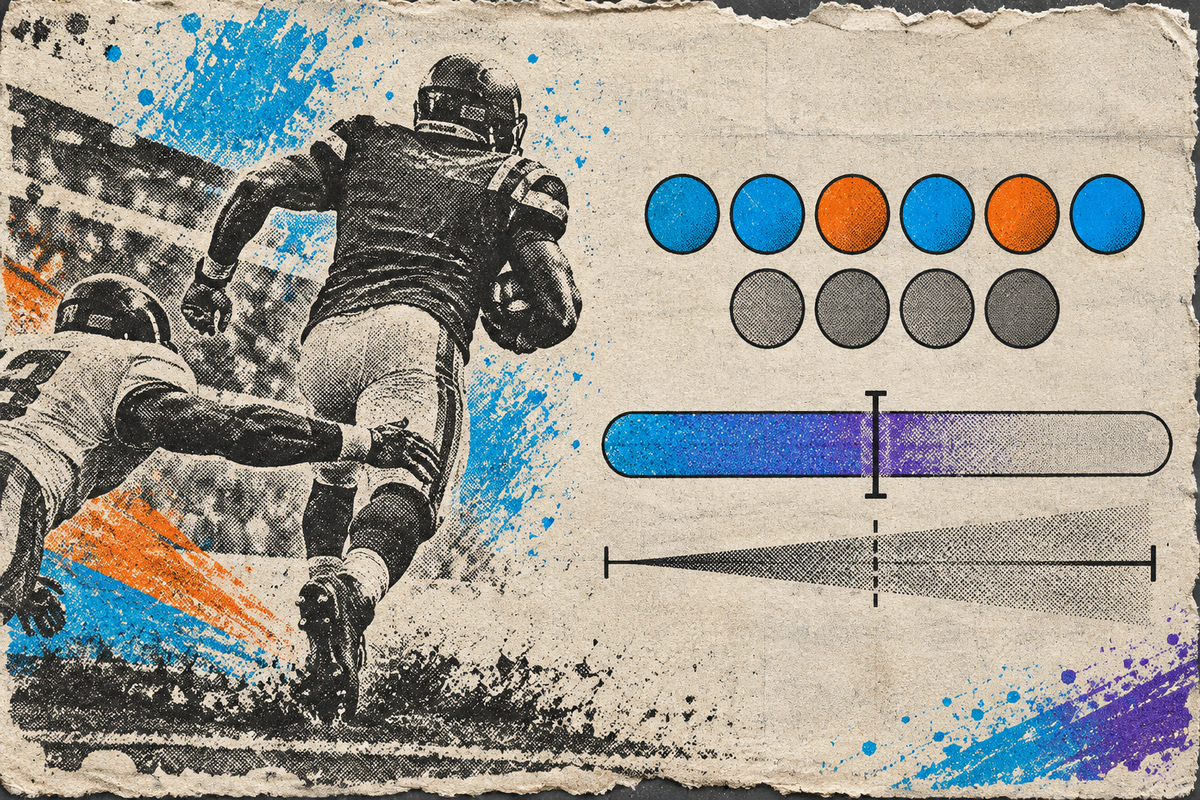
Hit rate is the fastest filter you have. It answers one narrow question: how often has this player cleared this line? StatsBench attaches the sample, like 6 of the last 10, so you can weigh it properly.
Ten games is thin. At a true coin-flip rate, 6/10 happens constantly. Treat it as a hint, not proof.
Then convert the price to a break-even rate. At -111 you need about 52.6% to break even. At -130 you need 56.5%. Run it through the implied probability calculator and a 60% hit rate reads very differently at those two prices: comfortable at the short number, thin at the long one.
The matchup matters more than last week’s box score
Receiving yards come from targets, and targets come from opportunity. A receiver who ran 40 routes last week is a different bet than one who ran 18, even if the yard totals looked similar.
- Coverage: a corner who shadows the WR1 follows him across the formation and takes away the free releases.
- Scheme: zone-heavy defenses give up catches underneath but squeeze the deep ball.
- Game script: a team protecting a big lead throws less in the second half, which tilts the under.
- Quarterback: pressure rate and accuracy decide whether the targets are even catchable.
- Role: snap share, route participation, depth charts and injury reports. A healthy teammate back from injury can erase the volume that built the line.
That check takes ten minutes. It decides most of the edge.
Price is half the bet
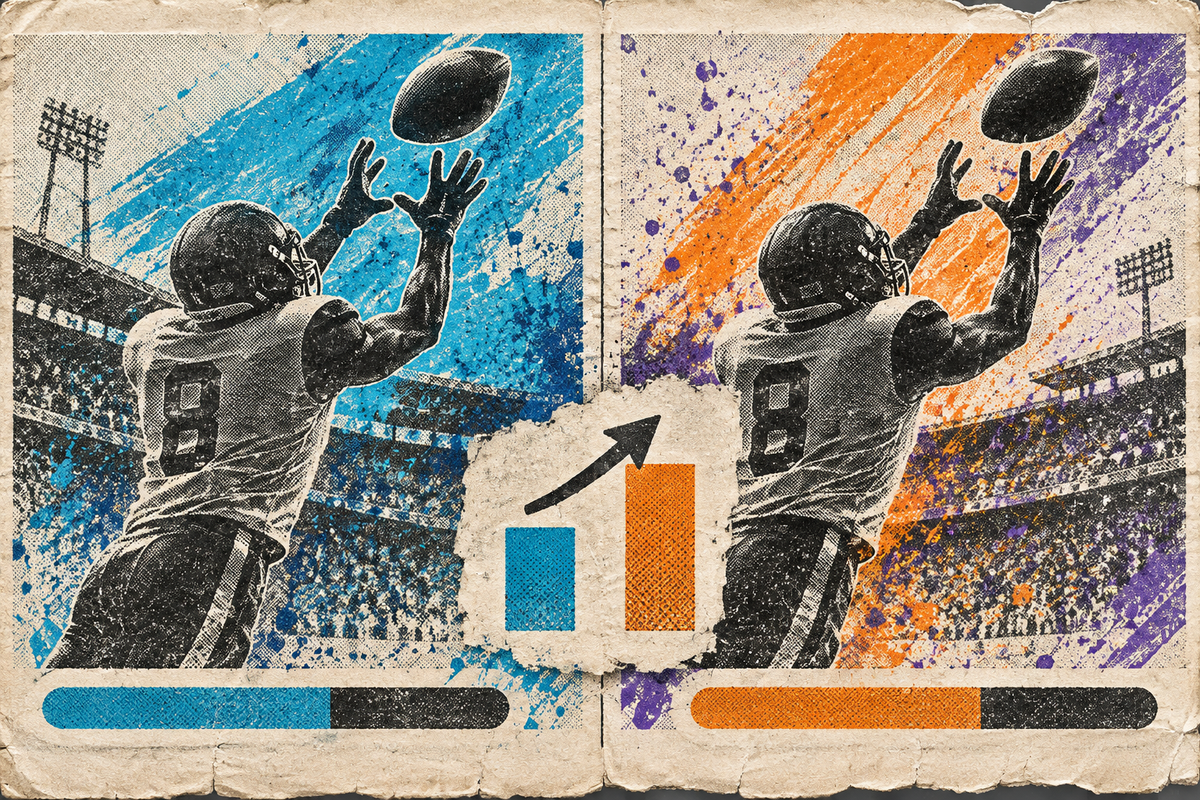
Two books can hang the same 33.5 line at -111 and -130. That gap is money you collect without predicting anything.
- -111 pays $90.09 on a $100 bet.
- -130 pays $76.92 on the same $100.
Thirteen dollars on one bet. Across a season of them, the gap gets bigger than most of the edges people chase, and it’s the one thing you can fix in thirty seconds.
StatsBench shows the best available price across 30+ sportsbooks, DFS apps and exchanges right next to the hit rate. If one book posts American odds and another posts decimal, the odds converter squares them up before you compare.
Does a positive +EV number mean the bet wins?
No. A +EV % is an estimate of the gap between the price and a fair price, and it plays out over a large number of bets, not one. A +14% prop can lose on Sunday and still have been the right bet. That’s variance, and it’s why bankroll rules matter more than any single prop.
If you’d rather size stakes by edge than by feel, the Kelly criterion calculator runs the math. Most bettors are still better off with flat stakes and a hard cap on any one game.
Do tight end and running back receiving props work the same way?
Structurally, yes. The same three questions apply: role, matchup, price. The difference is where the yards come from.
Tight end lines are usually shorter and depend on red-zone usage and middle-of-field targets, which are more matchup-sensitive than raw speed. Running back receiving lines lean on game script and check-down volume, so a back catching five passes in a blowout loss can look nothing like the same back in a close game. Check how the player actually gets his yards before you trust a hit rate built on a different kind of game.
A five minute checklist before you bet a receiving yards over
- Confirm the role. Snap share and route count over the last three games.
- Find the corner. Who covered him the last time these teams met?
- Read the hit rate next to its sample size, not on its own.
- Convert the price into a break-even percentage.
- Shop the number across books, DFS apps and exchanges.
- Check the game total. A low total caps passing volume on both sides.
How do you find receiving yards props worth researching?
You can’t read every matchup on a full slate, so filter first and dig second.
StatsBench’s Prop Finder sorts through 10,000+ daily props in season by market, player, team and line, and can order them by Best EV. Daily Standouts narrows the slate to the strongest overs and unders against the market. Both are research shortcuts, not a bet slip. The free preview shows you the format before you commit to anything.
Then take the two or three props that survive and run the matchup checks above. That’s a better hour than scrolling a picks feed.
Receiving yards or longest reception?
They’re different bets. Receiving yards is a total, so volume drives it. Longest reception is a single play, so one deep ball settles it even if the receiver is quiet for three quarters.
In that same Dallas at Philadelphia snapshot, Flournoy’s longest reception line at 15.5 showed +7% at -113, against +14% on the 33.5 receiving yards line. Same player, same game, different risk. Single-play markets swing harder in both directions, which is worth knowing before you combine them with anything else.
Last thing: none of this removes variance. A good process still loses bets. Bet within your means, keep it fun, 21+ only, and if it stops being fun, the National Problem Gambling Helpline is 1-800-GAMBLER.
Free preview
See today’s NFL player props on StatsBench
Live lines, hit rates and the best price across 30+ books and pick’em apps. A free preview shows today’s first props; a free account shows more.
Open the NFL player props board →
Prefer email? Get the daily picks newsletter.
Frequently Asked Questions
What is a good hit rate for a receiving yards prop?
There’s no single number, because it depends on the price. At -111 you need about 52.6% to break even, and at -130 you need about 56.5%. A 60% hit rate is a real margin at the short price and a thin one at the long price, so always pair the rate with the odds and the sample size.
Should I bet receiving yards over or under?
Neither side is inherently better. The edge comes from the line versus the player’s role, the matchup and the price. Sometimes the value sits on an under because a receiver’s volume was inflated by one big game or a teammate is returning.
What does +EV mean on a receiving yards prop?
It’s an estimate of the gap between the posted price and a fair price. It plays out over many bets, not one, so a positive number is a long-run signal rather than a prediction that the prop cashes.
How do I compare receiving yards prop prices?
Put the same line side by side across books, DFS apps and exchanges. A 20 cent difference on a $100 bet is roughly $13 in payout, which is often bigger than the edge you were chasing.
 Today's NBA picks



 Today's NFL picks


 Today's NHL picks


 Today's College Football picks


 Today's EPL picks



 Today's La Liga picks



 Today's Serie A picks



 Today's Bundesliga picks



 Today's Ligue 1 picks



 Today's EFL Championship picks



 Today's CS2 picks



 Today's LoL picks



 Today's Valorant picks
 Today's Dota 2 picks


 PHI
 DET
 BOS
 ATL
 TOR
 CLE
 NY
 WSH
 MIA
 CHA
 IND
 ORL
 BKN
 CHI
 MIL
 POR
 LAL
 HOU
 OKC
 SA
 MEM
 MIN
 GS
 DEN
 NO
 DAL
 PHX
 LAC
 UTAH
 SAC
 BUF
 DEN
 PIT
 JAX
 KC
 CIN
 NE
 CLE
 LV
 BAL
 HOU
 NYJ
 IND
 MIA
 TEN
 LAC
 SF
 MIN
 NYG
 CAR
 CHI
 DET
 GB
 SEA
 LAR
 TB
 ATL
 ARI
 DAL
 WSH
 NO
 PHI
 CAR
 BOS
 MTL
 OTT
 TB
 NJ
 FLA
 TOR
 BUF
 NYR
 DET
 WSH
 NYI
 CBJ
 PIT
 PHI
 EDM
 MIN
 VGK
 UTA
 DAL
 SEA
 COL
 NSH
 STL
 ANA
 CGY
 SJ
 WPG
 LA
 CHI
 VAN
 MIA
 UGA
 UTAH
 ND
 UCLA
 IU
 BYU
 UK
 ALA
 TEX
 OSU
 MISS
 TTU
 WAKE
 LSU
 TENN
 HOU
 USC
 MIZ
 BOIS
 IOWA
 UNM
 SC
 ARIZ
 FLA
 ARS
 MCI
 BHA
 CHE
 LIV
 BRE
 EVE
 BOU
 TOT
 AVL
 Hull City
 LEE
 NEW
 IPS
 FUL
 Coventry
 MUN
 CRY
 NFO
 SUN
 BAR
 ATM
 RMA
 BET
 RSO
 SEV
 ATH
 DEP
 VIL
 CEL
 ALA
 RAY
 GET
 ESY
 OSA
 RAC
 ELC
 LVT
 VAL
 MAL
 LAZ
 INT
 ROM
 COM
 MIL
 Frosinone
 JUV
 NAP
 BOL
 TOR
 GEN
 CAG
 ATA
 LEC
 PRM
 FIO
 SAS
 MON
 UDI
 VEN
 FCB
 BVB
 SCF
 RBL
 SVW
 B04
 SV Elversberg
 SGE
 M05
 FCA
 VFB
 TSG
 KOE
 SC Paderborn 07
 HSV
 FCU
 FC Schalke 04
 BMG
 PSG
 LOSC
 LYO
 PFC
 REN
 OM
 ASM
 NCE
 LEN
 B29
 LOR
 TOU
 STR
 AUX
 ANG
 Troyes
 Le Mans
 LEH