

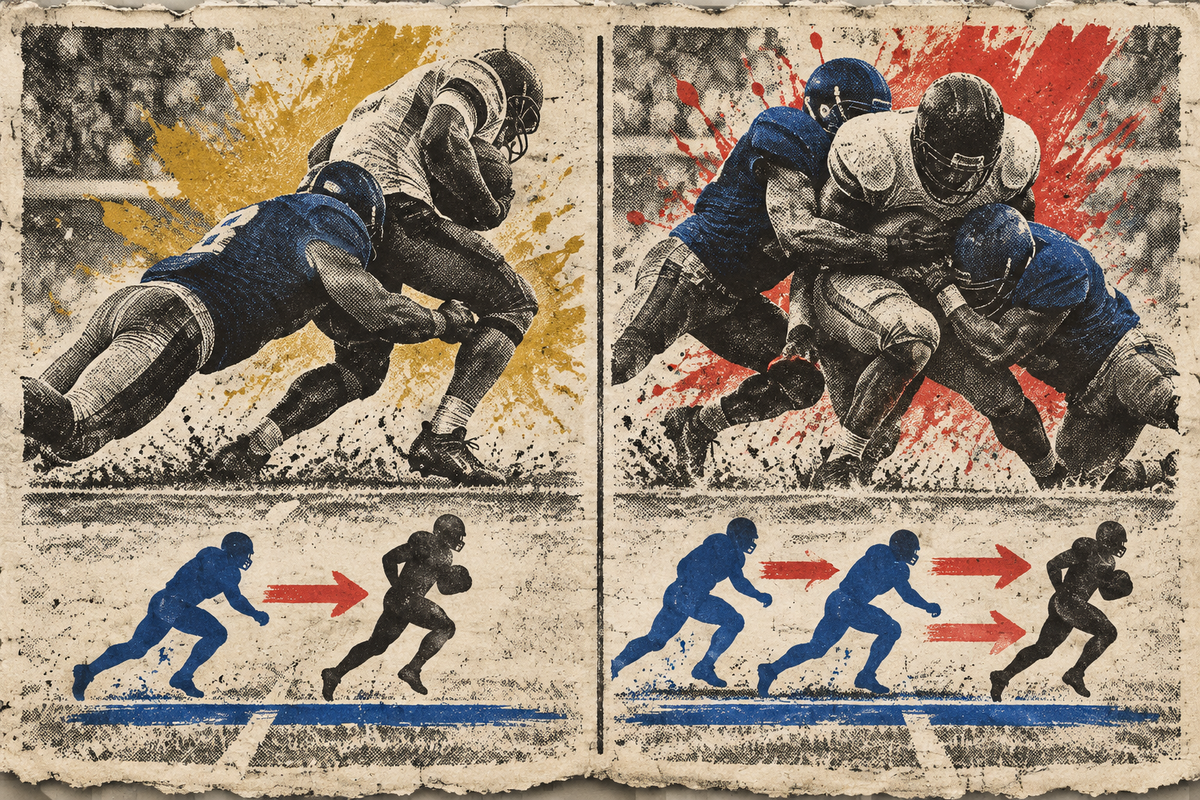
A solo tackle is credited to one defender who makes the stop alone. A total tackle adds assists to the same play, so the combined line always sits higher than the solo line for the same player. That gap is why solo tackles vs total tackles deserves its own breakdown. They are two separate bets with two different math problems.
What counts as a solo tackle?
A solo tackle is one defender, one stop, no help credited. If a second defender arrives at the same time, the official scorer can log a solo for the first man and an assist for the helper. The combined tackle number on the box score adds both.
Books treat each of those as its own market. Some post solo tackles. Some post assisted tackles. Most post a combined total. All of them grade off the official NFL gamebook, which you can check on NFL.com’s official player stats.
Here’s the wrinkle most bettors ignore. Stat crews review film after the game and issue corrections, usually midweek. A stop can flip from solo to assist, or vanish entirely. Your book settles on the final official number, not the one you saw on the broadcast graphic. The definition of a tackle is simple. The bookkeeping is not.
Solo tackles vs total tackles: how the lines differ
Pull up a defensive prop board and the solo line for a player is typically two to three stops lower than his combined line. That’s not a pricing error. It’s the assist tax.
Take three Saints defenders from a StatsBench snapshot of an October 2026 Saints at Steelers slate:
| Player | Market | Line | Hit rate (last 10) | StatsBench edge | Best price |
|---|---|---|---|---|---|
| Jonas Sanker | Total tackles | 4.5 | 60% (6/10) | 0.7% | -140 |
| Kool-Aid McKinstry | Total tackles | 3.5 | 60% (6/10) | 0.5% | -115 |
| Justin Reid | Solo tackles | 2.5 | 60% (6/10) | 0.1% | -160 |
Look at what the market did. Sanker’s combined line is 4.5 at -140. Reid’s solo line is 2.5 at -160. Nearly two full tackles lower on the number, yet priced as more likely to cash. The book knows solo stops are the cleaner stat, so it charges you for the clarity.
All three players carried the same 6-of-10 hit rate in that snapshot. The edges came out at 0.7%, 0.5% and 0.1%. Same recent form, three different prices. That spread is the entire reason you research these markets instead of guessing.
Why assists make combined tackle props noisier
Assists are a judgment call. Who got there first, who finished the play, who was in on the pile. Two stat crews can watch the same snap and score it differently, and a road game can quietly change a linebacker’s weekly floor.
That cuts both ways for a combined tackle bet:
- More volume. A player who is around the ball gets credit for help, so combined totals climb.
- More noise. The extra half-stop or full stop per game is not something you can forecast from snap counts.
- More variance on the number. A 4.5 combined line can be decided by one assist that a scorer could reasonably have logged differently.
Solo tackles strip that out. You’re betting on the defender making the play himself, which is more repeatable week to week. You pay for that in juice and in a lower line that leaves less cushion.
How do you know if the price is right?
Hit rate alone tells you very little. A 60% hit rate sounds solid until you notice it comes from a 10-game sample, which is small enough that two or three flips change the whole picture. Then compare that rate to the price.
At -160, the market implies roughly a 61.5% chance. At -140, it’s about 58.3%. So a 6-of-10 player at -160 is being asked to beat his own recent rate. Run the conversion yourself with the free implied probability calculator before you take a side.
This is also where a hit rate and a real edge part ways. Our breakdown of hit rate vs edge goes deeper, but the short version is this: a defender can clear 60% of his lines and still be a losing bet at the wrong number.
How to research a tackle prop in five minutes
Defensive props are not skill-position props with a highlight reel attached. The process is boring and it works:</p
- Check the snap share. A safety playing 95% of defensive snaps sees far more tackle chances than a rotational lineman. Depth charts and injury reports matter more here than anywhere else.
- Find where the tackles come from. Run-stuffing linebackers and box safeties pile up stops. Coverage corners can go weeks without a clean tackle opportunity.
- Look at the opponent’s play mix. A run-heavy offense creates more tackle volume for the front seven and less for the secondary.
- Note the venue and the stat crew. Home and road splits on tackle props are real, and assist tendencies are not identical stadium to stadium.
- Shop the number and the price. A half tackle and 20 cents of juice are worth more than most bettors think.
StatsBench pulls odds from 30+ sportsbooks, DFS apps and exchanges, so you can see the best available price on the same prop in one place. The free NFL prop board is an easy way to see what a board looks like, and Premium’s Prop Finder lets you filter the day’s props and sort by best EV.
If you want the general market covered first, our NFL tackles props guide walks through the combined market from scratch. For the game-level view of the matchup used in the example above, the Saints-Steelers props breakdown covers the full board.
Common mistakes on defensive tackle props
Most of the money lost on these markets comes from four habits:
- Treating solo and combined as the same bet. You cannot compare a 2.5 solo line to a 4.5 combined line and call one of them a bargain. Different stat, different probability.
- Ignoring stat corrections. If your book grades on official stats, a midweek correction can settle a prop you already counted as a win.
- Overreading a 10-game sample. Small samples look like trends. They’re mostly noise.
- Betting the name, not the role. A safety with a new defensive coordinator can lose five tackle chances a game and nobody posts about it.
One more thing worth saying plainly. Tackle props are thin-margin bets with real variance, and even a good process loses plenty of weeks. Bet within your means, 21+, and treat it as research and entertainment rather than income. If it stops being fun, 1-800-GAMBLER is there.
The short version
Solo tackles are one defender making the stop. Total tackles add assists, which is why the combined line runs higher. The solo market gives you a cleaner stat at a worse price. The combined market gives you more volume and more scorer-dependent noise.
Neither is better in a vacuum. Pick the market, price it against a real probability estimate, shop across books, and keep your sample honest. That’s the whole edge.
Free preview
See today’s NFL player props on StatsBench
Live lines, hit rates and the best price across 30+ books and pick’em apps. A free preview shows today’s first props; a free account shows more.
Open the NFL player props board →
Prefer email? Get the daily picks newsletter.
Frequently Asked Questions
Is a solo tackle the same as a tackle?
Not exactly. A solo tackle is credited to one defender who makes the stop alone, while a combined tackle total also includes assists. That’s why books post solo tackles, assisted tackles and total tackles as separate markets with separate lines.
Why is the solo tackles line lower than the total tackles line?
Because assists inflate the combined number. A defender who makes four solo stops might finish with five or six combined tackles once helpers are counted. The solo line sits lower to reflect that, and it usually carries more juice because it’s the cleaner stat.
Can a stat correction change my tackle prop result?
Yes. Official scorers review film after games and issue corrections, often midweek, and a stop can flip between solo and assist. Books settle on the final official stat per their house rules, so check those rules before you bet.
What’s a good hit rate for tackle props?
There’s no fixed number. It depends on the line and the price, so convert the odds to implied probability and compare. A 60% hit rate over 10 games is a small sample, and at -160 the market already expects roughly 61.5%.
Are defensive props worth betting at all?
They can be, if you research role, snap share and opponent play mix instead of chasing names. The margins are thin and the variance is real, so they reward discipline and punish guesswork.
 Today's NBA picks



 Today's NFL picks

 Today's NHL picks


 Today's College Football picks

 Today's EPL picks



 Today's La Liga picks



 Today's Serie A picks



 Today's Bundesliga picks



 Today's Ligue 1 picks



 Today's EFL Championship picks



 Today's CS2 picks

 Today's LoL picks



 Today's Valorant picks
 Today's Dota 2 picks


 PHI
 DET
 BOS
 ATL
 TOR
 CLE
 NY
 WSH
 MIA
 CHA
 IND
 ORL
 BKN
 CHI
 MIL
 POR
 LAL
 HOU
 OKC
 SA
 MEM
 MIN
 GS
 DEN
 NO
 DAL
 PHX
 LAC
 UTAH
 SAC
 BUF
 DEN
 PIT
 JAX
 KC
 CIN
 NE
 CLE
 LV
 BAL
 HOU
 NYJ
 IND
 MIA
 TEN
 LAC
 SF
 MIN
 NYG
 CAR
 CHI
 DET
 GB
 SEA
 LAR
 TB
 ATL
 ARI
 DAL
 WSH
 NO
 PHI
 CAR
 BOS
 MTL
 OTT
 TB
 NJ
 FLA
 TOR
 BUF
 NYR
 DET
 WSH
 NYI
 CBJ
 PIT
 PHI
 EDM
 MIN
 VGK
 UTA
 DAL
 SEA
 COL
 NSH
 STL
 ANA
 CGY
 SJ
 WPG
 LA
 CHI
 VAN
 MIA
 UGA
 UTAH
 ND
 UCLA
 IU
 BYU
 UK
 ALA
 TEX
 OSU
 MISS
 TTU
 WAKE
 LSU
 TENN
 HOU
 USC
 MIZ
 BOIS
 IOWA
 UNM
 SC
 ARIZ
 FLA
 ARS
 MCI
 BHA
 CHE
 LIV
 BRE
 EVE
 BOU
 TOT
 AVL
 Hull City
 LEE
 NEW
 IPS
 FUL
 Coventry
 MUN
 CRY
 NFO
 SUN
 BAR
 ATM
 RMA
 BET
 RSO
 SEV
 ATH
 DEP
 VIL
 CEL
 ALA
 RAY
 GET
 ESY
 OSA
 RAC
 ELC
 LVT
 VAL
 MAL
 LAZ
 INT
 ROM
 COM
 MIL
 Frosinone
 JUV
 NAP
 BOL
 TOR
 GEN
 CAG
 ATA
 LEC
 PRM
 FIO
 SAS
 MON
 UDI
 VEN
 FCB
 BVB
 SCF
 RBL
 SVW
 B04
 SV Elversberg
 SGE
 M05
 FCA
 VFB
 TSG
 KOE
 SC Paderborn 07
 HSV
 FCU
 FC Schalke 04
 BMG
 PSG
 LOSC
 LYO
 PFC
 REN
 OM
 ASM
 NCE
 LEN
 B29
 LOR
 TOU
 STR
 AUX
 ANG
 Troyes
 Le Mans
 LEH