
College Football Anytime Touchdown Props, Explained
An anytime touchdown scorer prop pays if one player reaches the end zone at least once, whether he runs it in or catches it. In college football that market runs deeper than the NFL version. More teams, faster pace, and backfields that can change with one depth chart update.
That looseness is where the value hides. It’s also where bettors give money back. Here’s how to read these lines without donating to the book.
College football anytime touchdown scorer markets, defined
You pick a player. If he scores a rushing or receiving touchdown at any point in the game, the bet cashes. Passing touchdowns don’t count toward a quarterback’s anytime line, and most books exclude defensive and special teams scores from a player’s total. Read the house rule once, then stop thinking about it.
Two versions of the market exist, and they are not close in difficulty:
- Anytime touchdown scorer: he needs one score all game. Usually priced in the plus-money range for starters.
- First touchdown scorer: he needs the game’s first score. Long odds, thin margins, and a lot of luck baked into the price.
The anytime market is the one worth learning first. It rewards role and volume research, while the first-score market leans heavily on coin flips. If you’re new to how these lines are built, the 2026 college football player props guide covers the basics of over/unders before you move to touchdown markets.
Why college football TD props play differently than NFL ones
Books can’t price 130-plus FBS rosters as tightly as they price 32 NFL teams. That gap is the whole reason this market is interesting.
- Committee backfields. NFL coaches hand the ball to one guy near the goal line. College staffs rotate, and the third-stringer sometimes gets the one-yard plunge.
- Mobile quarterbacks. A dual-threat QB is a touchdown vulture. Sneaks and designed keepers steal scores from the back who did all the work between the 20s.
- Blowouts and pace. A heavy favorite against an overmatched opponent can score six or seven times. That inflates every starter’s chances and shifts the math on the whole board.
- Softer information. Depth charts move late, injuries get announced quietly, and national coverage is thinner than it is for the NFL.
Slate handicapping matters here too. If you want a structured way to work through a Saturday card, the NCAAF picks handicapping guide walks through it step by step.
Three checks before you bet an anytime TD
Yardage and highlight reels don’t decide these bets. Touches near the goal line do. Start with these three numbers and most bad tickets filter themselves out.
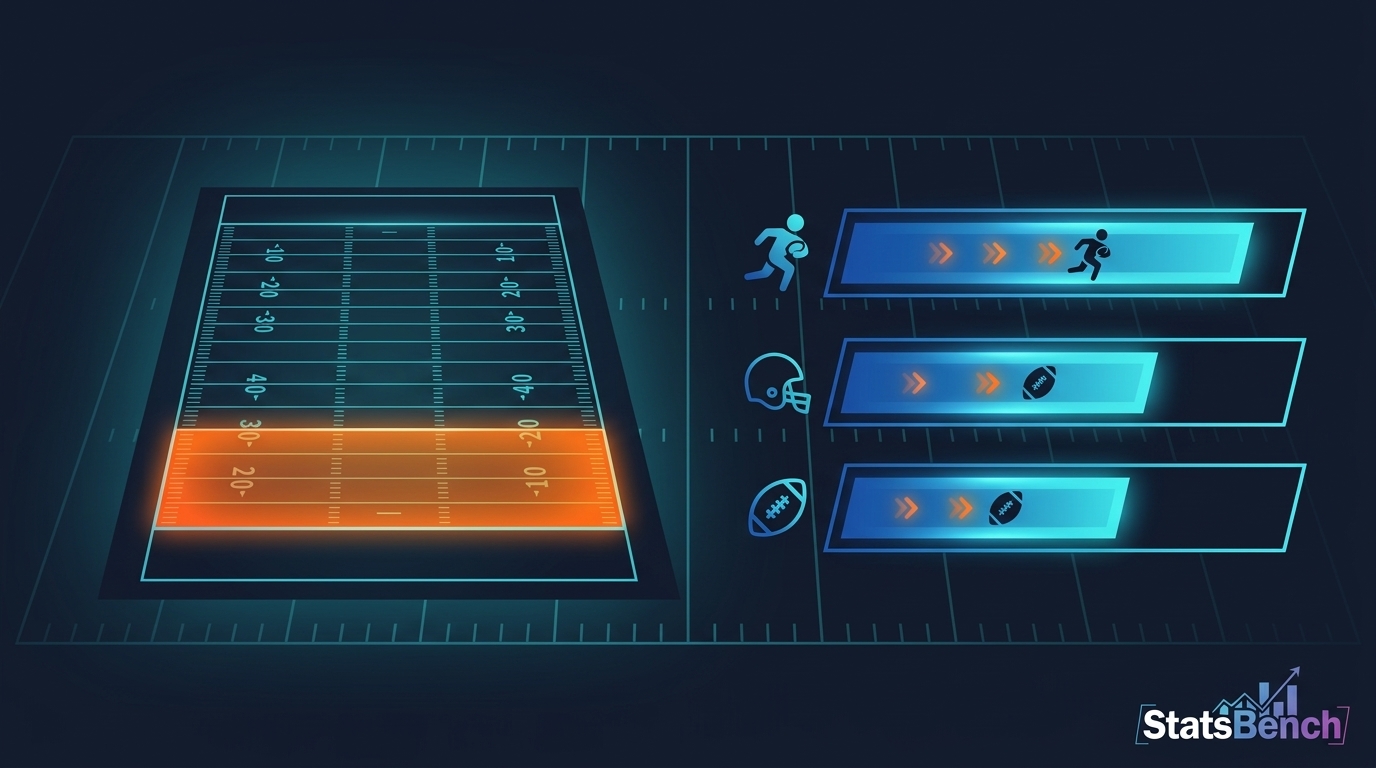
| Check | Why it matters | What good looks like |
|---|---|---|
| Red-zone touches | Total yards lie. Carries and targets inside the 20 are where scores actually come from. | A steady share of the team’s red-zone work over several games, not one outlier week. |
| Team implied total | A team projected to score a lot creates more touchdown chances for everyone on the roster. | A top-third implied total and a favorable matchup, not a projected rock fight. |
| Goal-line role | One-yard touchdowns settle these bets, and they usually go to a specific back or the quarterback. | He’s the guy who gets the ball at the 2 (or the QB who sneaks it). |
Add opponent rushing or passing touchdown rate allowed as a fourth check if you have time. A defense that gets pushed around near the goal line makes every touch count more.
Red-zone usage is the same logic that drives the NFL anytime touchdown strategy guide. Roles beat luck, in both leagues.
How do you price an anytime touchdown longshot?
Convert the price to a percentage, then ask whether the player’s real chance is higher than that number. That’s the whole game.
At +250, the implied probability is 100 divided by 350, which is about 28.6%. If you think his true chance is 33%, the bet has an edge. If you think it’s 25%, you’re paying for someone else’s margin.
Longshot prices carry heavy hold. Books build a bigger cushion into a +400 touchdown prop than into a -110 spread, so your estimate needs room for that tax. Run the numbers through the implied probability calculator and, when you compare two sides of the same market, the de-vig calculator to strip out the built-in margin.
One rule keeps most bettors out of trouble: never take a plus-money touchdown prop just because the payout looks fun. Price it first, then decide.
Where to research CFB touchdown props
StatsBench lists props across every major stat, and you can browse college football markets on the NCAAF props preview without an account. That’s the fastest way to see how a player’s lines are moving before you dig deeper.
From there, the workflow is simple:
- Hit rates and game logs show how often a player has actually found the end zone, not just how many yards he piled up in one blowout.
- Matchup and defense data tells you whether the opponent gives up touchdowns on the ground or through the air.
- Best price across 30+ sportsbooks, DFS apps and exchanges does the boring work of line shopping, including pick’em apps like PrizePicks and Underdog where touchdown markets are popular.
- The Bet Tracker logs what you actually bet, so a month from now you know whether your touchdown props made money.
In season, the Prop Finder filters through 10,000+ props a day. Finding the best number on the same player is worth more than most people realize, and it costs nothing but a second look. If the odds formats are tripping you up, this guide to reading player prop odds covers American, decimal and fractional in plain English.
Five mistakes that cost CFB bettors money
Most losing touchdown tickets come from the same handful of habits. Fix these before you worry about finding an edge.
- Chasing last week’s backup hero. One 80-yard score on a busted coverage isn’t a role change. Check the snap counts.
- Ignoring the quarterback’s legs. If he’s taking every sneak inside the 3, the backup running back’s anytime price is worse than it looks.
- Stacking longshots in a parlay. Four anytime scorers in one ticket is a lottery stub with extra steps. Use the parlay calculator to see the real combined price before you talk yourself into it.
- Betting first touchdown because the payout is big. That market is close to a coin flip dressed up as analysis.
- Forgetting the weather. Late-October and November wind and rain change how many points a game produces, and that hits touchdown props directly.
One more: sample size. A back who has scored in four straight games is not guaranteed anything on Saturday. Streaks feel predictive and mostly aren’t, so check whether the underlying touches are still there.
Touchdown props are long-run bets, not certainties. Prices are set by people who also do the math, so any edge is small, gradual, and subject to variance. Bet within your means, keep it fun, 21+ only, and if it stops being either, call 1-800-GAMBLER.
Free preview
See today’s college football player props on StatsBench
Live lines, last-10 hit rates and the best price across 30+ books and pick’em apps. No account needed to look.
Open the college football player props board →
Prefer email? Get the daily picks newsletter.
Frequently Asked Questions
What counts as an anytime touchdown scorer prop in college football?
The bet wins if the player scores a rushing or receiving touchdown at any point, including overtime. Passing touchdowns do not count for a quarterback, and most books exclude defensive and special teams scores. Check your book’s house rule before betting.
Are anytime touchdown props good bets?
They can be, but only when you price them. Convert the odds to an implied percentage and compare it to your own estimate of his scoring chance. The hold on longshot prices is heavy, so a plus-money ticket is not automatically value.
What is the difference between anytime and first touchdown scorer?
Anytime just needs one score at any point in the game, so it’s a much shorter price. First touchdown requires the game’s opening score, which is closer to a coin flip and tends to carry a bigger book margin.
How do you calculate implied probability on a touchdown prop?
Divide 100 by the odds plus 100. A +250 anytime touchdown prop implies about 28.6%, meaning you need to believe his real chance is higher than that to justify the bet.
Does StatsBench cover college football props?
Yes. College football is one of 19 covered leagues, and the NCAAF props preview is free to browse. Paid plans add Prop Finder filters, matchup data and best-price comparison across 30+ sportsbooks, DFS apps and exchanges.































 ATL
 DET
 PHI
 TOR
 IND
 WSH
 BOS
 CHI
 CHA
 BKN
 CLE
 NY
 MIL
 ORL
 MIA
 MIN
 POR
 LAL
 OKC
 MEM
 HOU
 LAC
 UTAH
 DAL
 DEN
 PHX
 NO
 SA
 GS
 SAC
 KC
 BUF
 JAX
 CLE
 DEN
 PIT
 BAL
 CIN
 NE
 LV
 NYJ
 IND
 HOU
 TEN
 MIA
 LAC
 SF
 MIN
 CAR
 NYG
 CHI
 GB
 DET
 SEA
 ATL
 NO
 PHI
 DAL
 ARI
 LAR
 WSH
 TB
 CAR
 BOS
 NYR
 TB
 OTT
 TOR
 NYI
 NJ
 MTL
 FLA
 DET
 WSH
 BUF
 PIT
 PHI
 CBJ
 EDM
 VGK
 SEA
 UTA
 MIN
 DAL
 COL
 SJ
 STL
 WPG
 NSH
 ANA
 LA
 CGY
 CHI
 VAN
 MIA
 BYU
 OSU
 ND
 UGA
 IU
 MISS
 TTU
 UCLA
 UTAH
 TENN
 UK
 ALA
 HOU
 IOWA
 USC
 WAKE
 LSU
 TEX
 FLA
 BOIS
 MIZ
 SMU
 NU
 ARIZ