
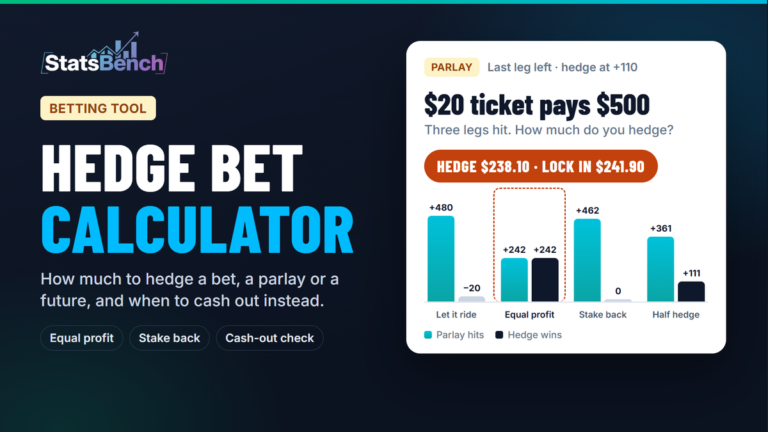
To hedge a bet, you place a second bet on the other outcome so you profit, or lose less, whichever way it goes. For the same profit either way, the hedge stake is your bet’s potential payout divided by the hedge’s decimal odds. The calculator below does that math for straight bets, futures and parlays, and shows whether a cash-out offer is worth taking.
How to use the hedge calculator
- Pick Straight bet or future and enter your stake and the odds you got, or pick Parlay and enter the payout shown on the ticket.
- Enter the hedge odds: the current price on the other side of the game, or of the parlay’s remaining leg.
- Read the table: what each option pays if your bet wins and if the hedge wins. Drag the slider to hedge only part of it.
- Optional: add your side’s current odds to see the bet’s fair value, and the book’s cash-out offer to see whether hedging beats it.
What hedging a bet means
A hedge is a bet against your own bet. Once the price has moved your way, a bet on the other side can lock in a profit no matter who wins, or at least get your stake back. You give up part of the upside to remove some or all of the risk.
Hedging works best on bets with a big payout and time between placing them and the result: futures, long parlays, and bets whose odds have moved since you placed them.
Three ways to hedge a bet
Say you bet $100 on a team to win the title at +300, so a win pays $400. They reach the final, and the other team is -150. Here are your three choices:
| Option | Hedge stake | If your team wins | If the other team wins |
|---|---|---|---|
| Let it ride | $0 | +$300.00 | −$100.00 |
| Lock equal profit | $240.00 | +$60.00 | +$60.00 |
| Get your stake back | $150.00 | +$150.00 | $0.00 |
| Hedge half | $120.00 | +$180.00 | −$20.00 |
Lock in equal profit
Bet $240.00 on the other team at -150: $400 divided by 1.67, the decimal odds of -150. You make $60.00 whichever team wins. This is the full hedge: no risk left, and the least upside.
Get your stake back
Bet $150.00 on the other team, your $100 stake divided by 0.67 (the decimal odds minus one). If the other team wins, the hedge returns exactly your $100. If your team wins, you make $150.00. You keep most of the upside and can’t lose money.
Hedge part of it
Any stake between $0 and the full hedge keeps some upside and protects part of it. Half the equal-profit stake, $120.00, makes $180.00 if your team wins and loses $20.00 if it doesn’t. The calculator’s slider shows every point in between.
How to hedge the last leg of a parlay
A parlay works the same way once only one leg is left: the ticket’s payout is your “if it wins” number. Say a $20 four-leg parlay pays $500, the first three legs hit, and the other side of the last leg is +110.
| Option | Hedge stake | If the parlay hits | If the hedge wins |
|---|---|---|---|
| Let it ride | $0 | +$480.00 | −$20.00 |
| Lock equal profit | $238.10 | +$241.90 | +$241.90 |
| Get your stake back | $18.18 | +$461.82 | $0.00 |
| Hedge half | $119.05 | +$360.95 | +$110.95 |
Getting your $20 back costs only $18.18, and locking in $241.90 either way costs $238.10. Which one fits depends on how much $500 means next to your bankroll.
With two or more legs left, you can hedge each leg as it comes up, or wait and hedge the last one. Waiting keeps more upside but leaves more riding on legs that can still lose. If two of your parlays end on the same leg, add their payouts together and hedge the total; if they need opposite results, they already hedge each other.
New to the math behind the payout? See how parlay odds turn into a payout.
Hedge or cash out?
Most sportsbooks offer to cash out an open bet for a set amount. To judge the offer, compare it with the bet’s fair value: the payout times the chance the market gives it once the book’s margin is taken out.
In the parlay above, say the last leg is -130 on your side and +110 on the other. Taking the margin out of both prices gives your side a 54.3% chance, so the ticket is worth $271.37. Against that:
- A $230 cash-out gives up $41.37 of value.
- The equal-profit hedge returns $261.90 either way and gives up about $9.47.
Here, hedging returns $31.90 more than cashing out. That’s common: the book builds its margin into the cash-out offer. Put both numbers into the calculator before you accept one. The de-vig calculator shows the margin-free price for any market.
When hedging is worth it, and when it isn’t
Every hedge is a second bet that pays the sportsbook’s margin, so over many bets hedging costs a little money. It’s insurance. It earns its cost when:
- The payout is big for your bankroll. Losing a $5,000 parlay on the last leg hurts far more than the few dollars of expected value a hedge costs.
- Something changed since you bet. An injury, a lineup change or a big line move can make your side less likely than the price you’re holding. Check whether the news is already in the hedge price.
- You can get a better price. Shopping the hedge across sportsbooks cuts what it costs; the best price on the other side is rarely at the book that took your first bet.
It usually isn’t worth it on small bets you still like, or as a habit on every parlay: you pay the margin each time and cap your best results. Line movement can also open a middle, where both bets can win, such as Over 44.5 early and Under 47.5 later on the same game.
Hedge bet formulas
- Equal-profit hedge stake = potential payout ÷ hedge decimal odds
- Break-even hedge stake = original stake ÷ (hedge decimal odds − 1)
- Profit if your bet wins = potential payout − original stake − hedge stake
- Profit if the hedge wins = hedge stake × (hedge decimal odds − 1) − original stake
- American to decimal: +odds → 1 + odds ÷ 100; −odds → 1 + 100 ÷ the odds without the minus sign
More odds math: the parlay calculator, the free bet conversion calculator (it uses the same hedge method) and the odds converter.
Frequently Asked Questions
How much should I hedge my bet?
For the same profit whichever side wins, divide your bet’s potential payout by the hedge’s decimal odds. To get only your stake back if the hedge wins, divide your stake by the hedge’s decimal odds minus one. Anything between the two keeps some upside and protects part of it.
Is it better to hedge or cash out?
Compare both with your bet’s fair value: the payout times the market’s no-margin chance that it wins. Sportsbooks build their margin into cash-out offers, so hedging at a good price usually returns more than cashing out, but not always. The calculator shows both side by side.
Should I hedge the last leg of my parlay?
Hedge when the payout is large next to your bankroll and losing it would hurt more than the hedge costs. Each hedge pays the book’s margin, so hedging every small parlay costs money over time. With two or more legs left, you can hedge each one as it comes up or wait for the last.
Is hedging a bet allowed?
Yes. Betting the other side of your own bet is an ordinary wager at regulated sportsbooks, at the same book or a different one. Taking the hedge at the book with the best price on the other side saves money.
Does hedging lose money in the long run?
On average, a little: every hedge pays the sportsbook’s margin on the extra bet. That is the price of lowering risk. A hedge can still be worth it when the payout is big for your bankroll, when news has changed the odds, or when you can get a better price than the market.
 Today's NBA picks



 Today's NFL picks



 Today's NHL picks



 Today's College Football picks



 Today's CS2 picks



 Today's LoL picks

 Today's Valorant picks
 Today's Dota 2 picks
 PHI
 BOS
 DET
 ATL
 NY
 TOR
 CLE
 MIA
 CHA
 WSH
 IND
 ORL
 BKN
 CHI
 MIL
 LAL
 SA
 OKC
 GS
 MIN
 HOU
 MEM
 POR
 DAL
 DEN
 NO
 PHX
 LAC
 SAC
 UTAH
 BUF
 DEN
 JAX
 PIT
 KC
 CIN
 NE
 CLE
 LV
 BAL
 HOU
 NYJ
 IND
 MIA
 TEN
 LAC
 SF
 CHI
 NYG
 CAR
 DET
 MIN
 GB
 SEA
 LAR
 DAL
 NO
 TB
 ATL
 ARI
 WSH
 PHI
 CAR
 BOS
 NJ
 MTL
 TB
 OTT
 NYR
 FLA
 BUF
 WSH
 NYI
 TOR
 DET
 PHI
 CBJ
 PIT
 EDM
 MIN
 VGK
 DAL
 COL
 NSH
 ANA
 UTA
 SEA
 CGY
 WPG
 SJ
 STL
 LA
 CHI
 VAN
 UGA
 UTAH
 ND
 UCLA
 MIA
 IU
 ALA
 TEX
 TENN
 TTU
 WAKE
 BYU
 UK
 HOU
 USC
 IOWA
 BOIS
 ORE
 MISS
 SC
 OSU
 ARIZ
 UNM
 LSU
 SMU