
The short answer
Finding the best first basket bets today comes down to three inputs, in order: who wins the tip, who touches the ball on the opening possession, and what price you can get. Everything else is noise. Get those three right and you are betting a market that most people treat like a coin flip.
This is a strategy piece, not a general overview. If you want the basics of how the market works, start with our first basket NBA betting guide and come back here for the process.
Key takeaway: first basket is a two-stage problem, and stage one (the tip) gets ignored constantly.
Why the tip-off is stage one
The team that wins the jump ball gets the first shot attempt. That is not a small nudge. It roughly doubles the pool of realistic candidates on one side of the board before a single shot goes up.
So your first filter is not a player. It is a team. Ask which center is jumping, how tall he is, and how he has done against this specific opponent’s center. Jump-ball matchups repeat all season, which makes them one of the few genuinely stable signals in a market this random.
StatsBench’s First Basket Model is built exactly this way: two stages, tip-off winner first, then player likelihood inside that possession. We backtested that method at a 17.7% pre-game first-basket hit rate over 724 games in 2024-25. That is a description of a backtest, not a promise about tonight.
- Who is the listed starting center, and is he actually available?
- Does either team use a wing to jump (some coaches do)?
- Has this exact center pairing met before this season?
Stage two: who actually shoots on possession one
Winning the tip only matters if you know who finishes the play. Opening possessions are usually scripted. Coaches call a set they have practiced, aimed at a specific player, and that player is often not the leading scorer.
Look for three roles:
- The designed target. The guy the first play is drawn up for. Frequently a big man on a post entry or a lob, or a wing coming off a pinch-post action.
- The default creator. If the set breaks down, the ball ends up with the primary handler. He shoots.
- The trailing big. On a live-ball push, the center who runs the floor gets a dump-off or an offensive rebound putback.
Once you have those three names per team, you have roughly six live candidates for the whole game. Now compare them to the prices posted. Any name outside your six is a pass no matter how tempting the number is.
Does a free throw count?
Usually no. Most books grade first basket on a made field goal, so an opening trip to the line that produces two free throws does not settle your ticket. The rules vary by book, and it changes which players are actually good bets (foul-drawing guards get overrated here). We broke the grading down in do free throws count as first basket.
How to build a shortlist of the best first basket bets today
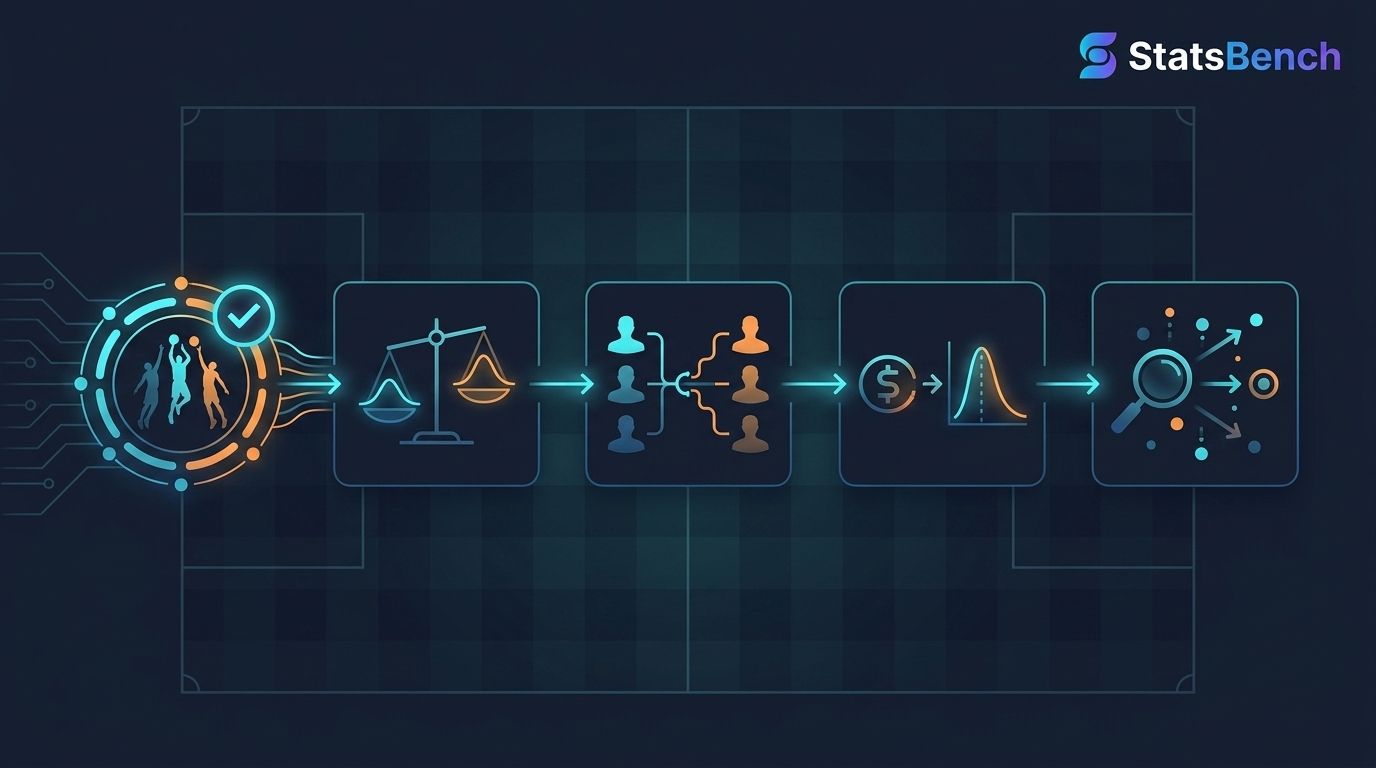
Here is the repeatable process. It takes about ten minutes per game once you have done it a few times.
- Confirm the jumpers. Check the official injury report and the starting lineups on NBA.com. A late scratch at center rewrites the whole board.
- Assign a tip probability. You do not need a decimal. “Clear favorite,” “slight lean,” or “coin flip” is enough to weight the two sides.
- List three candidates per team using the roles above.
- Convert every posted price to implied probability. Use the implied probability calculator so you are comparing apples to apples.
- Compare your estimate to the price. If your read says a player is around a 1-in-10 shot and the board pays like he is 1-in-16, that is where you look harder.
- Shop the number. First basket prices move a lot between books. StatsBench compares best available price across roughly 60 sportsbooks, and on a longshot market that difference is real money.
Run the loop, then walk away from the games where nothing lines up. Most nights, only two or three games produce a candidate worth backing.
Line shopping matters more here than anywhere
First basket is a longshot market, and longshot markets carry fat vig. Books hold more on a +900 than on a -110 because the payout gap between two books at the same “true” probability is wider in raw percentage terms.
A quick example of the math, using our own tools rather than invented numbers: run two prices for the same player through the odds converter and then the vig and hold calculator. You will see how much of your theoretical edge one book’s extra juice quietly eats. On a market you might bet 200 times a season, that gap compounds.
Never take the first price you see on a first basket ticket.
What real StatsBench prop data teaches about hit rates
First basket lines are not on the standard cheatsheet, but the way we grade every other prop shows the discipline this market needs. Take a snapshot of the StatsBench cheatsheet from September 7, 2026. Several NFL receiving props that morning sat at exactly 60% hit rates over a 10-game window: Rashid Shaheed over 5 receiving yards (6/10, 20.6% edge), A.J. Brown over 60.5 receiving yards (6/10, 14.9% edge, best price -111), and Hunter Henry over 33.5 receiving yards (6/10, 12.3% edge, best -109).
Notice what that shows. Three props, identical 6-of-10 hit rates, wildly different edges. The hit rate alone told you almost nothing. The gap between your estimate and the price told you everything. We unpack that tension in hit rate vs edge.
Apply the same lens to first basket. A player who has opened the scoring three times in ten games looks hot. But 3-of-10 on a market where a good candidate might be a 10% shot is a tiny sample telling you nothing. Sample size is the whole ballgame here.
Common mistakes in the nba first basket market
Most losing tickets in the nba first basket market come from betting stars instead of roles. The market prices star names efficiently because everyone bets them. The edge, if there is one, sits on the third and fourth options.
- Chasing the leading scorer. A 28-point-per-game wing may rank fourth on his own team in opening-possession touches.
- Ignoring the tip. Backing a player whose team loses the jump ball 65% of the time is a self-inflicted wound.
- Overreacting to last game. One opening bucket is not a trend.
- Parlaying first baskets. Two longshot legs multiply the vig. If you must, understand the math first via our parlay odds math explainer.
- Betting every game. A full slate does not mean a full card.
Sizing the bet honestly
First basket is a high-variance market. Even a strong process loses the large majority of individual tickets, because the best candidate on a board is rarely better than a 1-in-8 or 1-in-10 shot. That is normal. It is also why stake size matters more than pick quality on any single night.
Keep units small and fixed. If you prefer a formula, the Kelly criterion calculator will tell you how small a fractional stake is appropriate at longshot prices, and the answer is usually “smaller than you thought.” Long cold runs on a 10% market are mathematically expected, not evidence your read was wrong. Our post on variance in betting covers why good bets lose.
Track every ticket. The free Bet Tracker (available with any StatsBench account) logs P&L and hit rate, which is the only way to know whether your first basket process is working over a season rather than a week.
Where to check the model output
You can see how the two-stage method ranks candidates on the free NBA first basket tool. It orders players by likelihood inside a game, which saves you the manual role-mapping described above. The WNBA version works the same way if you want to practice the method on a smaller slate.
For the underlying method write-up, see first basket predictions: the data method and the historical numbers in first basket stats. Between the three, you have the full picture: what the data says, how the model reads it, and how to price it yourself.

A quick reference table
| Input | What to check | Why it matters |
|---|---|---|
| Tip-off | Listed centers, height, prior matchups | Decides which side gets shot one |
| Opening set | Designed target, primary handler, running big | Narrows to ~3 names per team |
| Availability | Official injury report, late scratches | A scratch can void your whole read |
| Price | Best number across books, implied probability | Longshot vig eats thin edges |
| Stake | Small fixed unit or fractional Kelly | Variance is brutal at 10% win rates |
Responsible framing
This is research tooling, not advice and not income. Bet only what you can afford to lose, keep it entertainment, and remember that sports betting is 21+ and legal only in some jurisdictions. If betting stops being fun, call 1-800-GAMBLER. A market where you lose 85% of your tickets by design is not a place to chase losses.
Free tool
Today’s NBA first basket model, updated daily
Real recent game logs behind every number. Free to browse.
Open the NBA first basket model →
Prefer email? Get the daily picks newsletter.
Frequently Asked Questions
What is the best way to pick a first basket bet?
Start with the tip-off, since the team that wins the jump ball takes the first shot attempt. Then narrow to about three candidates per team: the designed target of the opening set, the primary ball handler, and the big man who runs the floor. Compare those names to the posted prices and only bet when the number is better than your own estimate.
Do free throws count as the first basket?
At most sportsbooks, no. First basket usually grades on a made field goal, so opening free throws do not settle the bet. Rules differ between books, so check the specific market rules before you place a ticket.
How often should a good first basket bet win?
Even a strong candidate is typically somewhere around a 1-in-8 to 1-in-10 shot, so you should expect to lose the clear majority of tickets. That is why stake sizing and long-run tracking matter more here than in most markets. Judge the process over a season, not a week.
Does StatsBench have a first basket tool?
Yes. The free NBA first basket tool ranks players by likelihood using a two-stage method: tip-off winner first, then player likelihood inside the opening possession. That method was backtested at a 17.7% pre-game hit rate across 724 games in 2024-25.
Is line shopping really worth it on first basket?
More than almost anywhere else. Longshot prices carry heavier vig, and the gap between two books on the same player can be large in raw percentage terms. Comparing best available price across books is one of the few free edges in this market.