
What is the first basket market in the NBA?
First basket NBA betting asks one question: which player scores the game’s opening field goal? You pick a single player, and the bet settles within the first minute or two of action. It’s a long-odds market, so hit rates look low even when your process is good.
The market is popular because it’s simple to explain and fun to sweat. It’s also priced with heavy juice, because books know casual money piles onto stars. That combination (public bias plus a market that resolves fast) is exactly why a structured approach beats gut feel.
Key takeaway: this is a probability puzzle with three inputs, not a coin flip on your favorite scorer.
How does a first basket bet settle?
Most books grade the first made field goal of the game. Free throws usually don’t count, and rules differ book to book on things like a game that starts with a technical foul. Read the house rules before you fire, because grading edge cases are where bettors get burned.
Also check whether your book offers “first field goal” versus “first point.” Those are different markets. One player can draw a shooting foul, hit two free throws, and cash the first-point ticket while your first-basket ticket lives on.
What actually decides who scores first?
Three things drive the probability, and they stack in a specific order.
- Possession. The tip-off winner gets the first shot attempt roughly two-thirds of the time in practice, since the other team needs a miss or turnover to touch the ball.
- Opening play design. Teams script their first action. Some coaches run the same entry pass to the same big every single night.
- Shot profile. A center who catches on the block and finishes at a high rate converts opening looks more often than a guard hunting a step-back three.
Notice what isn’t on that list: season-long scoring average. The league’s leading scorer might be your fourth-best first basket candidate if he sets the screen on the first action instead of receiving it.
That’s the gap. Casual bettors sort by points per game. The market rewards people who sort by first-touch likelihood.
Why the tip-off matters more than the star
Jump balls are semi-predictable. Height, standing reach and matchup history all carry signal, and the same centers win tips at high rates year after year. You can check who’s active and who jumps on the official box scores at NBA.com/stats.
Once you have a tip-off lean, you’ve cut the field almost in half. Then you only need to solve the second question: on that team’s scripted first possession, who is most likely to take and make the shot?
How StatsBench models first basket NBA odds
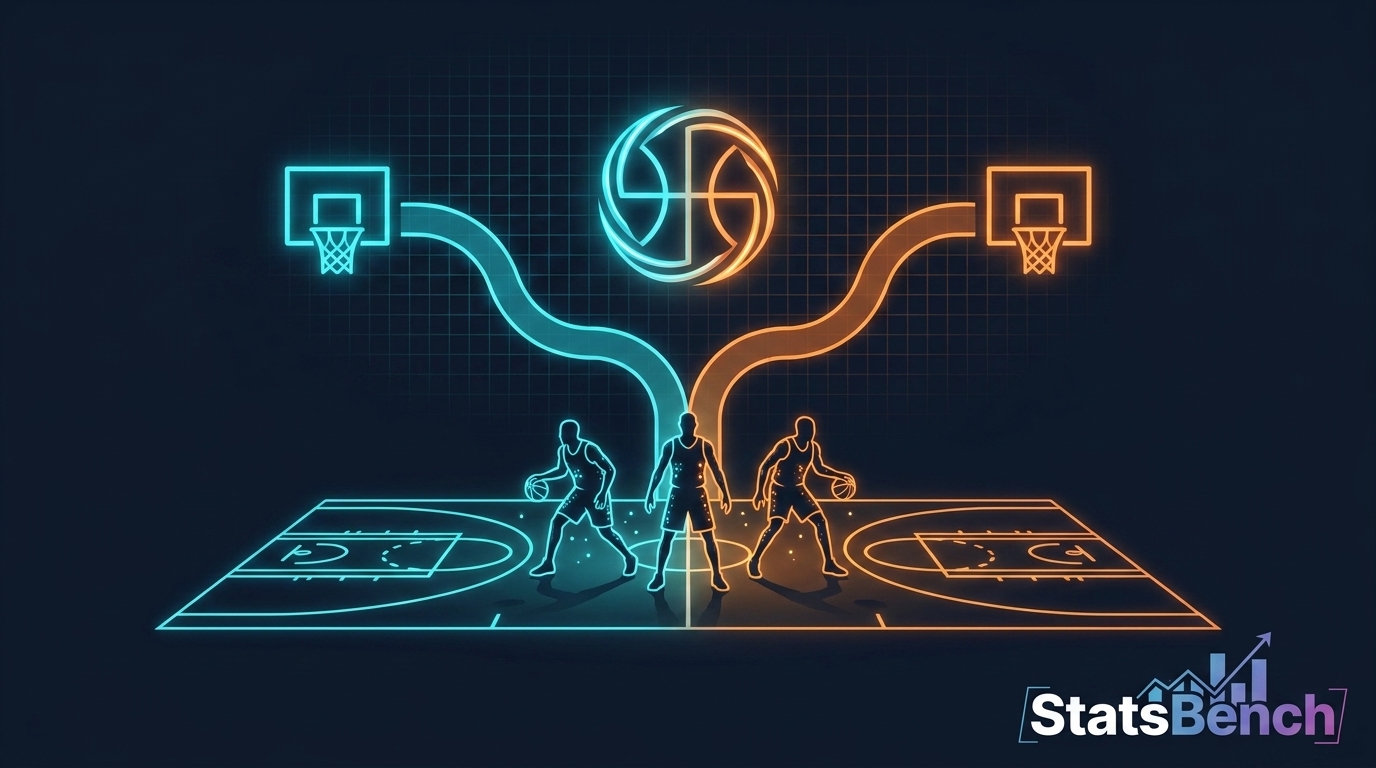
The StatsBench First Basket Model is a two-stage process. Stage one estimates who wins the tip-off. Stage two estimates each player’s likelihood of scoring the opening basket given his team has the ball.
Splitting it that way keeps the math honest. A player’s raw first-basket rate mixes two different things: how often his team gets the first possession, and how often he’s the one finishing. Separate them and you can price a center on a team that loses tips as a different animal than the same center on a team that wins them.
On performance, we only publish what we can verify: the model was backtested at a 17.7% pre-game first-basket hit rate over 724 games in 2024-25. That’s a backtest, not a promise, and it’s a market where variance is brutal. A 17.7% hit rate means long, ugly cold streaks are normal even when the process is fine.
What hit rate do you need to break even?
Depends entirely on the price. Here’s the honest math on common first basket odds.
| Odds | Implied probability | Break-even hit rate |
|---|---|---|
| +500 | 16.7% | 16.7% |
| +700 | 12.5% | 12.5% |
| +900 | 10.0% | 10.0% |
| +1400 | 6.7% | 6.7% |
So a candidate you think hits 14% of the time is a bad bet at +500 and a good bet at +900. Price is the whole game here. If you want the mechanics behind that conversion, our implied probability guide walks through it step by step.
Why line shopping matters so much on long odds
Long-odds markets have the widest price spreads. The same first basket candidate can be +650 at one book and +850 at another, because these lines get less attention than a spread. That difference is not small. It’s the entire edge.
StatsBench tracks prices across roughly 60 sportsbooks and prediction-market exchanges, including FanDuel, DraftKings, BetMGM, Caesars, bet365 and Pinnacle. Our Positive EV Scanner recomputes fair prices from sharp books every minute and flags soft-book gaps. Same logic applies to first basket tickets: take the best number available, always.
One habit that pays: never bet a long shot at the first price you see. Two minutes of shopping on a +700 versus +800 line is a bigger EV swing than most people’s entire prop research.
Where real prop data fits into your process
First basket is the flashy market, but the same research habits carry over to every prop. Hit rate over a defined sample, a clear edge number, and the best available price. That’s the whole checklist.
Here’s what that looks like in practice. A StatsBench cheatsheet snapshot from a July 26, 2026 slate showed these baseball props, listed with their 10-game hit rate and best price at the time:
| Player | Prop | Hit rate (L10) | Edge | Best price |
|---|---|---|---|---|
| Kyle Schwarber (PHI vs NYY) | H+R+RBI o0.5 | 60% (6/10) | 0.9% | -275 |
| J.T. Realmuto (PHI vs NYY) | Total bases o1.5 | 60% (6/10) | 0.2% | +130 |
| Bryce Harper (PHI vs NYY) | H+R+RBI o0.5 | 60% (6/10) | 0.7% | -313 |
Look at Realmuto versus Harper. Similar hit rate in that sample, wildly different prices. The plus-money line needs a much lower true probability to be worth backing. That’s the same lesson the first basket market teaches, just in a market that resolves over nine innings instead of nine seconds.
Sample size caveat: a 10-game window is a starting point, not proof. We wrote about how much sample you actually need if you want to size that risk properly.
Common mistakes in the opening-basket market
Most losing tickets come from a handful of repeat errors.
- Betting the biggest name. Star scorers are the most bet and therefore the shortest priced. Short prices on a 12% event kill you.
- Ignoring the tip. If your guy’s team loses the jump, his probability drops hard before the ball is even in play.
- Skipping the injury report. A backup center changes both the tip-off odds and the scripted first action.
- Parlaying it. Stacking two long shots multiplies the vig you’re paying. Our parlay math breakdown shows how fast that compounds.
- Chasing after a cold run. At a sub-20% hit rate, 10 straight misses is a normal Tuesday. Flat stakes, no exceptions.
Does this market work outside the NBA?
The concept exists in college hoops too, and searches for things like “march madness bracket predictions” spike every spring for a reason: people want structure for unpredictable events. The logic transfers, but the data doesn’t. College rosters turn over fast, opening plays are less scouted, and public liquidity is thinner. StatsBench’s props coverage is built around the NBA, WNBA, NFL, NHL, MLB, eight soccer leagues and three esports titles, so treat college first basket as a fun bet, not a modeled one.
Do shorter players ever score first?
Yes, and more often than you’d guess. Short basketball players in the NBA who handle the ball, guys running the opening pick-and-roll, can be a live first basket candidate at a much better price than the center. If a team’s scripted first action is a guard driving to the rim, the height of the roster is irrelevant. Read the play design, not the height chart. The jump ball only decides possession, not who finishes.
How to build your own first basket routine
Keep it to five steps and you’ll beat most of the market’s process.
- Confirm starting lineups and who’s jumping.
- Form a tip-off lean using the two centers.
- List two or three players who touch the ball first on the likely winner’s opening set.
- Convert your estimate to a break-even hit rate and compare it to the offered price.
- Shop every book, then bet once at a flat stake.
Then track it. A journal is the only way to tell a bad process from a bad month, and the StatsBench Bet Tracker is free with any account. Pair it with the NBA player props strategy guide if you want to widen out beyond opening tips, or check the NBA props preview to see what the data view looks like.
Bet it for fun, size it like a long shot
Opening-basket tickets are entertainment with a solvable structure underneath. Model the tip, model the first action, shop the price, keep the stake small. Do that and you’re playing a different game than the guy clicking the biggest name on the screen.
Betting is 21+ and legality varies by state. Only risk money you can afford to lose, and if it stops being fun, call 1-800-GAMBLER.
Want the same hit-rate-and-best-price view we used above, for free? Grab the free player prop cheatsheet and see which lines are worth a second look before you bet.
Free tool
Today’s NBA first basket model, updated daily
Real recent game logs behind every number. Free to browse.
Open the NBA first basket model →
Prefer email? Get the daily picks newsletter.
Frequently Asked Questions
What is a first basket bet in the NBA?
It’s a wager on which player scores the game’s first field goal. The bet settles in the opening minute or two of play. Free throws usually don’t count, so check your book’s grading rules before betting.
How often does the tip-off winner score the first basket?
The team that wins the jump ball gets the first shot attempt the large majority of the time, since the opponent needs a miss or turnover to gain possession. That’s why tip-off handicapping comes before player selection. Winning the tip doesn’t guarantee the make, only the first look.
Is the StatsBench First Basket Model profitable?
We don’t publish a profit claim. The verifiable figure is a backtest: a 17.7% pre-game first-basket hit rate across 724 games in 2024-25. Whether that’s profitable depends entirely on the prices you get, and variance in this market is severe.
What hit rate do I need to break even on first basket bets?
Convert the odds to implied probability. At +500 you need 16.7%, at +900 you need 10%, and at +1400 you need 6.7%. Beating those thresholds is only possible if you shop for the best available price.
Should I parlay first basket bets?
Generally no. Each leg already carries heavy juice, and multiplying two long shots multiplies the hold the book keeps. Single flat-staked tickets at the best price are the cleaner way to play a low-probability market.