College football player props live in a market most bettors ignore until Saturday morning. The edges are real, but they come from process, not from a hot tip. Rosters turn over, depth charts change, and the sample behind every number is smaller than anything you’d see in the NFL.
StatsBench covers college football as one of its 19 leagues, and the NCAAF props preview is free to browse. Here’s how to actually use it instead of scrolling for a number that looks wrong.
How are college football props different from NFL props?
An NFL prop is built on 17 games of the same quarterback throwing to the same receivers. College football hands you a new starter, a new coordinator, or a new conference every season, sometimes all three at once. That gap changes the work. In the pros you study a player. In college you study a role.
- Turnover. Seniors graduate, juniors declare, and the transfer portal reshuffles depth charts every spring.
- Schedule swings. September often means a softer opponent. Then comes the conference gauntlet. A season average hides both.
- Blowouts. Coaches pull starters in the third quarter of a four-touchdown game. Usage dries up and a 60-minute projection dies with it.
- Thinner menus. Books build deeper prop boards for the NFL than for a Week 4 game between two unranked teams.
- Overtime. College extra periods hand out stats, which stretches the top end of a distribution in ways a 10-game log won’t show.
Which college football prop markets are worth your time?
The menu is shorter than the NFL’s, so spend your attention on markets where role and volume are measurable.
| Market | What drives it | Check before you bet |
|---|---|---|
| Passing yards | Attempts times yards per attempt, game script | Is the QB healthy, and is the weather clear? |
| Rushing yards | Carry share, run fits, size of the spread | Does the team protect a lead with him? |
| Receptions | Route participation and target share | Slot or perimeter, and who covers him? |
| Receiving yards | Depth of target and coverage shell | Blowout risk cuts both ways |
| Anytime touchdown | Red-zone touches and goal-line role | Who gets the ball at the 3? |
| Longest reception | One play, very high variance | Usually a pass, rarely a bet |
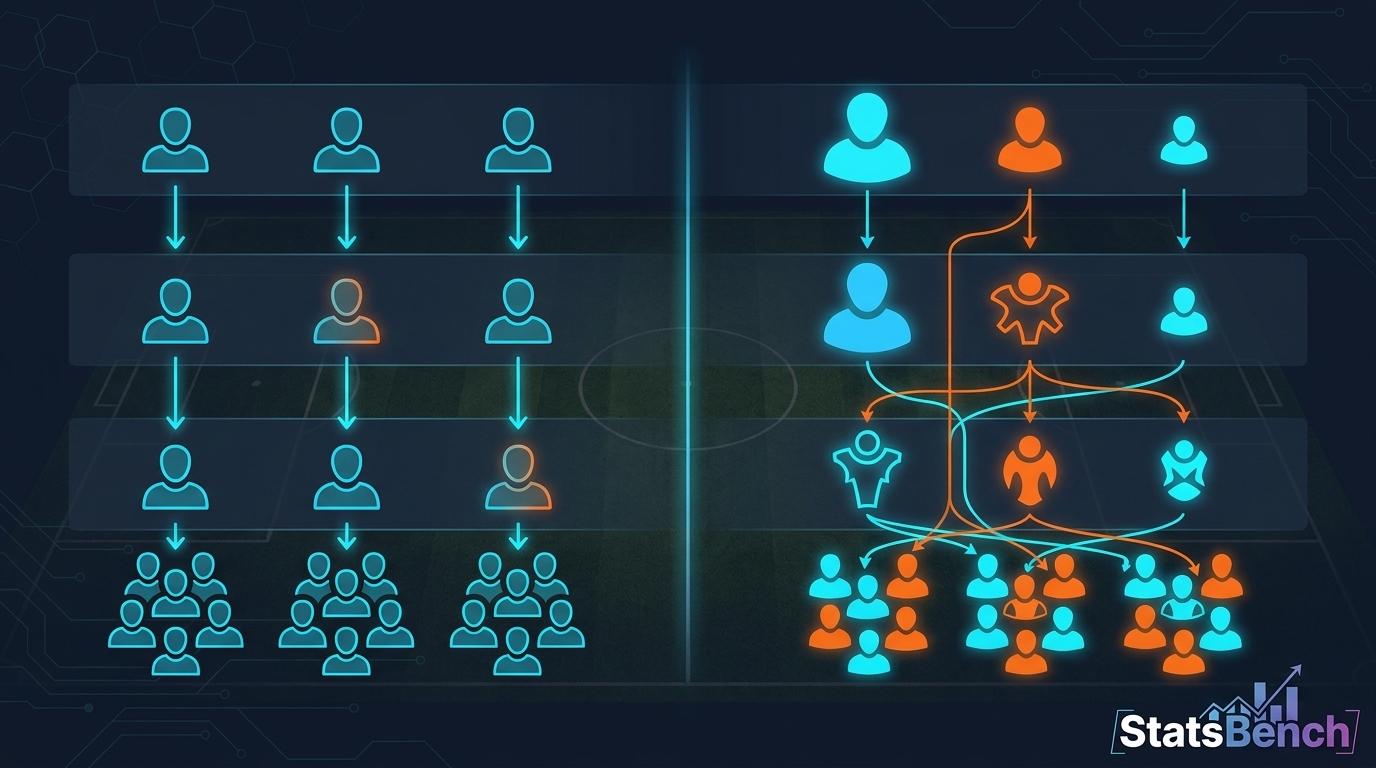
Two of those markets reward research. Two are close to coin flips. Longest reception and longest rush hinge on a single broken tackle. Passing and receptions props hinge on snaps and targets, which you can verify with a game log.
College football player props: a routine you can run every Saturday
Pick a game, then work top-down instead of hunting the board for a number that looks off.
- Confirm who actually plays. A starter label means little. Snap share over the last three games tells you far more.
- Study the opponent by play type. Run-funnel and pass-funnel defenses matter more than a raw ranking. Style beats rank in September.
- Read the total and the spread. A huge total with a two-touchdown spread sets both scripts. Passing volume follows the game state.
- Check weather and kickoff time. Wind and rain hit deep throws first. A night game in late November is a different sport.
- Compare the number to the price. A good stat at a bad price is still a bad bet.
That routine takes about ten minutes per game once you’ve done it a few times. It beats scrolling a list of picks.
Why sample size decides college football prop bets
Twelve games is not a season of evidence. It’s a sample, and plenty of it is contaminated. Games against lower-division opponents, fourth-quarter garbage time and a mid-season quarterback switch all bend the raw numbers.
Before you trust any hit rate, ask what’s inside it: how many games, which defenses, and how many of those snaps came while the game was still competitive. There’s a full breakdown of how much sample is enough, and a companion piece on what a hit rate percentage really means. Both apply directly to a 12-game college season.
This is where a filterable board beats a spreadsheet. StatsBench shows hit rates and game logs for every player, and Prop Finder lets you sort thousands of props instead of reading one season-long average that hides three outlier games.
Turn a hit rate into a price before you bet
A hit rate means nothing until you convert it to a break-even number. That’s the whole job of the implied probability calculator: -110 becomes 52.4%, so any estimate north of that is the start of an argument, and anything below it is a pass.
Next, compare your number to the market. The EV calculator shows what a few points of edge are worth across 100 bets, and how fast a bad price eats it. Every prop on StatsBench carries its own +EV%, and Premium users can sort the board by Best EV. That’s a long-run edge over a large sample, never a guarantee on one Saturday.
How to shop for the best college football prop price
Lines move on news: a questionable quarterback, a late scratch at receiver, a weather report that flips overnight. Odds and props refresh through the day, so the number you saw Thursday isn’t the number on Saturday.
StatsBench compares best price across 30+ sportsbooks, DFS apps and exchanges, and in season it tracks 10,000+ props a day across its leagues. Two practical notes. Pick’em apps score props differently from sportsbooks, so the same player can be a buy on one and a pass on the other. And correlated legs in a same-game parlay aren’t free value, because the book prices that correlation into the odds.
Mistakes that cost college football bettors money
- Betting the brand, not the role. A former five-star recruit is still a backup if he’s third on the depth chart.
- Forecasting from a September blowout. Stats piled up against a lower-division opponent don’t predict conference play.
- Ignoring the backup quarterback. One injury changes three or four props at once, including the receiver props.
- Assuming a big favorite keeps throwing. Most coaches run the ball and shorten the game in the fourth quarter.
- Chasing a line that already moved. The edge left with the news. There’s another game on the board.
For a look at how these numbers get priced before kickoff each week, the weekly college football prop picks page shows the finished product: market, player, line and the reasoning behind it.
What a good college football prop bet looks like
Three things line up: a role you can verify with snaps or targets, a matchup that supports the volume, and a price that hasn’t caught up to either. If one of the three is missing, pass. You don’t need this game. College football gives you dozens more every Saturday, plus a full season of them.
Keep your unit size steady, expect losing streaks even on good bets, and treat this as research rather than a paycheck. It’s for adults 21+ where legal, and if betting stops being fun, call 1-800-GAMBLER.
Free preview
See today’s college football player props on StatsBench
Live lines, last-10 hit rates and the best price across 30+ books and pick’em apps. No account needed to look.
Open the college football player props board →
Prefer email? Get the daily picks newsletter.
Frequently Asked Questions
Are college football player props harder to bet than NFL props?
They’re thinner, not necessarily harder. Fewer markets get priced and rosters change more often, so the research burden is higher. If you verify snaps and targets instead of trusting season averages, the inefficiencies can work in your favor.
Which college football prop markets are the most predictable?
Passing yards, rushing yards and receptions are the most researchable because they follow volume: attempts, carries and targets. Longest reception and longest rush depend on a single play, so they behave much closer to coin flips.
How many games do I need before a CFB hit rate means something?
More than a 12-game season usually gives you. Filter for comparable opponents, competitive game states and the current quarterback, then treat the result as a range rather than a precise probability.
Can I see college football props on StatsBench for free?
Yes. The NCAAF props preview is open without an account. Premium adds the full prop research desk with filters, best price across 30+ sportsbooks, DFS apps and exchanges, and the +EV% on every prop.
What does +EV mean on a college football prop?
It’s the estimated edge on that price compared to the fair odds. A positive number means the price looks better than the probability implies. It’s a long-run measure over a large sample, not a promise that the bet cashes.