
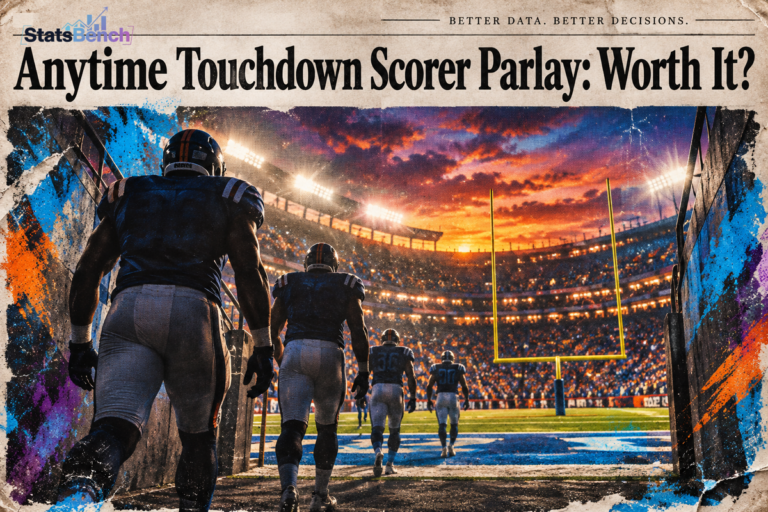
An anytime touchdown scorer parlay pays more because it asks more. Two or three touchdown legs multiply the payout, and they multiply the chance that one player gets stopped at the 2. Single ATTD bets are the calmer play. Stacking scorers only earns its risk when every leg is genuinely mispriced and you can stomach the swing.
Below is the head-to-head: what each bet costs, what each one returns, and where the parlay actually wins. Prices come from a StatsBench cheatsheet snapshot dated October 29, 2026, and the arithmetic is the same arithmetic the books run.
What is an anytime touchdown scorer parlay?
It is one bet with multiple legs, each a player to score at least once in his game. A rushing score counts. So does a receiving score or a return. A passing touchdown does not count for the quarterback, which catches people out every week (here is the rule in full).
Two legs is the common build. Three is where payouts start looking like a scratch ticket. Anything past four is a novelty bet, not a plan.
Anytime touchdown vs first touchdown scorer
First touchdown asks who scores the game’s opening touchdown. Anytime asks only whether the player scores at all. Same player, very different question. A lead back might sit near even money to score at some point and +450 to score first. The first-TD version is a long shot with a wide hold. For most bettors, ATTD is the version worth studying.
Anytime Touchdown Scorer Parlay vs Single Bets: The Trade-Off
Singles win more often and pay less. Parlays pay more and win less. There is no version of this where you get both.
| Single ATTD bet | ATTD parlay (2 to 3 legs) | |
|---|---|---|
| Legs at risk | 1 | 2 or 3 |
| Typical price | Even money to about +250 for a starter | +250 to +900, depending on legs |
| Hit chance | Whatever the price implies | The product of every leg |
| Vig | Paid once | Paid on every leg |
| Variance | Moderate | Rough on a short bankroll |
| Best use | A steady bet with a real edge | A spot where every leg is underpriced |
The table hides the detail that matters most. You pay the vig on every leg, not once at the end. A two-leg parlay of two -110 lines pays +260. Two 52.4% chances multiplied come to 27.5%, which is +264. That four-cent gap is nothing. The real cost is that you accepted a 52.4% price twice.
Singles let you be wrong about one thing. A parlay needs you to be right about two or three, and a single goal-line carry can kill the whole ticket.

How the parlay price is actually built
Multiply the decimal odds of every leg, then subtract one. That is the whole formula, and it is why small prices on each leg turn into a big number.
Take two real prices from the October 29 snapshot. Christian Watson to score at +134 converts to 2.34. Xavier McKinney over 4.5 tackles at -135 converts to 1.741. Multiply them and you get 4.074, roughly +307.
- +134 becomes 2.34
- -135 becomes 1.741
- 2.34 x 1.741 = 4.074, about +307
Add a third leg at -110 (1.909) and the ticket jumps to 7.78, near +678. Each leg you add lengthens the odds by a bigger multiplier than the last. That feels great until you remember the hit chance is shrinking at the same pace.
To check the math without a spreadsheet, the free parlay calculator does the multiplication, and the implied probability calculator turns any price back into a percentage so you can compare it to your own number.
Two legs or three? Where the math turns
Same edge, different ride. If each leg is a genuine 55% chance at a -110 price, the expected return per dollar climbs when you stack, because you are compounding an edge. The variance climbs faster.
| Legs | Hit chance at 55% per leg | Payout at -110 each |
|---|---|---|
| 1 | 55% | -110 |
| 2 | 30.3% | +260 |
| 3 | 16.6% | +596 |
| 4 | 9.2% | +1229 |
Here is the catch. That compounding only works when every leg is really plus-EV. Swap one 55% leg for a 48% leg you talked yourself into, and the ticket flips from an edge to a donation. Adding legs does not make you sharper. It multiplies whatever you already are.
When does stacking touchdown scorers make sense?
Only when each leg would be a bet on its own. If you would not put a single dollar on a player to score straight up, he has no business doubling your ticket.
- Every leg clears your number. Your estimate of his scoring chance beats the price, not just matches it.
- Different games. Spread the legs across kickoff windows so one blowout cannot wreck the whole ticket.
- Two legs, maybe three. The fourth leg is where the payout gets exciting and the win rate gets ugly.
- Small stake. Size it so a loss is a shrug, not a Monday problem.
Bad reasons to stack: you are chasing a losing week, you found a five-leg lock on social media, or you want a sweat on a game you had no opinion about. All three are how parlays become a donation.
Same-game ATTD parlays and correlation
If two legs come from the same game and help each other, the book shortens the price. A quarterback’s passing yards and his top receiver’s touchdown are not independent events, so you should not be paid as if they were. That is the logic behind same-game parlay pricing, and it is why the number looks worse than straight multiplication.
Correlation can work for you too. A back who gets the goal-line carries on a team with a big implied total is a cleaner piece than a receiver who needs a 45-yard catch to score. The correlation cheat sheet walks through which pairings the books price badly.
Reading a real NFL touchdown prop line
A price alone tells you nothing. You need the recent rate, the matchup and the best number across books side by side. Here is what that looks like on a StatsBench cheatsheet snapshot from October 29, 2026, for Packers at Panthers.
| Player | Prop | Hit rate (last 10) | Best price |
|---|---|---|---|
| Christian Watson | Touchdowns over 0.5 | 6 of 10 (60%) | +134 |
| Christian Watson | Longest reception over 26.5 | 6 of 10 (60%) | -107 |
| Xavier McKinney | Tackles over 4.5 | 6 of 10 (60%) | -135 |
| Keisean Nixon | Solo tackles over 3.5 | 6 of 10 (60%) | -150 |
Start with Watson’s touchdown line. Six of his last ten games cleared 0.5 touchdowns, and the best available price was +134. That price implies roughly a 43% chance. A 60% raw rate against a 43% price looks like a canyon, and this is exactly where people get hurt: ten games is a thin sample, and touchdown rates swing hard on red zone luck.
That is why the cheatsheet shows a hit rate next to an edge figure instead of selling you a lock. The rate is history. The edge is the gap between history and price. Neither one is a promise about Sunday.

NFL touchdown props: what to check before you add a leg
Four things do most of the work, and none of them need a model: snap share, red zone usage, team scoring expectation and the opponent’s touchdown rate allowed.
Red zone usage and goal-line role
A back who gets the carries inside the 5 is a different bet from a back who gets 18 carries between the 20s. Pull his red zone touches, not his total touches. Receivers work the same way. Targets inside the 20 say more than targets overall.
Team total and opponent
A player on a team expected to score 17 points has fewer touchdown chances than one on a team expected to score 27. Check the implied team total before you fall for a price. Then check how often the opponent gives up touchdowns to that position.
Price shopping across books
The same anytime touchdown prop can sit at +110 at one book and +134 at another. On a parlay, that gap multiplies. The NFL props preview shows the lines, and StatsBench compares the best price across 30+ sportsbooks, DFS apps and exchanges so you are not guessing.
How to size an ATTD parlay
Small. A parlay is a high-variance bet, and high-variance bets need small stakes to survive a cold month. Many bettors keep parlay stakes to a fraction of what they would put on a single they like. Whatever the number is, it should be an amount you would happily lose for a two-hour sweat.
Track the results too. If your touchdown parlays go 2 for 18 over a season, the problem is not bad luck, it is leg count. The StatsBench Bet Tracker logs the bets and keeps the honest record that memory does not.
If you want the method for singles first, the full anytime touchdown scorer guide covers it, and this piece on pricing touchdown bets goes deeper on the numbers. For the specific Packers at Panthers slate, the game preview has the rest of the board.
The honest answer
Singles first, parlays second. Build your read on individual touchdown props, find the ones where the price is wrong, then decide whether two of them deserve to share a ticket. The parlay is not the strategy. It is a way to combine edges you already found.
Bet within your means. It is entertainment, any edge is long run, and it is 21+ only. If betting stops being fun, call 1-800-GAMBLER.
Free preview
See today’s NFL player props on StatsBench
Live lines, last-10 hit rates and the best price across 30+ books and pick’em apps. No account needed to look.
Open the NFL player props board →
Prefer email? Get the daily picks newsletter.
Frequently Asked Questions
Is an anytime touchdown scorer parlay a good bet?
It can be, but only if every leg is a bet you would make on its own. Stacking multiplies your edge and your variance at the same time, so a parlay of mispriced legs is fine and a parlay of guesses is expensive.
How do you calculate an ATTD parlay payout?
Convert each leg’s American price to decimal odds, multiply them together, then subtract one and convert back. Two legs at -110 each give 1.909 x 1.909 = 3.645, which is +260.
Should touchdown parlay legs come from the same game?
Mostly no, unless the legs are genuinely independent. Books shorten same-game prices when the outcomes are correlated, and they shorten them most on pairings like a quarterback’s yards with his receiver’s touchdown.
Do passing touchdowns count in anytime touchdown scorer markets?
Not for the quarterback. A passer who throws for three scores has zero touchdowns for ATTD purposes. The receiver who catches them does count.
How many legs should an anytime touchdown parlay have?
Two or three for most bettors. Four legs at a 55% hit rate each lands about 9% of the time, which means long dry spells even when every leg is a good bet.
 Today's NBA picks



 Today's NFL picks

 Today's NHL picks



 Today's College Football picks


 Today's EPL picks



 Today's La Liga picks



 Today's Serie A picks



 Today's Bundesliga picks



 Today's Ligue 1 picks



 Today's EFL Championship picks



 Today's CS2 picks

 Today's LoL picks



 Today's Valorant picks
 Today's Dota 2 picks

 PHI
 DET
 BOS
 ATL
 TOR
 CLE
 NY
 WSH
 MIA
 CHA
 IND
 ORL
 BKN
 CHI
 MIL
 POR
 LAL
 HOU
 OKC
 SA
 MEM
 MIN
 GS
 DEN
 NO
 DAL
 PHX
 LAC
 UTAH
 SAC
 BUF
 DEN
 PIT
 JAX
 KC
 CIN
 NE
 CLE
 LV
 BAL
 HOU
 NYJ
 IND
 MIA
 TEN
 LAC
 SF
 MIN
 NYG
 CAR
 CHI
 DET
 GB
 SEA
 LAR
 TB
 ATL
 ARI
 DAL
 WSH
 NO
 PHI
 CAR
 BOS
 MTL
 OTT
 TB
 NJ
 FLA
 TOR
 BUF
 NYR
 DET
 WSH
 NYI
 CBJ
 PIT
 PHI
 EDM
 MIN
 VGK
 UTA
 DAL
 SEA
 COL
 NSH
 STL
 ANA
 CGY
 SJ
 WPG
 LA
 CHI
 VAN
 MIA
 UGA
 UTAH
 ND
 UCLA
 IU
 BYU
 UK
 ALA
 TEX
 OSU
 MISS
 TTU
 WAKE
 LSU
 TENN
 HOU
 USC
 MIZ
 BOIS
 IOWA
 UNM
 SC
 ARIZ
 FLA
 ARS
 MCI
 BHA
 CHE
 LIV
 BRE
 EVE
 BOU
 TOT
 AVL
 Hull City
 LEE
 NEW
 IPS
 FUL
 Coventry
 MUN
 CRY
 NFO
 SUN
 BAR
 ATM
 RMA
 BET
 RSO
 SEV
 ATH
 DEP
 VIL
 CEL
 ALA
 RAY
 GET
 ESY
 OSA
 RAC
 ELC
 LVT
 VAL
 MAL
 LAZ
 INT
 ROM
 COM
 MIL
 Frosinone
 JUV
 NAP
 BOL
 TOR
 GEN
 CAG
 ATA
 LEC
 PRM
 FIO
 SAS
 MON
 UDI
 VEN
 FCB
 BVB
 SCF
 RBL
 SVW
 B04
 SV Elversberg
 SGE
 M05
 FCA
 VFB
 TSG
 KOE
 SC Paderborn 07
 HSV
 FCU
 FC Schalke 04
 BMG
 PSG
 LOSC
 LYO
 PFC
 REN
 OM
 ASM
 NCE
 LEN
 B29
 LOR
 TOU
 STR
 AUX
 ANG
 Troyes
 Le Mans
 LEH