

An Asian handicap is a football (soccer) bet that removes the draw. One team starts with a goal deficit or a goal head start, so you get two prices instead of three, and the bet settles on the adjusted score. If you have ever wanted to back a side without paying for a result you do not believe in, this is the market that lets you do it.
The idea is old and simple. The execution, especially on quarter lines, is where most bettors leak money. Here is how the numbers settle, what the price is telling you, and how to test a line against real data.
What Is an Asian Handicap?
A handicap is a number attached to one team. It shifts the starting score before kick-off. A team at -1 has to win by two clear goals. A team at +1 loses the bet only if it loses by two or more.
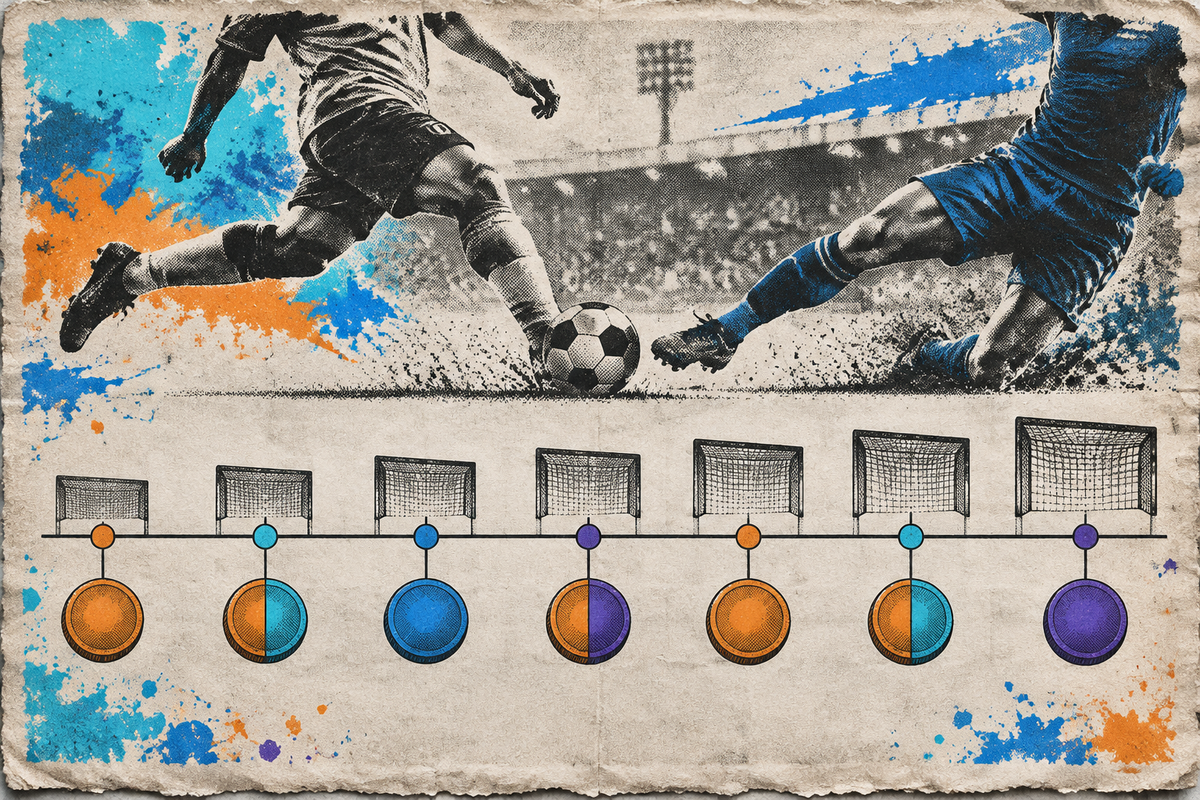
Books set the number to balance money on both sides. That is why handicap prices cluster near 1.90 to 2.00 (roughly -110), and why you rarely see a huge price on either side of the line.
The draw is not a separate outcome. A level game resolves to whichever side the handicap favours, or pushes if the line lands exactly on the margin. The concept itself is well documented. The part that costs people money is the settlement.
Whole, Half and Quarter Lines: How Each One Settles
Three families of numbers, three different behaviours. This table assumes you are backing the favourite.
| Line | What the bet needs | Level score |
|---|---|---|
| 0 (draw no bet) | Team wins the match | Stake returned |
| -0.5 | Team wins the match | Bet loses |
| -0.75 | Win by 1 for a half win, by 2+ for a full win | Bet loses |
| -1 | Win by 2 or more | Stake returned |
| -1.25 | Win by 1 for a half loss, by 2+ for a full win | Bet loses |
| -1.5 | Win by 2 or more | Bet loses |
| -1.75 | Win by 2 for a half win, by 3+ for a full win | Bet loses |
Quarter lines exist because a book wants a number between two whole ones. Your stake splits evenly across the two nearest half lines, which is why a one-goal margin can pay a half win or a half loss instead of a full one.
The underdog mirrors it. At +0.75 your stake is half +0.5 and half +1, so a one-goal defeat returns half your money and loses the other half. At +1, a one-goal defeat returns the full stake.
How This Differs From the Standard 1X2 Market
A 1X2 market gives you three prices for three results. The draw is a live outcome and it carries real value, which is exactly why it can be an expensive place to park a bet you did not think through. The handicap throws that third price away.
Two things follow. The price becomes a cleaner statement of what the market expects, and there is less room to bury margin in two numbers than in three. Draw no bet is the 0 handicap under a different name, so if your book lists DNB, you already understand the first step.
If you want the three-way picture before you choose a number, our football predictions page sets out win, draw and loss chances for the day’s fixtures. Read it, then decide whether the draw is worth paying for or worth removing.
A Worked Example on a Quarter Line
No real fixture here, just the arithmetic. Say you take a side at 1.90 (-111) on -0.75 and stake 10 units.
- Win by two or more: both halves win. You get 19 units back, 9 profit.
- Win by one: the -0.5 half wins (9.50 back), the -1 half is voided (5.00 back). Total 14.50, profit 4.50.
- Draw or defeat: both halves lose. Nothing comes back.
That 4.50 is the whole case for quarter lines. You get a partial result instead of an all-or-nothing one, and the price moves to reflect it. If your book offers both -0.75 and -1 on the same team, compare the two payouts before staking. The safer number always pays less, so decide what the extra cushion is worth to you.
Reading the Price Before You Take the Number
Decimal odds convert to implied probability in one step: divide 1 by the price. A 1.90 shot implies 52.6%. A 2.10 shot implies 47.6%.
Add both sides up and you get the book’s margin. A hypothetical two-way market at 1.95 and 1.95 implies 51.3% each, a total of 102.6%, so the margin is 2.6%. A hypothetical three-way market at 2.40, 3.30 and 3.10 implies 41.7%, 30.3% and 32.3%, a total of 104.3%. Three prices, more margin.
That gap is why some bettors do most of their work in two-way markets. The free implied probability calculator does the conversion, and the de-vig calculator strips the margin out so you can compare your own estimate to a fair price.
Once the margin is off, you have one real question. Does this team win by two more often than 52% of the time? That is a data question. Removing the vig is the first skill worth building, because every other judgement depends on the fair number.
What Does the Data Underneath the Line Look Like?
A StatsBench props snapshot from early November 2026 shows the player-level side of several matches on the same cards. Prices below are the best available across 30+ sportsbooks, DFS apps and exchanges, with the record from the last 10 games (or fewer where the sample is shorter).
| League | Player | Match | Market | Record | Best price |
|---|---|---|---|---|---|
| Serie A | Antoine Hainaut | Venezia vs Udinese | Shots 0.5+ | 8/10 | 1.53 (-188) |
| EPL | Kiernan Dewsbury-Hall | Everton vs Coventry | Tackles 1.5+ | 7/10 | 1.59 (-170) |
| Bundesliga | Fábio Vieira | HSV vs Gladbach | Shots on target 0.5+ | 7/10 | 1.67 (-150) |
| Serie A | Gianluca Busio | Venezia vs Udinese | Tackles 1.5+ | 5/6 | 1.65 (-155) |
| La Liga | Youssouf Fofana | Sevilla vs Alavés | Shots on target 0.5+ | 5/8 | 1.95 (-105) |
| Serie A | Albion Rrahmani | Venezia vs Udinese | Shots on target 0.5+ | 2/8 | 1.53 (-189) |
| EPL | V. Torp | Coventry at Everton | Assist 0.5+ | 1/5 | 6.50 (+550) |
Read the price against the record, never the record alone. Hainaut’s 8/10 and Rrahmani’s 2/8 sit at the same 1.53 (-189) price, which tells you the number is not a summary of the last ten games. Torp at 1/5 pays 6.50 (+550), roughly a 15% implied chance, on a five-game sample that is close to noise.
This is a ranked selection from one slate, not a survey of the market. Treat it as an example of how to read a price, not a shortlist.
The same expectation that prices a -1 line prices the shots, tackles and saves markets in that match. If both keepers carry high saves lines, the market expects a busy game at both ends. If a fullback’s tackle line sits high, someone expects him to defend a lot. That is context for a handicap bet, not a signal on its own.
The Line Shopping Habit That Pays for Itself
Handicap numbers differ slightly between books, and a quarter of a goal is worth real money across a season. The same habit applies on player markets. StatsBench compares the best price across 30+ sportsbooks, DFS apps and exchanges, so the Premier League prop board shows you a full card’s worth of prices side by side, and the Serie A prop board does the same for Italian fixtures.
Shopping only helps if you know the number you want. Write down the price you think is fair before you open a book, then take the best of what is offered. If nothing beats your number, there is no bet. That discipline is the difference between a research process and a scroll through the app.
Where the Handicap Fits With Other Football Markets
Totals and handicaps are cousins. A handicap asks who wins by how much. The Asian total asks how many goals land in the game, and the two markets often disagree about the same match, which is worth knowing before you stake.
If you are weighing a big underdog plus a start, check the goals side first. Our over 2.5 goals page ranks the day’s highest-scoring fixtures, and both teams to score tells you whether the market expects the underdog to get on the sheet. If a +1.5 line only works when the underdog scores, that is a different bet to the one you thought you were making.
Player markets close the loop. The football player props guide covers how shots, tackles and card lines are built, and the EPL board lets you filter the day’s props by market and price. Use team-level markets for the result and player-level data for the workload behind it.
Bet only where it is legal and at the legal age where you live. A handicap bet is a long-run proposition. A good price on a 55% outcome still loses 45% of the time, and one result tells you nothing about whether the method works. Stake what you can afford to lose.
Free account
See today’s football player props on StatsBench
Live lines, last-10 hit rates and the best price across 30+ books and pick’em apps. A free account opens the board.
Open the football player props board →
Prefer email? Get the daily picks newsletter.
Frequently Asked Questions
What does Asian handicap +1 mean?
The team you back starts a goal ahead. It wins the bet if the match is drawn or if it wins outright. A one-goal defeat returns your stake, and only a two-goal defeat loses the bet.
What happens to an Asian handicap bet when the game is a draw?
It depends on the line. A +0.5 or +1 underdog bet wins, a 0 line is voided and the stake comes back, and any negative favourite line loses. There is no draw price to fall back on.
Is Asian handicap the same as draw no bet?
The 0 handicap and draw no bet are the same bet under two names. Every other handicap, including -0.5 and the quarter lines, removes the draw entirely rather than refunding it.
Why do handicap prices sit close to even money?
The book picks the number that balances money on both sides, so neither price needs to be far from 1.90 to 2.00 (around -110). The margin on a two-way market also has fewer places to hide than on a 1X2 market.
What is a quarter line in Asian handicap betting?
It is a number between two whole lines, like -0.75 or -1.25. Your stake splits evenly across the two nearest half lines, so you can end up with a half win, a half loss, or a mix of a win and a refund.
 Today's NBA picks


 Today's NFL picks



 Today's NHL picks


 Today's College Football picks


 Today's EPL picks



 Today's La Liga picks



 Today's Serie A picks



 Today's Bundesliga picks



 Today's Ligue 1 picks



 Today's MLS picks



 Today's EFL Championship picks



 Today's CS2 picks



 Today's LoL picks



 Today's Valorant picks
 Today's Dota 2 picks


 PHI
 DET
 BOS
 ATL
 TOR
 CLE
 NY
 WSH
 CHA
 MIA
 IND
 ORL
 BKN
 CHI
 MIL
 POR
 LAL
 HOU
 OKC
 SA
 MEM
 GS
 MIN
 DEN
 NO
 DAL
 PHX
 LAC
 UTAH
 SAC
 BUF
 DEN
 JAX
 PIT
 KC
 CIN
 NE
 CLE
 LV
 BAL
 HOU
 NYJ
 IND
 MIA
 TEN
 LAC
 SF
 MIN
 NYG
 CAR
 CHI
 DET
 GB
 SEA
 LAR
 TB
 ATL
 ARI
 DAL
 WSH
 NO
 PHI
 CAR
 BOS
 MTL
 TB
 NJ
 OTT
 FLA
 NYR
 TOR
 BUF
 DET
 WSH
 NYI
 CBJ
 PIT
 PHI
 MIN
 EDM
 VGK
 UTA
 DAL
 COL
 SEA
 NSH
 ANA
 STL
 CGY
 WPG
 SJ
 LA
 CHI
 VAN
 MIA
 UGA
 UTAH
 ND
 UCLA
 IU
 BYU
 UK
 ALA
 TEX
 OSU
 MISS
 TTU
 WAKE
 LSU
 TENN
 HOU
 USC
 MIZ
 BOIS
 IOWA
 UNM
 SC
 ARIZ
 FLA
 ARS
 MCI
 BHA
 CHE
 LIV
 BRE
 EVE
 BOU
 TOT
 AVL
 Hull City
 LEE
 NEW
 IPS
 FUL
 Coventry
 MUN
 CRY
 NFO
 SUN
 BAR
 ATM
 RMA
 BET
 RSO
 SEV
 ATH
 DEP
 VIL
 CEL
 ALA
 RAY
 GET
 ESY
 OSA
 RAC
 ELC
 LVT
 VAL
 MAL
 LAZ
 INT
 ROM
 COM
 MIL
 Frosinone
 JUV
 NAP
 BOL
 TOR
 GEN
 CAG
 ATA
 LEC
 PRM
 FIO
 SAS
 MON
 UDI
 VEN
 FCB
 BVB
 SCF
 RBL
 SVW
 B04
 SV Elversberg
 SGE
 M05
 FCA
 VFB
 TSG
 KOE
 SC Paderborn 07
 HSV
 FCU
 FC Schalke 04
 BMG
 PSG
 LOSC
 LYO
 PFC
 REN
 OM
 ASM
 NCE
 LEN
 B29
 LOR
 TOU
 STR
 AUX
 ANG
 Troyes
 Le Mans
 LEH