NCAAF public betting splits tell you where the crowd sits on a college football game. They don’t tell you who wins. That gap is where most bettors get hurt: they see a lopsided number, assume the market is about to flip, and take the other side without checking the price.
Read the numbers correctly and they become useful context. Read them as a signal on their own and you’re guessing with extra steps.
What does NCAAF public betting percentage actually mean?
It’s a book’s estimate of how bets are split on a game, reported two ways: percent of tickets and percent of handle. Tickets count bets. Handle counts money. When a game shows 78% of tickets on the favorite but only 55% of the money, someone with real size is on the other side.
Three limits to keep in mind before you act on any of it:
- Tickets are not money. A hundred $10 bets and one $2,000 bet are not the same signal.
- Each book reports its own split. DraftKings, FanDuel and BetMGM don’t post matching numbers, and none of them shows the whole market.
- Splits update. What you read on Wednesday morning isn’t the closing picture on Saturday night.
So the useful question isn’t “is the public on the favorite?” It’s “who is taking the other side, and what happened to the line when they did?”
Why ticket count and handle disagree
College football is a volume sport for casual money. Ranked teams, big brands and marquee kickoff windows pull in a flood of small bets on the favorite and the over. A Saturday slate can have ten games where the popular side is obvious before the lines even settle.
Handle is quieter. A smaller number of larger bets, often placed earlier in the week, does most of the price movement. When ticket percent and handle percent point in opposite directions, that gap is the thing worth studying. It usually means a handful of accounts disagreed with the crowd and had enough behind the opinion to matter.
One caution: the handle data is always partial. Books report what they choose to report, and the reporting lags the betting.
How reverse line movement exposes sharp money
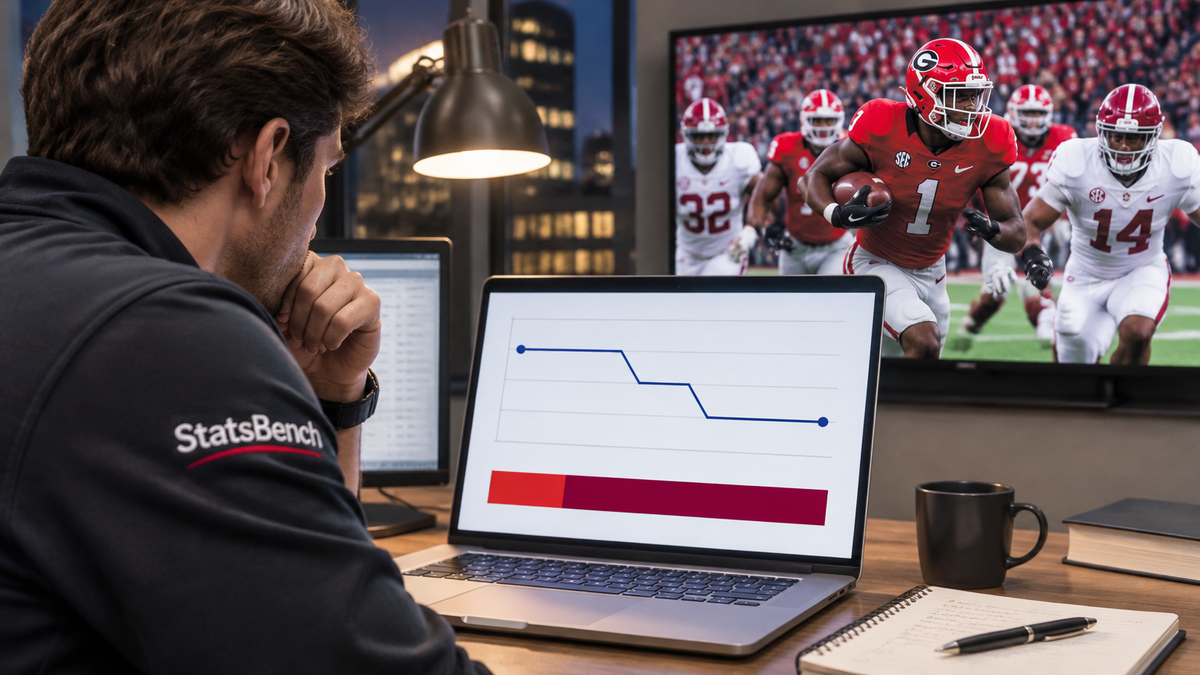
Reverse line movement is when the line moves against the popular side. Say 70% of tickets are on the home team at -6.5, and by kickoff the number sits at -5.5. The book has taken so much on the road team that it needs to attract money back onto the favorite.
That’s a real signal, and it’s the most cited one in public betting analysis. It’s also noisy in three specific ways:
- Injuries and weather move lines without any sharp money involved. A starting quarterback ruled out on Thursday shifts a spread more than a public split ever will.
- Books manage risk, they don’t grade picks. A move tells you where the liability sat, not what will happen on Saturday.
- The sharp side wins more often over large samples. That is a much weaker claim than “right on this game.”
You can measure what a move is worth instead of eyeballing it. Run both prices through the de-vig calculator to strip the book’s margin, and you’ll see whether the shift reflects a real change in implied probability or just juice being nudged.
When the crowd gets it right
Fading the public is not a strategy by itself. Crowds win plenty: home favorites in November, overs in good weather, big brands against Group of Five opponents. The crowd number is only mispriced when the price hasn’t caught up to what the money already knows.
That’s why line history matters more than the split. A 75% ticket share on a line that never budged is a book comfortable with its exposure. The same share with a two-point move in the other direction is a different story entirely.
Do free NCAAF picks beat a public betting read?
No, and neither one works alone. A free pick is a conclusion with no evidence behind it. A public split is evidence with no conclusion attached. You need your own number plus a price.
The workable order is unglamorous:
- Build a number before you look at the market. Power ratings, pace, injury news, home field.
- Compare your number to the posted line and note the gap.
- Check the public split and the line history. Heavy tickets on one side with a move the other way is context, not a bet.
- Price it. If the wager is worth making, it should still be worth making at the worst number you’d accept.
Computer ratings help because they force you to write a number down. Our guide to vetting NCAAF computer picks walks through the checks that separate a usable model from a list of scores. The spread handicapping guide covers the same idea from the line side, and the parlay piece explains why stacking public sides multiplies the vig.
What public splits can’t tell you about player props
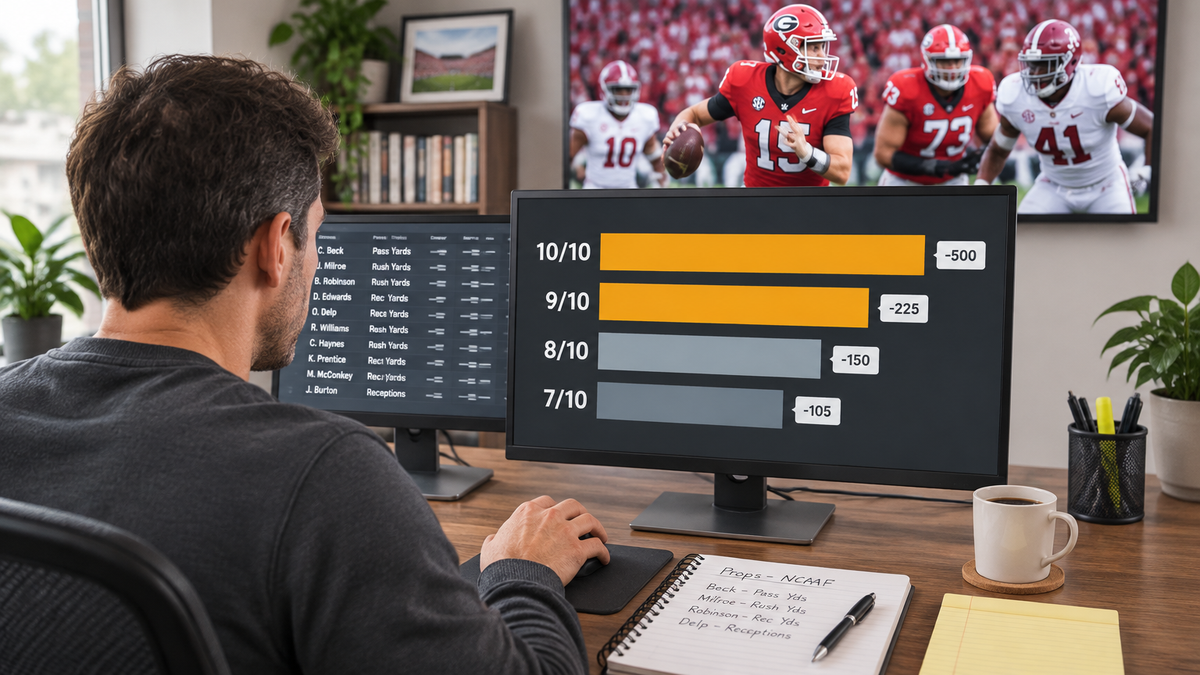
Almost nothing. Public betting percentages are published for spreads, totals and moneylines, and they rarely reach player props. That’s an advantage, not a gap. College football props are thinner markets with less attention, so a real research process can find more there than on a Saturday night spread everyone already bet.
Here’s a snapshot from the StatsBench college football board, pulled from a November 2026 slate. Each row is one prop, the record in the tracked sample, and the best price available at the time.
| Player (game) | Prop | Line | Record | Best price |
|---|---|---|---|---|
| Wayne Knight (UCLA vs. Illinois) | Anytime TD | 0.5 | 10/10 | -225 |
| Jayden Maiava (USC at Indiana) | Pass yards | 227.5 | 9/10 | -114 |
| Devon Dampier (Utah at Arizona) | Pass TDs | 1.5 | 9/10 | -104 |
| Jaylin Carter (Memphis at USF) | Rec yards | 13.5 | 8/10 | -125 |
| Marcus Stokes (Memphis at USF) | Rush yards | 19.5 | 7/9 | -120 |
| Jordan Gant (Akron vs. Western Michigan) | Rush + rec yards | 82.5 | 7/10 | -115 |
Hit rate alone isn’t a bet, and this table shows why. A 10/10 record at -225 needs roughly 69% to break even. A 7/10 record at -115 needs about 53.5%. Read the two together and the “worse” record is the one with more room to be a good bet, because the price already gave back most of the certainty.
Sample size matters just as much. Nine or ten tracked games is a small window, and a hot streak can cool off in a month. The college football props that hold up best tend to be volume-driven: passing yards, rush attempts, receptions. Touchdown and longest-reception markets swing on a single play.
StatsBench shows a +EV % on every prop and lets you sort by Best EV, so you’re comparing prices across 30+ sportsbooks, DFS apps and exchanges instead of taking the first number you see. The NCAAF prop board is where those rows live. For a wider look at how these markets are built and graded, the college football player props guide covers the prop types in detail.
The other half of the bet is the number you take
Every public betting discussion circles back to price. A 60% proposition at -115 and the same proposition at +105 are different bets. College football lines move all week, and the same game can sit at three different numbers depending on the book, the DFS app or the exchange you check.
Shopping is the least exciting edge in betting and one of the most reliable. Two free tools make it concrete: the implied probability calculator turns any price into the win rate you need, and the vig calculator shows how much margin sits inside a two-sided market.
If the crowd is on the favorite at -6.5 and you can take the dog at +7 somewhere else, you aren’t fading the public. You’re paying less for the same opinion. That’s a better position no matter who covers.
Keeping the read honest
Public betting data is context, not a tip sheet. Any single Saturday can make the sharpest read look silly, because a short run of results looks like a pattern more often than people expect. Track your bets, grade them honestly, and judge the process over months rather than weekends. The performance page at NCAA.com is a decent place to start when you want raw team and player numbers instead of opinion.
Bet within your means and treat it as entertainment with a math hobby attached. 21+ where legal, and 1-800-GAMBLER if it stops being fun. StatsBench’s Bet Tracker is free and it’s the simplest way to see whether your reads are actually working.
Free preview
See today’s college football player props on StatsBench
Live lines, hit rates and the best price across 30+ books and pick’em apps. A free preview shows today’s first props; a free account shows more.
Open the college football player props board →
Prefer email? Get the daily picks newsletter.
Frequently Asked Questions
What does public betting mean in college football?
It’s the share of bets and money a sportsbook reports on each side of a game. Books usually show two numbers: percent of tickets and percent of handle. They measure the crowd, not the outcome.
Is fading the public a good NCAAF strategy?
Only when the price hasn’t already adjusted. A heavy public side on a line that never moved is a book comfortable with its exposure. The same split with a move in the other direction is a different situation, and even then it’s context rather than a bet on its own.
Where do you find public betting percentages for college football?
Most large sportsbooks publish splits inside their app or site, and each one reports its own numbers. Expect them to disagree, and expect the figures to change as the week goes on.
Do public betting splits work for player props?
Rarely, because splits are published for spreads, totals and moneylines. Player props get far less public attention, which is exactly why a hit-rate and price comparison is more useful there than a crowd number.
How big a sample do you need before trusting a prop hit rate?
More than ten games, in most cases. A 10-for-10 run is encouraging but fragile, and the price has to leave room anyway. Volume stats like passing yards and receptions stabilize faster than touchdown or longest-reception markets.
 Today's NBA picks


 Today's NFL picks


 Today's NHL picks



 Today's College Football picks
 Today's CS2 picks

 Today's LoL picks

 Today's Valorant picks
 Today's Dota 2 picks
 PHI
 BOS
 DET
 ATL
 NY
 TOR
 CLE
 MIA
 CHA
 WSH
 IND
 ORL
 BKN
 CHI
 MIL
 LAL
 SA
 OKC
 GS
 MIN
 HOU
 MEM
 POR
 DAL
 DEN
 NO
 PHX
 LAC
 SAC
 UTAH
 BUF
 DEN
 JAX
 PIT
 KC
 CIN
 NE
 CLE
 LV
 BAL
 HOU
 NYJ
 IND
 MIA
 TEN
 LAC
 SF
 CHI
 NYG
 CAR
 DET
 MIN
 GB
 SEA
 LAR
 DAL
 NO
 TB
 ATL
 ARI
 WSH
 PHI
 CAR
 BOS
 NJ
 MTL
 TB
 OTT
 NYR
 FLA
 BUF
 WSH
 NYI
 TOR
 DET
 PHI
 CBJ
 PIT
 EDM
 MIN
 VGK
 DAL
 COL
 NSH
 ANA
 UTA
 SEA
 CGY
 WPG
 SJ
 STL
 LA
 CHI
 VAN
 UGA
 UTAH
 ND
 UCLA
 MIA
 IU
 ALA
 TEX
 TENN
 TTU
 WAKE
 BYU
 UK
 HOU
 USC
 IOWA
 BOIS
 ORE
 MISS
 SC
 OSU
 ARIZ
 UNM
 LSU
 SMU