
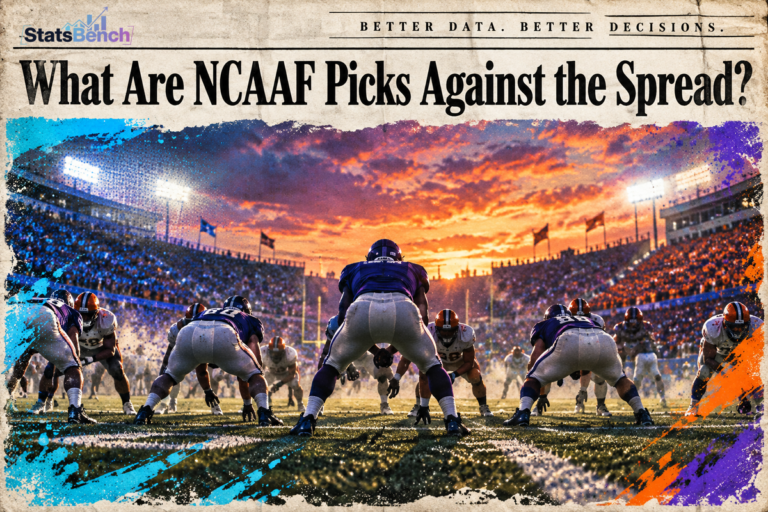
An NCAAF pick against the spread is a wager on the final margin, not on the winner. The book sets a point handicap for each game, and your pick cashes if the team you chose covers that number. A 7-point favorite has to win by 8 or more. A 7-point underdog can lose by 6 and still pay.
That is the whole concept. The part that takes longer is learning how those numbers get built, why they move, and how to tell a researched pick from a coin flip with a team logo stamped on it.
How NCAAF Picks Against the Spread Are Graded
Grading is easier once you see one example. Say a team is listed -6.5 and you take the favorite. They win 24-17, a 7-point margin, and the bet cashes by half a point. Same game and same score on a -7 line would have pushed and returned your stake.
Whole numbers push. Half numbers do not. That is why books charge more for -6.5 than for -7, and why moving a line half a point in your favor (buying the hook) has a real price attached.
Three rules cover almost every ticket:
- Favorites must win by more than the spread.
- Underdogs must lose by less than the spread, or win outright.
- Pushes only happen on whole numbers, and the stake comes back.
A Spread Pick Is Not a Prediction of the Winner
An ATS bet can win while the team you backed loses the game. That is the entire point of the handicap, and it trips up newer bettors who assume every pick is a winner prediction.
Moneyline betting asks who wins. Spread betting asks by how much. A 14-point underdog that loses 31-24 cashes the ATS ticket and loses the moneyline in the same afternoon. Treating those two bets as the same thing is one of the most common mistakes in college football betting.
Where the Spread Comes From
College football spreads start with a power rating. Oddsmakers rate every team, adjust for home-field advantage and injuries, and post an opening number. From there the market takes over and the line drifts toward where the money sits.
Two things matter for a bettor. First, an opening line is a guess, and guesses get beaten. Second, 3 and 7 are the margins that come up most often in football scoring, so spreads sitting on those numbers attract the heaviest action and move the least.
The juice matters as much as the number itself. At -110 on both sides you need to win 52.4% of your ATS picks just to break even. That math is not optional. You can run any price through the implied probability calculator before you commit a unit.
What Is NCAAF Public Betting?
NCAAF public betting is the split of bets and money on each side of a game. Books publish both figures, and they are rarely identical. One side can take most of the tickets while a much smaller share of the handle lands there.
That gap is the interesting part. A line that moves toward the popular side usually means the book is managing exposure. A line that moves the other way, against the crowd, usually means sharper money got down early. Bettors call that reverse line movement. It is a clue, not an answer.
Read public percentages as context, never as a verdict. A crowd does not make a side right or wrong. It only tells you where the current price came from.

Are Free NCAAF Picks Actually Worth Anything?
Sometimes. The honest version is that free NCAAF picks are content, and content is not a process. A pick with no reasoning behind it gives you nothing to grade, nothing to repeat, and nothing to learn from the following week.
What does have value is a repeatable method: a rating for each team, a read on pace and matchups, a price check across books, and a record you keep yourself. Our guide to vetting NCAAF computer picks lists the questions to ask before trusting any number set, and the CFB picks ATS guide goes deeper on handicapping a spread.
What Can Data Actually Tell You About a Spread?
Team data tells you what a team tends to do. It cannot tell you what the line already reflects. That gap is where ATS picks get interesting, and it is where most casual research stops.
Player props sit on the same Saturday and hint at how a game might be scripted. Here is a snapshot from an early-November 2026 college football slate, pulled from StatsBench:
| Player prop | Record | Best price |
|---|---|---|
| Byrum Brown (AUB vs ARK), anytime TD | 10/10 | -165 |
| Nate Sheppard (DUKE @ NCSU), anytime TD | 10/10 | -370 |
| Aidan Chiles (NU vs IOWA), anytime TD | 9/10 | +150 |
| Avery Johnson (KSU vs OKST), 0.5 pass TD | 8/10 | +120 |
Same record, wildly different price. Brown and Sheppard both cleared their touchdown prop in 10 of 10 tracked games, and one pays -165 while the other pays -370. The record alone says nothing about value. The price tells you what the market already believes.
Flip it and the lesson holds. Avery Johnson cleared half a passing touchdown in 8 of 10, and that bet pays plus money. A lower hit rate at a bigger price beats a perfect record with no margin left in it.
The same trap catches spread bettors. A team sitting 10-0 against the number is not automatically a good bet next Saturday, because the number has moved to reflect that run. College football props live on the NCAAF Prop Finder board, where the full record sits next to the best available price. The weekly college football props page is where those numbers get refreshed.
A Short Checklist Before You Back a Side
Four checks catch most bad ATS tickets:
- Has the number already moved? If you are taking a side two points off the opener, you are paying for news you did not act on.
- What is the price? -115 and -105 are different bets on the same spread. Shop across books.
- Who is missing? A starting quarterback out changes the number before it changes the public’s opinion.
- Does the matchup fit the number? A fast-tempo offense and a ball-control offense are playing two different games. Strength of schedule is a rough proxy for how those team numbers were built.
Should You Put ATS Picks in a Parlay?
Usually not more than two. ATS legs are not as independent as a parlay calculator assumes. Two favorites in the same conference, in games with similar weather, tend to move together. Every extra leg also multiplies the vig against you.
If you build one anyway, correlate the legs on purpose and count the price first. Our guide to NCAAF parlay picks covers building around a game script instead of stacking big names.
Where the Edge Actually Lives
Not in a free pick, and not in a 10/10 record printed without a price beside it. The edge in spread betting comes from a number that is wrong for a reason you can explain, at a price you shopped, in a market you understand.
That is a slow process, and it is the one that survives a losing Saturday. College football is a small-sample sport, so treat one weekend as noise. Bet within your means, remember this is research and entertainment rather than income, and know that 21+ bettors in legal markets are the only audience here. If it stops being fun, 1-800-GAMBLER is there.
For the official side of the college game, the NCAA’s FBS football page carries schedules, results and rules. For background on how spread betting works as a concept, Wikipedia’s spread betting entry is a reasonable starting point.
Free preview
See today’s college football player props on StatsBench
Live lines, hit rates and the best price across 30+ books and pick’em apps. A free preview shows today’s first props; a free account shows more.
Open the college football player props board →
Prefer email? Get the daily picks newsletter.
Frequently Asked Questions
What does ATS mean in college football?
ATS means against the spread. The bet is graded on the final margin rather than on which team wins, so an underdog can cash a ticket in a loss. A favorite has to win by more than the posted number.
What happens to an ATS pick if the game lands exactly on the spread?
That is a push, and your stake is returned. Pushes only happen on whole-number spreads like -7 or +3. Half-point lines such as -6.5 exist specifically to remove the push.
Is NCAAF public betting data useful for spread picks?
It is context, not a signal. The split between ticket count and money handle tells you why a line moved, and a line moving against the crowd can flag sharper money. It never makes a side correct on its own.
Are free NCAAF picks reliable?
Treat them as content, not a track record. A pick without the reasoning, the price, and a graded history behind it gives you nothing to evaluate. Build or borrow a repeatable method and grade it yourself.
What win rate do you need to break even on ATS picks?
At standard -110 juice you need to win 52.4% of your spread bets to break even. Anything below that loses to the vig over a large sample, which is why price shopping matters as much as handicapping.
 Today's NBA picks


 Today's NFL picks

 Today's NHL picks


 Today's College Football picks

 Today's EPL picks



 Today's La Liga picks


 Today's Serie A picks



 Today's Bundesliga picks



 Today's Ligue 1 picks



 Today's MLS picks



 Today's CS2 picks

 Today's LoL picks



 Today's Valorant picks
 Today's Dota 2 picks



 PHI
 BOS
 DET
 ATL
 TOR
 CLE
 NY
 WSH
 MIA
 IND
 CHA
 ORL
 BKN
 CHI
 MIL
 LAL
 HOU
 OKC
 SA
 POR
 MIN
 MEM
 GS
 DEN
 DAL
 NO
 PHX
 LAC
 UTAH
 SAC
 BUF
 DEN
 JAX
 PIT
 KC
 CIN
 NE
 CLE
 LV
 BAL
 HOU
 NYJ
 IND
 MIA
 TEN
 LAC
 SF
 MIN
 NYG
 CAR
 CHI
 DET
 GB
 SEA
 LAR
 TB
 ATL
 ARI
 DAL
 WSH
 NO
 PHI
 CAR
 BOS
 MTL
 TB
 NJ
 OTT
 FLA
 BUF
 NYR
 TOR
 DET
 WSH
 NYI
 CBJ
 PIT
 PHI
 MIN
 EDM
 VGK
 UTA
 DAL
 COL
 SEA
 NSH
 ANA
 STL
 CGY
 WPG
 SJ
 LA
 CHI
 VAN
 MIA
 UGA
 UTAH
 ND
 UCLA
 IU
 BYU
 UK
 ALA
 TEX
 OSU
 MISS
 TTU
 WAKE
 LSU
 TENN
 HOU
 USC
 MIZ
 BOIS
 IOWA
 UNM
 SC
 ARIZ
 FLA
 ARS
 MCI
 BHA
 CHE
 EVE
 LIV
 BRE
 LEE
 BOU
 TOT
 AVL
 Hull City
 NEW
 IPS
 FUL
 Coventry
 MUN
 CRY
 NFO
 SUN
 BAR
 ATM
 RMA
 BET
 RSO
 SEV
 ATH
 DEP
 ALA
 VIL
 CEL
 RAY
 GET
 ESY
 OSA
 RAC
 ELC
 LVT
 VAL
 MAL
 LAZ
 INT
 ROM
 COM
 MIL
 Frosinone
 JUV
 NAP
 BOL
 TOR
 GEN
 CAG
 ATA
 LEC
 PRM
 FIO
 SAS
 MON
 VEN
 UDI
 FCB
 BVB
 SCF
 RBL
 SVW
 B04
 SV Elversberg
 HSV
 SGE
 M05
 FCA
 VFB
 TSG
 KOE
 SC Paderborn 07
 FCU
 FC Schalke 04
 BMG
 PSG
 LOSC
 LYO
 PFC
 REN
 OM
 ASM
 NCE
 LEN
 TOU
 B29
 LOR
 STR
 AUX
 ANG
 Troyes
 Le Mans
 LEH