
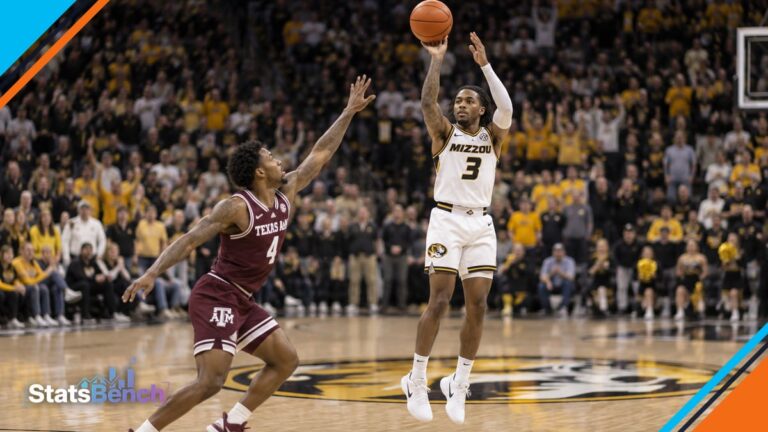
NCAAB public betting gives you two numbers on the same game, and they rarely agree: the percentage of tickets on a side and the percentage of money. Tickets count bets. Money counts dollars. Most of the time those two figures split apart, and the gap is the only part worth a second look.
Here’s what each number actually means, when a gap tells you something, and why the whole exercise gets shaky once you leave the power conferences.
What is the difference between bet percentage and money percentage?
Bet percentage is the share of individual wagers on a side. Money percentage is the share of dollars. A $10 bet and a $2,000 bet each count as one ticket, but they are nowhere near the same amount of money.
So when a book reports 68% of bets and 41% of money on a home favorite, it means more people took the favorite while the bigger stakes landed on the other side. That’s the entire mechanic. The interpretation is where bettors get carried away.
Three things the numbers don’t include. Books choose what to publish, and some publish nothing. The percentages cover that book’s own handle, not the whole market. And two books can show opposite splits on the same game while both are telling the truth about their own customers.
NCAAB public betting: what a gap between tickets and money suggests
A gap suggests the side with fewer tickets is carrying bigger bets. It does not tell you who placed them or why.
Picture a game where the road team draws most of the tickets and a small slice of the money. Three explanations fit, and the published number can’t separate them:
- Informed money. A few bettors with a real opinion took a position at a size that outweighs the crowd.
- One big bet. A single wager can move a money percentage in a market that isn’t deep.
- A book quirk. Promos, boosts or a stale line can funnel tickets to one side with no sharp involvement at all.
The usual follow-up is reverse line movement, where the line drifts against the popular side. It’s a real signal and it’s easy to overread. A line can move because of an injury, a lineup change, or a book rebalancing its exposure rather than because anyone knows something.
When a gap is just noise
Most gaps are noise. If the market took a few hundred bets total, one customer can distort both percentages. If the snapshot was taken at 10 a.m. for a 9 p.m. tip, it describes a market that hasn’t formed yet. If a sportsbook is running a profit boost on one side, ticket count is measuring the promotion, not opinion.
For more on how books frame these two figures, our breakdown of tickets vs money in betting splits goes deeper on the mechanics.
Why splits are thinner on small-conference games
Low and mid-major games draw fewer bets, lower limits and fewer books posting a line. Thin markets make every percentage unstable.
Walk through what that means in practice:
- Low limits. A low-major game might cap bets at a few hundred dollars. One max bet is then a huge slice of the money number.
- Fewer books. If three books post the game and two of them publish splits, you’re looking at a fraction of the market.
- Late lines. Some small-conference games don’t get a real price until close to tip, so an early split describes almost nothing.
- Different crowd. The people betting a Wednesday night game between two teams hovering around .500 are not the crowd betting Duke. They tend to know the conference better.
Compare that to a Duke or Kentucky home game, where tickets arrive by the thousand and the money percentage carries real weight. Same sport, completely different signal quality.
The practical rule: the smaller the game, the more you should lean on the price and your own read, and the less you should lean on a split percentage.
What are the limits of betting splits as a signal?
They are a sentiment gauge, not a forecast. Nobody has shown that fading a high-ticket side wins over a large sample, and these percentages aren’t built for that job.
- Snapshot, not flow. You see one moment, not the sequence. Money can arrive after you look.
- No central tape. There’s no consolidated record across books, unlike a stock exchange.
- “Public” is shorthand. It’s a label for a group of customers, and the group changes by sport, market and time of day.
- Tickets are unweighted. A thousand $5 bets and one $5,000 bet register the same way in the ticket number.
- Books manage their own risk. A split reflects a book’s exposure, not a verdict on the game.
Used well, a split sits next to the things that decide games: who is available, how the teams play, and what the price is. If you want to know what the book thinks, work it out from the line instead of guessing from a percentage. Our de-vig calculator strips the margin out of a two-way price and shows the implied chance on each side.
Should a big money gap change your bet?
Only if you can explain it. A gap you can’t explain is a number, not information. If the money is on a side because a starter is out and the market hasn’t caught up, that’s actionable. If it’s on a side because one person bet $3,000 on a Tuesday afternoon, it isn’t.
The better habit is to measure your own results instead of the crowd’s. Write down the number you took and compare it to the closing line. Beat the close consistently and you’re doing the right work even when a bet loses. Sit consistently behind it and no split percentage will rescue the process.
What numbers can you actually verify in college basketball?
Player-level data you can check yourself: the line, the player’s record against it, and the best available price. That’s the stuff that holds up when you go back and look. StatsBench doesn’t publish betting splits, so we won’t pretend to. We publish props, records and prices.
Here’s a StatsBench snapshot from November 2026, pulled from the NCAAB prop board. Every row is a real line with a real record behind it.
| Player (game) | Prop | Record | Best price |
|---|---|---|---|
| Jeremy Fears Jr. (MSU vs UNI) | Turnovers over/under 2.5 | 10/10 | +102 |
| Tomislav Buljan (MD vs UVA) | Rebounds over/under 6.5 | 10/10 | -141 |
| Tomislav Buljan (MD vs UVA) | Pts + rebs + asts over/under 15.5 | 9/10 | -110 |
| Darin Smith Jr. (RUTG vs BRY) | Pts + rebs + asts over/under 15.5 | 9/10 | -120 |
| Dylan Faulkner (CLEM vs GTWN) | Rebounds over/under 7.5 | 8/10 | -119 |
| Andre Mills (MD vs UVA) | Pts + asts over/under 13.5 | 8/10 | -135 |
| Tomislav Buljan (MD vs UVA) | Pts + asts over/under 9.5 | 8/10 | +142 |
Look at the prices. A 10/10 record on a turnover line priced at +102 and a 10/10 on rebounds at -141 are different bets. The record alone doesn’t tell you whether either one is worth taking, and ten games is a small sample. Treat the record as context, not a promise.
StatsBench shows a +EV percentage on every prop and lets you sort by Best EV, which is a read on the price versus the rest of the market, not a guarantee. The board also compares prices across 30+ sportsbooks, DFS apps and exchanges, so you can see whether the number in front of you is actually the best one available.
Do splits matter more in the NCAA tournament?
Yes and no. Tournament games draw a far bigger casual audience, so ticket counts swell and money percentages get heavier and more informative. Neutral sites also remove home-crowd bias from the number. The catch is variance. One cold shooting half ends a season, and a single-elimination game gives a read very little room to play out.
How should you use a public betting number on a college game?
Treat it as one line in your notes. Check the price, check who’s playing, and check whether the line moved for a reason you can name.
- Write down the split and the time you saw it.
- Check the line movement since the open. If it moved against the popular side, ask why.
- Look for news first. An injury explains more line moves than sharp money does.
- Compare prices across books before you bet.
- Log the bet so you can review it later, win or lose.
For the football version of the same market, our piece on NCAAF public betting covers how ticket counts behave on Saturdays. The dynamics carry over, with the same caveats.
If you want a starting point for today’s games, the college basketball prop picks page has the current slate, and the college basketball stats hub collects the season-long numbers behind it. Official box scores and pace data live at NCAA.com if you’d rather build your own picture from scratch.
Bottom line
Tickets and money answer different questions. Tickets show how many people like a side. Money shows where the weight went. On a power-conference game with a deep market, the gap is worth a look. On a small-conference game with low limits and three books posting, it’s close to decoration.
Bet within your means, expect variance to run for weeks at a time, and keep the 21+ rules in mind wherever you are. If gambling stops being fun, the National Council on Problem Gambling runs a 24-hour helpline at 1-800-GAMBLER.
Free preview
See today’s college basketball player props on StatsBench
Live lines, hit rates and the best price across 30+ books and pick’em apps. A free preview shows today’s first props; a free account shows more.
Open the college basketball player props board →
Prefer email? Get the daily picks newsletter.
Frequently Asked Questions
What does it mean when the money percentage is higher than the ticket percentage?
It means fewer bets are carrying more dollars. The side with fewer tickets is attracting larger stakes, which could be informed money, one big wager, or a book rebalancing. The percentage alone won’t tell you which.
Are betting splits reliable in college basketball?
Only on games deep enough to produce a real market, which usually means power-conference matchups with high limits and many books posting. On thin games the percentages swing on very few bets.
Why are splits unreliable on small-conference games?
Fewer tickets, lower limits and fewer books posting a line. When a market takes a few hundred bets, one customer can distort the money percentage, and early numbers describe a price that hasn’t formed yet.
Is fading the public a winning strategy?
Not on its own. High ticket counts on one side don’t mean that side is wrong, and no published split has been shown to beat the closing line over a large sample. Use splits as context alongside price, availability and matchup.
Do betting splits predict who wins the game?
No. They describe where bettors put their money at one moment at one book. They say nothing about injuries, pace, or how the two teams actually match up.
 Today's NBA picks



 Today's NFL picks

 Today's NHL picks

 Today's College Football picks


 Today's College Basketball picks


 Today's CS2 picks
 Today's Valorant picks
 Today's Dota 2 picks


 BOS
 PHI
 DET
 ATL
 MIA
 NY
 CLE
 ORL
 TOR
 IND
 CHA
 WSH
 BKN
 CHI
 MIL
 SA
 LAL
 HOU
 POR
 MIN
 MEM
 OKC
 DEN
 GS
 DAL
 PHX
 LAC
 NO
 SAC
 UTAH
 BUF
 KC
 JAX
 CIN
 DEN
 PIT
 CLE
 NE
 BAL
 LV
 HOU
 IND
 NYJ
 MIA
 TEN
 LAC
 SF
 DET
 NYG
 CAR
 MIN
 CHI
 GB
 SEA
 LAR
 DAL
 WSH
 TB
 NO
 ATL
 ARI
 PHI
 CAR
 NJ
 TB
 MTL
 OTT
 BOS
 FLA
 NYR
 NYI
 WSH
 BUF
 DET
 TOR
 PHI
 PIT
 CBJ
 EDM
 MIN
 VGK
 COL
 NSH
 DAL
 ANA
 UTA
 WPG
 SJ
 STL
 SEA
 CGY
 LA
 CHI
 VAN
 UGA
 UTAH
 ND
 UCLA
 MIA
 IU
 ALA
 TEX
 TENN
 WAKE
 TTU
 BYU
 IOWA
 ORE
 BOIS
 OSU
 UK
 USC
 ARIZ
 HOU
 LOU
 LIB
 FLA
 MEM
 MISS
 MSU
 CONN
 UVA
 DUKE
 ILL
 KU
 SJU
 VAN
 MICH
 ARK
 GONZ
 NEB
 LSU
 Premier League table
 ARS
 BHA
 MCI
 LIV
 CHE
 EVE
 BOU
 BRE
 LEE
 AVL
 TOT
 NEW
 Hull City
 IPS
 FUL
 NFO
 Coventry
 MUN
 SUN
 CRY
 La Liga table
 BAR
 RMA
 ATM
 BET
 RSO
 SEV
 ATH
 VIL
 DEP
 RAC
 CEL
 ALA
 ESY
 RAY
 GET
 OSA
 LVT
 ELC
 VAL
 MAL
 Serie A table
 LAZ
 INT
 ROM
 MIL
 COM
 Frosinone
 JUV
 BOL
 CAG
 NAP
 TOR
 ATA
 GEN
 LEC
 FIO
 PRM
 SAS
 MON
 VEN
 UDI
 Bundesliga table
 FCB
 BVB
 SCF
 RBL
 B04
 SVW
 SV Elversberg
 VFB
 TSG
 SGE
 HSV
 M05
 SC Paderborn 07
 FCA
 KOE
 FCU
 FC Schalke 04
 BMG
 Ligue 1 table
 PSG
 LOSC
 PFC
 OM
 LYO
 NCE
 ASM
 REN
 B29
 LOR
 LEN
 TOU
 STR
 AUX
 Le Mans
 ANG
 Troyes
 LEH