
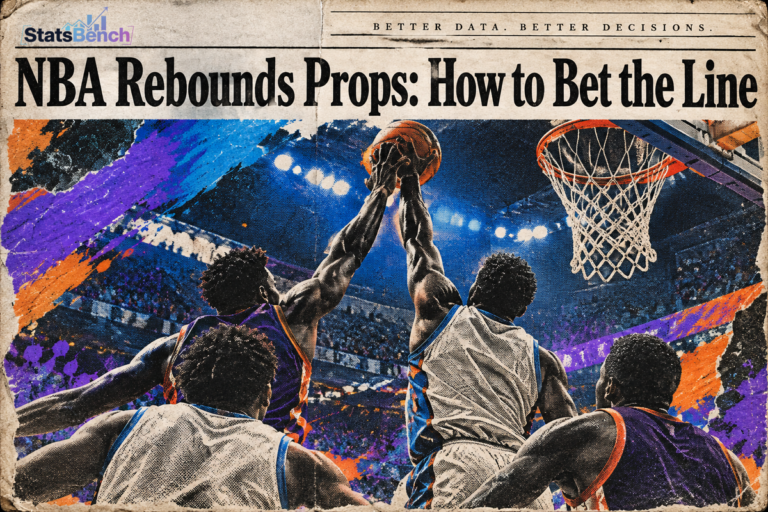
An NBA rebounds prop is an over/under on one player’s total rebounds in a single game. That’s the whole rule. The hard part is knowing which of the numbers in front of you is priced wrong, and most of that answer comes from minutes, role and matchup rather than talent.
Rebounding lines are the quiet end of the board. Fewer people bet them, the limits are softer, and the edge usually hides in a box score detail nobody bothered to check.
How do NBA rebounds props work?
The book posts a line, say 7.5 rebounds, plus a price on each side. Over 7.5 wins if the player grabs eight or more. Under 7.5 wins if he finishes with seven or fewer. Whole numbers like 8.0 create a push and your stake comes back.
Offensive and defensive rebounds count the same toward the total. A putback board and a defensive clear are both worth one. Game totals include overtime, so a five-minute extra period is a real factor on a big man’s number.
What the number does not include
Team rebounds do not count for any player. If a shot misses and the ball goes out of bounds off the defense, or nobody controls it cleanly, the stat crew credits the team, not a player. That matters on the under side, because a few of those a game quietly shrink everyone’s total.
The basic definition of a rebound in basketball is simple. The handicapping is where people get lazy.
Minutes come first, before anything else
Rebounds scale with time on the floor. A center who plays 32 minutes will almost always out-rebound the same center playing 22. So the first question on any rebounding line is not “is he good?” It’s “how many minutes is he getting tonight, and how sure am I about that?”
Check three things before you touch a price:
- Recent minutes trend. A starter logging 30+ every night is a stable bet. A guy who swung from 34 to 19 to 26 in his last three games is a guess.
- Who else is on the floor. A returning big man eats into the same rebounds your bet needs. So does a guard-heavy bench lineup that changes who protects the paint.
- Blowout risk. A 25-point game in the fourth quarter means starters sit. Rebound props die quietly in garbage time, and that risk is baked into the matchup, not the player.
If you only have last-10-game averages and no minutes context, you’re reading noise. That trap is worth understanding in detail, and it’s covered well in why last 10 games is a trap in NBA prop betting.
The three inputs that actually move a rebounding line
Once minutes are settled, three factors do most of the work. Rebound chance (how often the player grabs an available board while he’s on the floor), positional role, and the opponent’s shot profile.
That last one gets ignored. Rebounds only exist when shots miss. A team that takes and makes a lot of mid-range jumpers creates fewer live-ball misses than a team that bricks threes, and long three-point misses often bounce out to guards rather than bigs. So a center facing a high-volume three-point shooting team can see his number drop even in a fast game.
| Input | What to check | Why it moves the line |
|---|---|---|
| Minutes | Last 5 games, injury report, rotation notes | Rebounds scale almost linearly with floor time |
| Rebound chance | Boards per minute, not per game | Separates a good rebounder from a guy who plays 36 minutes |
| Opponent shot profile | Miss rate, three-point volume, pace | Missed shots create the chances; long misses go to guards |
If you like the player but hate the price on pure rebounds, combo markets are a reasonable detour. Points plus rebounds trades a little safety for a wider line, and the math is different enough to deserve its own read: how to bet points + rebounds combo props.
Hit rate without a price is a story, not an edge
A 60% hit rate sounds good. It isn’t, unless you know what the price demands. Every odds number carries a break-even rate, and if your hit rate sits below it, the bet loses money over time no matter how often it cashes.
- -110 breaks even at 52.4%
- -130 breaks even at 56.5%
- -150 breaks even at 60.0%
So a player who has gone over 6 of 10 times priced at -150 is not an edge. It’s a coin flip with extra juice. Run the conversion yourself with the free implied probability calculator before you decide a line is mispriced. For the deeper version of this idea, what 60% really means is a useful companion read.
A dated example from an October 2026 board
Here’s how the numbers look in practice. On an October 2026 StatsBench slate, one Washington forward’s rebounding lines read like this:
| Player (game) | Market | Line | Hit rate | Sample | Best price |
|---|---|---|---|---|---|
| Bilal Coulibaly (WAS @ CHA) | Rebounds | 3.5 | 60% | 3/5 | -150 |
| Bilal Coulibaly (WAS @ CHA) | Points + rebounds | 14.5 | 60% | 3/5 | -112 |
Two lines, same player, same 60% hit rate, very different bets. The pure rebounds line at -150 needs exactly 60% to break even, so there is no margin at all. The combo line at -112 needs about 52.8%, which leaves real room above the observed rate.
Now the part most people skip. That sample is three hits in five games. Five games tells you almost nothing about a rebounding rate, and the gap between 60% of five games and 60% of a full season is enormous. StatsBench’s edge figure on the pure rebounds line was 0.5%, basically noise. On the combo it was 4.1%, which is the more interesting number, and even that deserves skepticism at this sample size.
That’s the habit worth building: read the sample column before the hit-rate column. Small sample plus short price is a pass, not a play.
Shopping the line matters more here than most markets
Rebounding props get less attention than points, so prices are looser across books. The same 3.5 line can sit at -150 in one place and -125 in another. On a $50 bet that gap is roughly $7 of expected value handed back for no reason.
Line shopping across 30+ sportsbooks, DFS apps and exchanges is the single most boring edge in betting, and it’s free. StatsBench shows the best available price on every prop, which turns a twenty-tab exercise into one column. If you’re still converting American odds in your head, how to read player prop odds covers the format quickly.
Also strip the vig when you compare two sides of the same market. The de-vig calculator shows what the book actually thinks the fair price is, which is the number you’re trying to beat.
When to pass on a rebounds prop
Plenty of these lines are untouchable. Passing is a skill.
- Minutes uncertainty. A questionable tag, a back-to-back, or a coach who just changed his rotation.
- Foul trouble history. Bigs who average four fouls a game have a floor of 18 minutes on a bad whistle.
- Blowout spreads. A double-digit line is a warning that starters may not see the fourth quarter.
- Thin samples. Three or four games is a vibe, not a rate.
- Bad price. Even a genuinely good over is a bad bet at -160 when the fair number is -130.
Where to research rebounding lines and rates
StatsBench carries player props across every major stat, so rebounds sit next to points, assists and combos on the same board, with hit rates, game logs and the best price across books attached to each one. The NBA props preview is free and needs no account, which is a fine way to see whether the data lines up with how you already think about a game.
Two features do most of the work on this market. Prop Finder filters the daily board by stat type and market so you’re not scrolling past 200 point lines to find a rebound number, and Defense analysis shows which opponents give up the most boards by position. The rest is your judgment, which is the point. StatsBench is research, not a picks service.
One last thing worth saying plainly. Rebounding props are a long-run game. A 55% win rate over 200 bets still includes stretches of eight losses in ten, and no amount of research removes that. Bet within your means, treat it as entertainment with an analytical edge, and keep it 21+. If it stops being fun, the National Council on Problem Gambling helpline is 1-800-GAMBLER.
Free preview
See today’s NBA player props on StatsBench
Live lines, last-10 hit rates and the best price across 30+ books and pick’em apps. No account needed to look.
Prefer email? Get the daily picks newsletter.
Frequently Asked Questions
Do offensive rebounds count in prop bets?
Yes. Offensive and defensive rebounds are worth one each, and books grade player rebound props on the combined total. Team rebounds are the only boards that never count for an individual.
Does overtime count toward rebounds props?
Yes. Player props grade on the full game including any overtime period, which is why big men in close matchups can clear a line they looked short of through three quarters.
What hit rate do you need to profit on rebounds props?
It depends entirely on the price. At -110 you need 52.4%, at -130 you need 56.5%, and at -150 you need a full 60%. Convert the odds with an implied probability calculator before you judge a hit rate.
Why is a 3-of-5 hit rate unreliable?
Five games is far too small a sample to estimate a rebounding rate. The same player could be a 45% or 75% over hitter and produce that exact record, so treat short samples as context, not evidence.
What voids a rebounds prop?
If the player doesn’t appear in the game, the bet is typically voided and your stake returned. Rules vary by book, so check the house rules on player props before betting.
 Today's NBA picks


 Today's NFL picks

 Today's NHL picks



 Today's College Football picks


 Today's EPL picks



 Today's La Liga picks



 Today's Serie A picks



 Today's Bundesliga picks



 Today's Ligue 1 picks



 Today's EFL Championship picks



 Today's CS2 picks


 Today's LoL picks



 Today's Valorant picks
 Today's Dota 2 picks

 PHI
 DET
 BOS
 ATL
 TOR
 CLE
 NY
 WSH
 MIA
 CHA
 IND
 ORL
 BKN
 CHI
 MIL
 POR
 LAL
 HOU
 OKC
 SA
 MEM
 MIN
 GS
 DEN
 NO
 DAL
 PHX
 LAC
 UTAH
 SAC
 BUF
 DEN
 PIT
 JAX
 KC
 CIN
 NE
 CLE
 LV
 BAL
 HOU
 NYJ
 IND
 MIA
 TEN
 LAC
 SF
 MIN
 NYG
 CAR
 CHI
 DET
 GB
 SEA
 LAR
 TB
 ATL
 ARI
 DAL
 WSH
 NO
 PHI
 CAR
 BOS
 MTL
 OTT
 TB
 NJ
 FLA
 TOR
 BUF
 NYR
 DET
 WSH
 NYI
 CBJ
 PIT
 PHI
 EDM
 MIN
 VGK
 UTA
 DAL
 SEA
 COL
 NSH
 STL
 ANA
 CGY
 SJ
 WPG
 LA
 CHI
 VAN
 MIA
 UGA
 UTAH
 ND
 UCLA
 IU
 BYU
 UK
 ALA
 TEX
 OSU
 MISS
 TTU
 WAKE
 LSU
 TENN
 HOU
 USC
 MIZ
 BOIS
 IOWA
 UNM
 SC
 ARIZ
 FLA
 ARS
 MCI
 BHA
 CHE
 LIV
 BRE
 EVE
 BOU
 TOT
 AVL
 Hull City
 LEE
 NEW
 IPS
 FUL
 Coventry
 MUN
 CRY
 NFO
 SUN
 BAR
 ATM
 RMA
 BET
 RSO
 SEV
 ATH
 DEP
 VIL
 CEL
 ALA
 RAY
 GET
 ESY
 OSA
 RAC
 ELC
 LVT
 VAL
 MAL
 LAZ
 INT
 ROM
 COM
 MIL
 Frosinone
 JUV
 NAP
 BOL
 TOR
 GEN
 CAG
 ATA
 LEC
 PRM
 FIO
 SAS
 MON
 UDI
 VEN
 FCB
 BVB
 SCF
 RBL
 SVW
 B04
 SV Elversberg
 SGE
 M05
 FCA
 VFB
 TSG
 KOE
 SC Paderborn 07
 HSV
 FCU
 FC Schalke 04
 BMG
 PSG
 LOSC
 LYO
 PFC
 REN
 OM
 ASM
 NCE
 LEN
 B29
 LOR
 TOU
 STR
 AUX
 ANG
 Troyes
 Le Mans
 LEH