

An NHL assists prop asks one question: will this player record at least one assist in this game? Most books post the line at 0.5, so there’s no push, no middle, no half win. He sets up a goal or the bet loses.
That sounds like a coin flip. It’s closer to a bet on five other people. An assist needs a teammate to finish, a goalie to miss, and the official scorer to credit the right sweater. That chain is why assists are the hardest prop on the board to price.
NHL Assists Props: What the 0.5 Line Actually Means
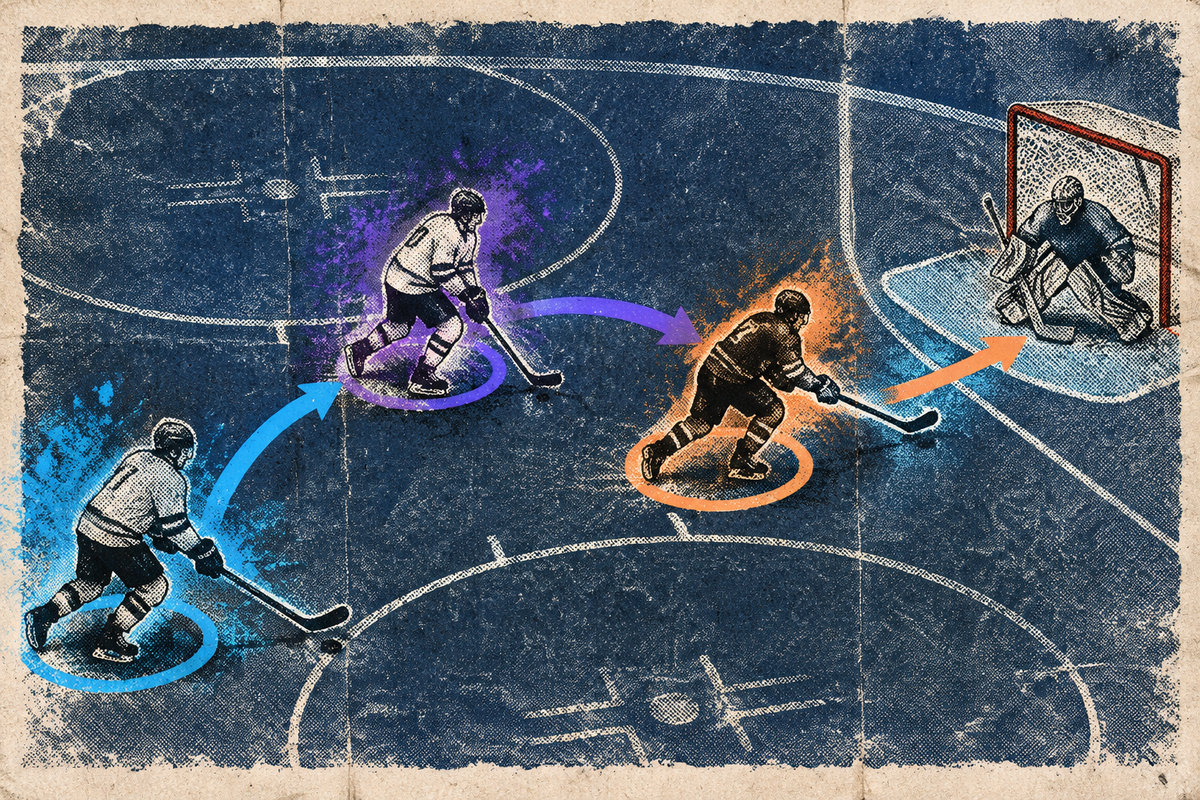
The bet is an over/under on one player’s assists in one game. The NHL credits up to two assists per goal, so a skater can clear 0.5 without shooting the puck. He just needs to be one of the last two players to touch it before the finish.
Primary assists go to the passer who created the goal. Secondary assists go to the player before that. Both count the same on the scoresheet, and both count for your bet. The official assist rule covers the strange cases: deflections, faceoff wins, pucks that bounce in off a skate.
Primary and secondary assists are not the same skill
A primary assist is usually a real play. A seam pass, a cycle feed, a shot-pass off the pad. A secondary assist is often a routine first touch that started the sequence. Secondary assists repeat far less often, which is why a player’s assist totals can swing for reasons that have nothing to do with his hands.
Why Are Assists the Hardest Prop to Project?
The last link in the chain belongs to someone else. Shot volume is a skill. Conversion is not. You can project how often a winger gets pucks on net with reasonable confidence. You can’t project whether his center buries the pass.
A perfect feed through the slot is worth nothing if the shot rings off the post. A routine dump-in becomes a point if the next guy scores from the top of the circle. Same player, same game, different box score.
Four things break an assist projection faster than anything else:
- Linemate finishing. A cold shooting stretch erases assists even when the passes are sharp.
- Power-play changes. Lose a spot on the first unit and the touches dry up.
- Goalie matchup. A hot goalie stops the shots that would have been your assist.
- Score effects. Blowouts reshuffle lines and minutes in the third period.
What Does an Assists Prop Look Like in the Data?
Here’s a real snapshot from the StatsBench cheat sheet on November 3, 2026, for the Toronto vs Utah game. It shows how the same 0.5 line can carry wildly different prices.
| Player | Prop | Line | Last 10 | Best price |
|---|---|---|---|---|
| Darren Raddysh (TOR) | Assists | 0.5 | 6/10 (60%) | +120 |
| Mikhail Sergachev (UTA) | Assists | 0.5 | 6/10 (60%) | -110 |
| Darren Raddysh (TOR) | Points | 0.5 | 6/10 (60%) | -120 |
| Vincent Trocheck (UTA) | Points | 0.5 | 6/10 (60%) | -105 |
| Clayton Keller (UTA) | Power-play points | 0.5 | 6/10 (60%) | +145 |
Every row cleared in 6 of his last 10 games. Every row carried the same tiny edge figure on the sheet, 0.2%. That number is worth sitting with. A 0.2% edge is not an edge, it’s the market saying it has this one priced about right. Most 0.5 assist lines are exactly that: close to fair, with the real money hiding in the outliers.
Where the two assist rows do split is price. Raddysh sat at +120, Sergachev at -110. Translate that with the implied probability calculator: +120 needs a 45.5% win rate to break even, -110 needs 52.4%. Roughly seven points of required win rate, same market, same night.
One warning about that table. Ten games is thin, and 6-of-10 is one bounce from 5-of-10. Treat the hit rate as a filter that tells you who is involved in the offense, not as a forecast. Sample size does the rest of the work.
Four Checks Before You Bet an Assist
1. Is he a passer or a shooter?
A 0.5 assist line on a pure finisher is a bad bet dressed up as a fair one. Look at the ratio of assists to points. Playmakers on the half wall, and centers who touch the puck first on the power play, are the natural over side. Snipers are shots-on-goal props, not assist props.
2. Where does he play on the power play?
Power-play assists come at a different rate than even-strength assists, and books price accordingly. That’s why a separate power-play points market exists. In the snapshot, Keller’s power-play points line paid +145 while Trocheck’s points line paid -105. Different bets, different questions, different prices.
3. Who is finishing his passes?
An assist is a two-player event. If the winger on his line is shooting 4% for a month, the assists vanish even when the passes are perfect. Line combinations, injuries and depth chart changes matter here more than in almost any other prop. Check the injury report before you check the price.
4. Are you getting the best number?
StatsBench shows the best price across 30+ sportsbooks, DFS apps and exchanges on every prop. On a market this thin, that matters. The gap between +120 and -110 is the difference between needing 45.5% and needing 52.4%. Same opinion, different price, different long-run result.
Assists Props vs Points Props: Which Line Is Better?
They are not the same bet. A 0.5 points line cashes on a goal or an assist. A 0.5 assists line only cashes on the assist. So the points line should always be shorter, and in the snapshot it was: Raddysh’s points line sat at -120 while his assists line sat at +120.
That gap is essentially the market’s price on him scoring a goal without an assist. When the gap looks too wide or too narrow relative to how the player actually scores, that’s where the argument lives.
Which one should you play? If your read is “this guy is involved and the puck is going in,” points is the broader bet. If your read is specifically about his setup role and his linemates’ finishing, assists is the sharper expression of it. Never take the assist line just because it pays more.
Three Mistakes That Kill Assist Prop Bets
- Treating 6-of-10 as a trend. Ten games is a snapshot of role and luck, not a rate you can bank. Hit rate tells you who touches the puck. It doesn’t tell you who will convert.
- Betting assists when you mean points. If you like the player’s scoring chance, a goal-only path to cashing is a worse bet than the points line, even at a bigger price.
- Taking the first price you see. A 22-cent spread between books on the same 0.5 line turns a marginal bet into a losing one, or the other way around.
How Do You Find Assist Props Worth Betting?
Start with a filter, not a hunch. Set the market to assists, cap the line at 0.5, and sort by hit rate and by the +EV percentage attached to each prop. The StatsBench research desk carries NHL props alongside the rest of the slate, with a hit rate and an EV figure on each one.
Then do the human part. Confirm the line combination, the power-play unit, and the opponent’s penalty kill. A 6-of-10 hit rate on a fourth liner means something very different from 6-of-10 on a first-line center with a shooter on his wing.
Log what you actually place in the Bet Tracker. Assist props swing hard, and memory is a liar. A written record is the only way to know whether your process is working or you’re just recalling the nights the passes landed. Our guide to the 2026 data method for NHL props walks through the rest of the workflow, and the difference between hit rate and edge is worth ten minutes before you bet a 0.5 line again.
One last thing, and it’s the boring one. This is a near coin-flip market with two-way juice. Size it small, only bet what you can afford to lose, and keep it fun. 21+, and 1-800-GAMBLER is there if it stops being fun.
Frequently Asked Questions
What is an NHL assists prop?
It’s an over/under on how many assists one player records in a single game. Most books set the line at 0.5, so the bet is simply whether he records at least one assist or none at all. There’s no push on a 0.5 line.
Do secondary assists count for prop bets?
Yes. Props grade on the official NHL box score, which credits up to two assists per goal. A secondary assist counts exactly the same as a primary assist for your bet, even though it’s a much less repeatable event.
Why does a points prop pay less than an assists prop?
Because a 0.5 points line cashes on a goal or an assist, while a 0.5 assists line only cashes on the assist. More ways to win means a shorter price. The gap between the two is roughly the market’s price on the player scoring a goal without an assist.
What’s a good hit rate for an assist prop?
There’s no magic number, and a 10-game hit rate is a thin sample either way. Around 60% over 10 games is common for players with real setup roles, but that’s recent form and role, not a forecast. Use it as a filter, then check linemates, power-play usage and the price.
Are assist props profitable long term?
Only if you’re consistently beating the closing price, and most 0.5 assist lines are priced close to fair. Small edges inside the noise of a short sample aren’t enough. Long-run results come from price shopping and picking spots, not from betting every game.
 Today's NBA picks



 Today's NFL picks



 Today's NHL picks


 Today's College Football picks



 Today's EPL picks



 Today's La Liga picks



 Today's Serie A picks



 Today's Bundesliga picks



 Today's Ligue 1 picks



 Today's EFL Championship picks



 Today's CS2 picks



 Today's LoL picks



 Today's Valorant picks
 Today's Dota 2 picks


 PHI
 DET
 BOS
 ATL
 TOR
 CLE
 NY
 WSH
 MIA
 CHA
 IND
 ORL
 BKN
 CHI
 MIL
 POR
 LAL
 HOU
 OKC
 SA
 MEM
 MIN
 GS
 DEN
 NO
 DAL
 PHX
 LAC
 UTAH
 SAC
 BUF
 DEN
 PIT
 JAX
 KC
 CIN
 NE
 CLE
 LV
 BAL
 HOU
 NYJ
 IND
 MIA
 TEN
 LAC
 SF
 MIN
 NYG
 CAR
 CHI
 DET
 GB
 SEA
 LAR
 TB
 ATL
 ARI
 DAL
 WSH
 NO
 PHI
 CAR
 BOS
 MTL
 OTT
 TB
 NJ
 FLA
 TOR
 BUF
 NYR
 DET
 WSH
 NYI
 CBJ
 PIT
 PHI
 EDM
 MIN
 VGK
 UTA
 DAL
 SEA
 COL
 NSH
 STL
 ANA
 CGY
 SJ
 WPG
 LA
 CHI
 VAN
 MIA
 UGA
 UTAH
 ND
 UCLA
 IU
 BYU
 UK
 ALA
 TEX
 OSU
 MISS
 TTU
 WAKE
 LSU
 TENN
 HOU
 USC
 MIZ
 BOIS
 IOWA
 UNM
 SC
 ARIZ
 FLA
 ARS
 MCI
 BHA
 CHE
 LIV
 BRE
 EVE
 BOU
 TOT
 AVL
 Hull City
 LEE
 NEW
 IPS
 FUL
 Coventry
 MUN
 CRY
 NFO
 SUN
 BAR
 ATM
 RMA
 BET
 RSO
 SEV
 ATH
 DEP
 VIL
 CEL
 ALA
 RAY
 GET
 ESY
 OSA
 RAC
 ELC
 LVT
 VAL
 MAL
 LAZ
 INT
 ROM
 COM
 MIL
 Frosinone
 JUV
 NAP
 BOL
 TOR
 GEN
 CAG
 ATA
 LEC
 PRM
 FIO
 SAS
 MON
 UDI
 VEN
 FCB
 BVB
 SCF
 RBL
 SVW
 B04
 SV Elversberg
 SGE
 M05
 FCA
 VFB
 TSG
 KOE
 SC Paderborn 07
 HSV
 FCU
 FC Schalke 04
 BMG
 PSG
 LOSC
 LYO
 PFC
 REN
 OM
 ASM
 NCE
 LEN
 B29
 LOR
 TOU
 STR
 AUX
 ANG
 Troyes
 Le Mans
 LEH