CS2 prop odds are probabilities in disguise. A price of -118 on a Map 1 kills line says the book expects that side to cash about 54% of the time. Your job isn’t to predict the match. It’s to check whether the number in front of you is the best one available, then decide if the implied probability asks too much.
That’s the whole job. Here’s how to do it without a spreadsheet.
What does a CS2 prop price actually mean?
Every American price converts to an implied probability, and that probability is the break-even rate. If you bet that number forever, it’s the win rate you need to land exactly even.
- -110 converts to 52.4%
- -118 converts to 54.1%
- -125 converts to 55.6%
- -128 converts to 56.1%
- -139 converts to 58.2%
- +100 converts to 50.0%
The formula for a negative price is simple: risk divided by (risk plus 100). For -139 that’s 139 / 239, which gives 0.582. For a positive price, flip it to 100 divided by (price plus 100).
An implied probability is not a forecast. It’s the bar the book has set for you.
You can run the conversion in your head for round numbers, or use the free implied probability calculator and odds converter when the prices get ugly.

How do you compare CS2 prop odds across books?
Prices on the same line are not identical everywhere. Books build their own numbers, and the gap between the best and worst price is money you either keep or hand back.
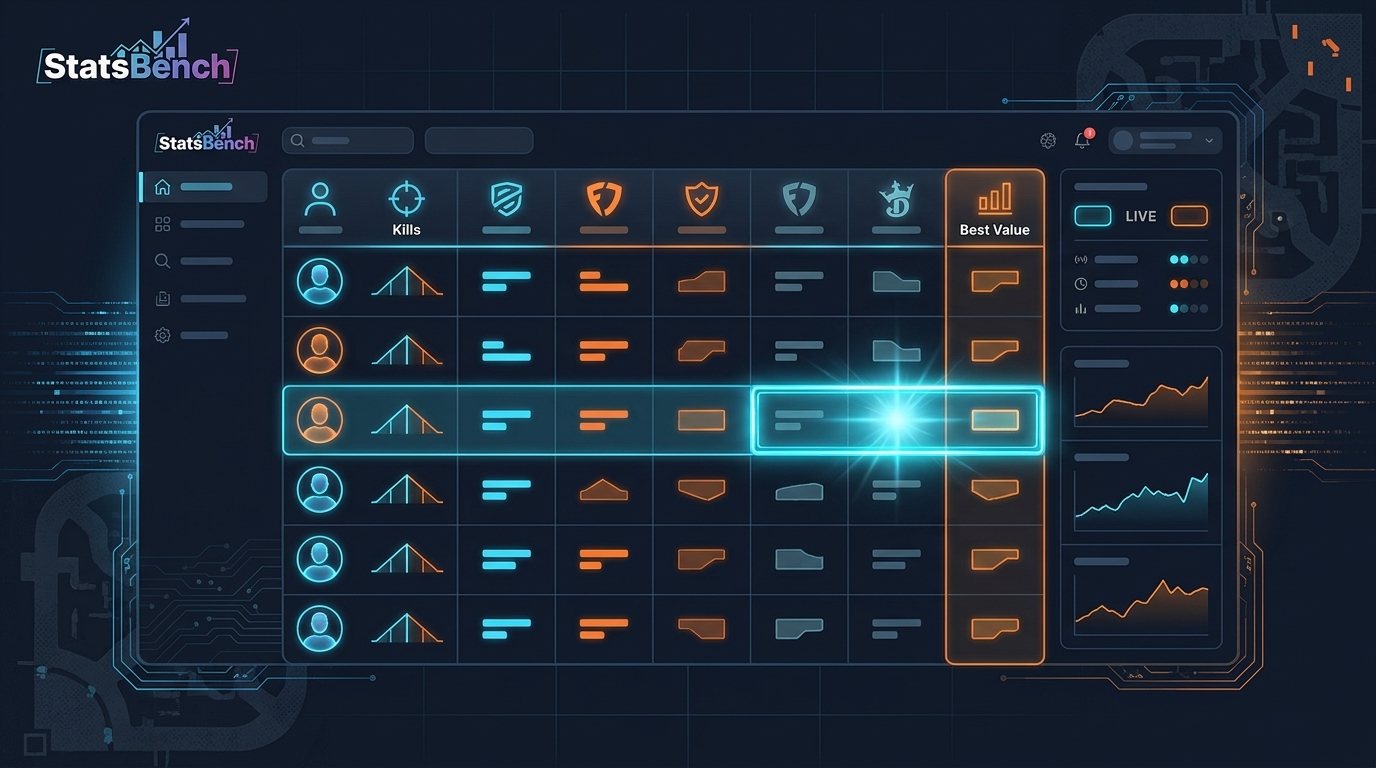
StatsBench collects CS2 prop prices from multiple sportsbooks into one table, so each row shows the market, the line, the recent hit rate, and the best available price. The CS2 props board is the fastest way to see that stacking. There’s also a free CS2 props preview if you want to look before making an account.
Two habits do most of the work:
- Shop before you think. If the same line sits at -118 at one book and -139 at another, the cheaper price needs a much better reason to ignore.
- Compare like with like. A 14.5 kills line and a 16.5 kills line are different bets. Price gaps only mean something on the same player, same market, same number.
Why the vig matters even more on map 1 markets
When both sides of a market are priced at -118, the implied probabilities add up to 108.3%. That extra 8.3% is the book’s margin, and it’s the reason a coin-flip bettor still bleeds over a season.
Map 1 lines make the margin easy to see. There’s no draw and rarely a push. The player either clears the number or he doesn’t. Two sides, one margin, every time.
A fair price and a posted price are rarely the same number. Removing the vig shows you what the book really thinks, which is a better starting point than the raw number on the screen. The vig and hold calculator and the de-vig tool handle that math, and our walkthrough on how to remove the vig from betting odds covers the method step by step.
A dated example: CS2 Map 1 prices from an October 2026 snapshot
Here’s a real StatsBench snapshot from October 21, 2026, filtered to CS2 Map 1 markets. Every row shows the same recent hit rate, 6 of 10, and a different best price.
| Player (match) | Market | Line | Hit rate | Best price | Implied |
|---|---|---|---|---|---|
| Banjo (FOKUS vs UNiTY) | Map 1 kills | 14.5 | 60% (6/10) | -118 | 54.1% |
| KWERTZZ (UNiTY vs FOKUS) | Map 1 kills | 14.5 | 60% (6/10) | -118 | 54.1% |
| Matheos (FOKUS vs UNiTY) | Map 1 kills | 15.5 | 60% (6/10) | -139 | 58.2% |
| 910 (The MongolZ vs magic) | Map 1 kills | 16.5 | 60% (6/10) | -128 | 56.1% |
| Banjo (FOKUS vs UNiTY) | Map 1 headshots | 7.5 | 60% (6/10) | -139 | 58.2% |
| MaSvAl (magic vs The MongolZ) | Map 1 headshots | 8.5 | 60% (6/10) | -125 | 55.6% |
The hit rates are identical. The prices are not. Break-even runs from 54.1% on the cheapest row to 58.2% on the most expensive, a four-point swing on props that look the same at a glance.
That gap is the argument for a price table. You can scan six lines in a few seconds and see which ones ask less of you. Doing the same by hand across several books takes an evening.
Notice the pairing too. FOKUS vs UNiTY lists Banjo at 14.5 and Matheos at 15.5. The MongolZ vs magic lists 910 on kills and MaSvAl on headshots. In a duel market both sides get priced. One player clearing his number tells you nothing about whether the other player’s line was a good bet.
If you want the raw map-level record behind any of those names, HLTV keeps public stat pages for tier-one play, and it’s the reference most analysts still start from.
How much sample does a CS2 hit rate need?
Six of ten is not a rate. It’s a rumor with a percentage sign attached.
Yes, 6/10 is 60%. But a 95% confidence interval around that sample runs from roughly 25% to 75%. A range that wide can’t separate a strong Map 1 player from an average one, which means the headline hit rate on a 10-map sample is mostly noise.
Sample size decides what a number can support. A 60% rate over 100 maps is a real claim. A 60% rate over 10 maps is a hint. Our posts on sample size in betting and what a 60% hit rate really means dig into that math if you want the longer version.
CS2 makes this harder than most sports. Series are short, map 1 is one map, and roles shift with the map pool. Liquipedia’s Counter-Strike pages list the active pool and series formats if you need to check context. And if you want a baseline for what a normal kills line looks like before you trust a sample, our breakdown of CS2 kills per map is a decent starting point.
What mistakes cost money on CS2 prop lines?
Most losing CS2 prop tickets come from a short list of habits. None of them are about game knowledge.
- Treating 6/10 like a settled rate. Ten maps is a thumbnail, not a photograph. Judge the price and the sample, not the percentage on its own.
- Taking the first price you see. A 20-cent gap on the same line is a real cost over a season, and it’s free to avoid.
- Ignoring the map context. Map 1 kill totals depend on which map gets played and how long it runs. A fast 13-5 closes a lot of kill lines.
- Betting one side of a duel without checking the other. Both lines are posted. Look at the pair before deciding one of them is mispriced.
- Reading a hit rate without the line. 60% over 14.5 kills and 60% over 16.5 kills are not the same achievement.
Where should you research CS2 props before betting?
The CS2 props board puts the pieces in one place: market, line, hit rate, the sample behind it, and the best price across tracked books. You can filter by market and consistency instead of scrolling a slate blind.
What it won’t do is tell you who to bet. StatsBench is a research desk. The data shows what happened and what the price is. Your read on the matchup, the map pool, and the role does the rest.
Bet within your means, treat every price as a long-run proposition, and expect variance to do what variance does. If betting stops being fun, 1-800-GAMBLER is there. 21+.
Free preview
See today’s CS2 player props on StatsBench
Live lines, last-10 hit rates and the best price across 30+ books and pick’em apps. No account needed to look.
Open the CS2 player props board →
Prefer email? Get the daily picks newsletter.
Frequently Asked Questions
What does -118 mean on a CS2 prop?
It’s a break-even rate of about 54.1%. You risk $118 to win $100, so that side has to cash roughly 54 times out of 100 for the bet to be neutral over a large sample. It says nothing about the actual chance of the player clearing the line.
How do I compare CS2 prop odds across sportsbooks?
Look at the same player, market, and exact line at multiple books, then keep the best price. A -118 on the same number that’s priced -139 elsewhere saves you roughly 20 cents of juice. A table that lists best available price per row does that scan for you.
How many maps do I need before a CS2 hit rate matters?
More than ten. A 6-of-10 sample gives you 60%, but the plausible true rate ranges from roughly 25% to 75%, which is far too wide to act on. Longer samples and a look at the specific line matter more than the headline percentage.
Are CS2 Map 1 kills props the same as total kills props?
No. Map 1 props settle on a single map, so a short or lopsided map caps the total. Full-match kill props include every map in the series and carry a different risk profile. Always check which market you’re actually pricing.
Does StatsBench predict CS2 props?
No. It’s a research tool that shows hit rates with their samples, the lines books are posting, and the best available price. There are no picks and no projections, just the data you need to form your own read.