
The BTTS meaning is simple: both teams to score. The bet wins when each side finds the net at least once in regulation, so 1-1, 2-1 and 3-2 all cash, while 1-0, 0-0 and 2-0 lose. There is no draw option and no push. A team either scores or it doesn’t.
That simplicity is exactly why the market gets mispriced. Most bettors stare at the two attacks. The price actually moves on the two defenses, the venue, and whether the game stays open for 90 minutes.
BTTS meaning: both teams to score, in plain terms
Bookmakers settle this market on 90 minutes plus stoppage time. Extra time and penalties in cup ties do not count, which matters if you’re betting a knockout game where a 1-0 could become 1-1 after 120 minutes. That late goal pays nothing.
An own goal counts for the team credited with it, so a scrappy deflected equaliser still lands the bet. You’ll see the market written three ways across books: “Both Teams to Score”, “BTTS Yes/No”, and “GG/NG” on some European sites. All three are the same wager.
- Wins: 1-1, 2-1, 3-2, 1-2, 2-2, 4-1
- Loses: 0-0, 1-0, 0-2, 3-0
Those examples matter more than they look. A 3-0 is a goal-fest that still busts your ticket, because one side never scored. New bettors trip on that constantly.
How to read BTTS odds and find the true price
Convert both prices to implied probability, add them together, and the amount over 100% is the book’s margin. That’s the whole method.
If both sides sit at -110, each one implies 52.4%. Together they add to 104.8%, so the book holds roughly 4.8% of margin on the pair. Run those two numbers through the de-vig calculator and you get the fair price the market is actually suggesting. The implied probability calculator handles the first step if you want to see it line by line, and there’s a longer walkthrough in how to remove the vig.
Why bother? Because BTTS prices drift between books more than people assume on a two-way market. Ten cents of difference on a bet you make 40 times a season is not a rounding error. One point of price, compounded, is the difference between a thin edge and none.
Keep the honest framing in mind too: any edge here is long-run. A market can be priced wrong and still lose six times in a row. Bet within your means, 21+, and treat variance as part of the job rather than a personal insult.
Both teams to score predictions: what actually moves the number
Four things: each team’s scoring rate, each team’s clean sheet rate, opponent quality, and venue. Team news at the back is the fifth and it can flip a price in an hour.
Clean sheets are the half of the equation most people skip. A side that keeps a lot of them suppresses BTTS even with a decent attack, because the bet needs the other team to score. Flip it around and a mid-table team that scores in most games but rarely keeps a clean sheet is a live BTTS team in almost any matchup.
Game state decides the rest. An early goal opens the game up. A red card, or a side sitting on a 1-0 with 25 minutes left, shuts it down. That is why the in-play price swings harder than the pre-match number.
StatsBench covers soccer props across nine leagues, from the Premier League and La Liga to MLS and the Champions League, and puts the best available price from 30+ sportsbooks, DFS apps and exchanges next to each market. You can see how it looks on the free soccer props preview, or dig into the full soccer props board for the league you’re betting.
| Signal | Why it matters for BTTS |
|---|---|
| Clean sheet rate | Directly caps how often one side gets blanked |
| Goals conceded at home/away | Venue splits are often bigger than season totals |
| Defensive injuries | One missing centre back changes more than a missing winger |
| Opponent’s shot volume | Volume is stickier week to week than conversion |
| Referee and tempo | Cards and stoppages can kill a game’s rhythm |
Both teams to score tips: a five-minute pre-bet routine
You don’t need a model to bet this market well. You need a repeatable check that takes less time than a coffee.
- Count recent clean sheets, both sides. Last six to eight games. Two clean-sheet machines in a low-tempo league is a BTTS No lean.
- Check who’s missing at the back. A backup centre back pairing is the single fastest way a price goes stale.
- Split home and away. Some teams are open at home and compact on the road. Season totals hide that.
- Look at the stakes. Late-season games where one team has nothing to play for can go either way, and dead rubbers are not automatically open.
- Set the price you’d take, then shop. If the best number across books is worse than your number, pass. Passing is a bet you win by default.
If you want more on how scoring markets get priced player by player, the anytime goalscorer guide covers the individual side of the same question.
BTTS combos: no draw and over 2.5 goals
Two variants show up in search a lot, and they behave differently from the plain market. Both add a condition, so both pay more, and both will lose bets that plain BTTS wins.
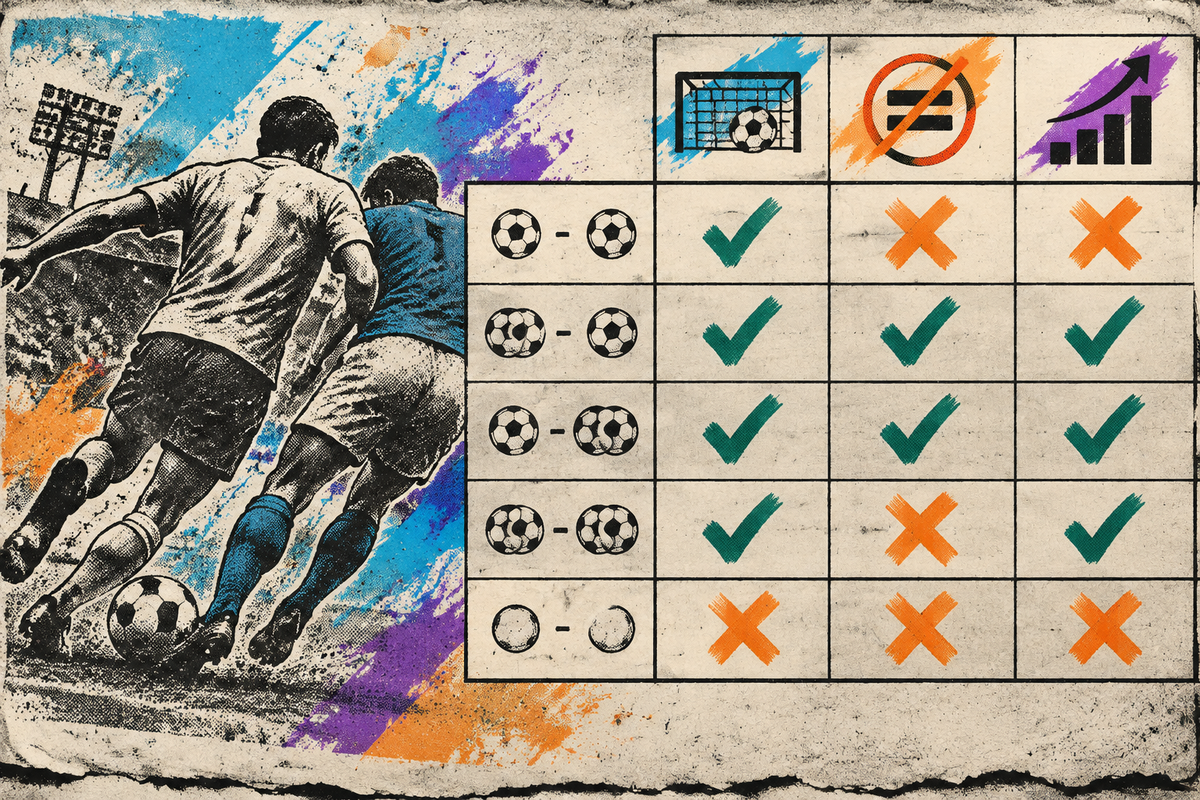
Both teams to score no draw
Both teams must score and the match must not end level. So 2-1 and 3-2 win, while 1-1 and 2-2 lose.
It pays more than plain BTTS because you’re stacking a second condition on top. It fits a specific read: a strong home side against a team that scores but doesn’t hold leads. You’re betting on goals and a winner at the same time, which is a narrower opinion than “this will be entertaining”.
Both teams to score over 2.5 goals
Both teams score and the match produces three goals or more. A 2-1 lands. A 1-1 does not, even though both teams scored.
This is the combo that trips people up most, because 1-1 feels like a goals game. It has two goals in it. The over 2.5 leg is doing real work.
Because the legs are correlated, the combo price is not the two single prices multiplied together. Bookmakers price the joint outcome. If you build it yourself in a same-game parlay, you’re being charged for correlation whether you asked for it or not.
| Market | 1-1 | 2-1 | 0-0 |
|---|---|---|---|
| BTTS Yes | Win | Win | Lose |
| BTTS No | Lose | Lose | Win |
| BTTS + No Draw | Lose | Win | Lose |
| BTTS + Over 2.5 | Lose | Win | Lose |
BTTS in parlays: price the correlation, not the multiplication
Adding BTTS to an over, or to two anytime scorer bets, doubles down on the same event. If the game stays 0-0, every leg dies together.
That’s not automatically bad. It’s bad when you price it as if the legs were independent. The parlay calculator shows what the multiplication implies, and the gap between that number and the book’s price is the correlation charge. The same game parlay correlation guide goes deeper on which legs genuinely belong together.
A practical rule: if two legs both need the same team to keep attacking, treat them as one bet with a bigger stake, not two brave opinions.
Comparing BTTS prices across books
The market is close to a coin flip, so the price is nearly the whole edge. A few cents of difference on a two-way market is the difference between a bet worth making and one that isn’t.
Shopping 30+ sportsbooks, DFS apps and exchanges by hand is nobody’s idea of a good Saturday. That’s the boring part StatsBench does for you, alongside hit rates, matchup data and the +EV percentage shown on each prop. Data plus your judgment, not a picks service. If you want a walkthrough of the wider research process, the soccer player props guide is the natural next read.
One last check before you fire: confirm the settlement rules on your book’s page, especially in cup ties. Ninety minutes is the standard, but reading the terms takes ten seconds and has saved plenty of arguments.
Live board
See today’s soccer match and player props on StatsBench
Live lines, last-10 hit rates and the best price across 30+ books and pick’em apps.
Prefer email? Get the daily picks newsletter.
Frequently Asked Questions
Does BTTS include extra time?
No. The market settles on 90 minutes plus stoppage time. Goals scored in extra time or a penalty shootout do not count, so a cup tie that finishes 1-0 after 90 minutes is a BTTS loss even if it ends 1-1 after 120.
Does a 1-1 win BTTS over 2.5 goals?
No. A 1-1 has two goals, so the over 2.5 leg fails even though both teams scored. You need three goals or more with both sides on the scoresheet, such as 2-1 or 3-2.
What does BTTS no draw mean?
Both teams must score and the match must produce a winner. A 2-1 wins, a 1-1 loses. It pays more than plain BTTS because you’re adding a second condition on top of the goals.
Do own goals count for both teams to score?
Yes. An own goal is credited to the opposing team, so it counts toward that side’s total. A deflected own goal that makes it 1-1 still lands a BTTS Yes bet.
Is BTTS the same as GG?
Yes. GG (and NG for no goal on both sides) is the term used on many European books. Both Teams to Score, BTTS Yes and GG are the same market with the same settlement rules.
 Today's NBA picks



 Today's NFL picks



 Today's NHL picks



 Today's College Football picks


 Today's EPL picks



 Today's La Liga picks



 Today's Serie A picks



 Today's Bundesliga picks



 Today's Ligue 1 picks



 Today's EFL Championship picks



 Today's CS2 picks

 Today's LoL picks



 Today's Valorant picks
 Today's Dota 2 picks


 PHI
 DET
 BOS
 ATL
 TOR
 CLE
 NY
 WSH
 MIA
 CHA
 IND
 ORL
 BKN
 CHI
 MIL
 POR
 LAL
 HOU
 OKC
 SA
 MEM
 MIN
 GS
 DEN
 NO
 DAL
 PHX
 LAC
 UTAH
 SAC
 BUF
 DEN
 PIT
 JAX
 KC
 CIN
 NE
 CLE
 LV
 BAL
 HOU
 NYJ
 IND
 MIA
 TEN
 LAC
 SF
 MIN
 NYG
 CAR
 CHI
 DET
 GB
 SEA
 LAR
 TB
 ATL
 ARI
 DAL
 WSH
 NO
 PHI
 CAR
 BOS
 MTL
 OTT
 TB
 NJ
 FLA
 TOR
 BUF
 NYR
 DET
 WSH
 NYI
 CBJ
 PIT
 PHI
 EDM
 MIN
 VGK
 UTA
 DAL
 SEA
 COL
 NSH
 STL
 ANA
 CGY
 SJ
 WPG
 LA
 CHI
 VAN
 MIA
 UGA
 UTAH
 ND
 UCLA
 IU
 BYU
 UK
 ALA
 TEX
 OSU
 MISS
 TTU
 WAKE
 LSU
 TENN
 HOU
 USC
 MIZ
 BOIS
 IOWA
 UNM
 SC
 ARIZ
 FLA
 ARS
 MCI
 BHA
 CHE
 LIV
 BRE
 EVE
 BOU
 TOT
 AVL
 Hull City
 LEE
 NEW
 IPS
 FUL
 Coventry
 MUN
 CRY
 NFO
 SUN
 BAR
 ATM
 RMA
 BET
 RSO
 SEV
 ATH
 DEP
 VIL
 CEL
 ALA
 RAY
 GET
 ESY
 OSA
 RAC
 ELC
 LVT
 VAL
 MAL
 LAZ
 INT
 ROM
 COM
 MIL
 Frosinone
 JUV
 NAP
 BOL
 TOR
 GEN
 CAG
 ATA
 LEC
 PRM
 FIO
 SAS
 MON
 UDI
 VEN
 FCB
 BVB
 SCF
 RBL
 SVW
 B04
 SV Elversberg
 SGE
 M05
 FCA
 VFB
 TSG
 KOE
 SC Paderborn 07
 HSV
 FCU
 FC Schalke 04
 BMG
 PSG
 LOSC
 LYO
 PFC
 REN
 OM
 ASM
 NCE
 LEN
 B29
 LOR
 TOU
 STR
 AUX
 ANG
 Troyes
 Le Mans
 LEH