
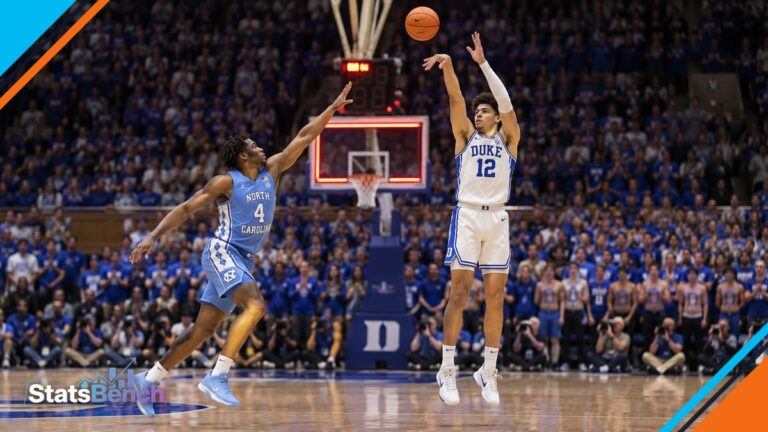
Three legs is the practical ceiling for most NCAAB parlay picks. Two is better if you’re still learning the market. The reason isn’t superstition. Every leg multiplies the book’s margin against you, and college basketball adds a wrinkle the NBA doesn’t: a 20-point lead can empty the floor with eight minutes left, which quietly kills every counting-stat over on the slip.
So the real question isn’t which legs look good. It’s which legs survive being multiplied together. That’s a different test, and here’s how to run it.
How many legs should a college basketball parlay have?
Two or three, and almost never more than four. That’s arithmetic, not tradition.
A standard -110 leg implies about 52.4% probability. Multiply two of them and you get roughly 27.5%, which prices near +264. Three legs fall to about 14.4%, near +595. Four legs land around 7.5%.
Those percentages already include the book’s cut, so the true break-even is worse than what the ticket shows. Run your own legs through the parlay calculator before the payout convinces you.
There’s a second cost. Each leg has to be a genuine edge. Finding one mispriced line on a Tuesday night is work. Finding four across four different games is a different job entirely. Two sharp legs and no filler beats five legs where three are coin flips.
What correlates inside a same game parlay?
Injuries, usage, and blowout risk, in that order. College correlation is less about statistics and more about who is on the floor, and for how long.
Three things tend to move together in a college game:
- One player’s overlapping stat lines. Rebounds, points plus rebounds, and points plus rebounds plus assists for the same player are not independent. Putting all three in one slip is one bet wearing three hats.
- Team pace and guard assists. Fast, high-possession games inflate counting stats on both benches.
- Game script and minutes. A close game keeps starters on the floor. A blowout doesn’t.
A real example from a mid-November 2026 StatsBench board: Tomislav Buljan (Maryland vs Virginia) showed rebounds over 6.5 at 10/10 (best price -141), points plus rebounds over 14.5 at 9/10 (-110), and points plus rebounds plus assists over 15.5 at 9/10 (-110). Three rows, three strong records, one player. Stack all three and you haven’t built a three-leg parlay. You’ve built a single expensive bet on Buljan’s minutes.
Why big favorites and totals behave differently in college
Because college spreads are wider and benches are deeper. A 20-point favorite can be up 25 with ten minutes left, and the starters sit. That’s how a player who averages 30 minutes ends up with 22, and how a comfortable over turns into a loss nobody saw coming.
Totals work the other way. College games end in fouls and free throws, which stretches the final two minutes and adds points that have nothing to do with how the first 38 minutes were played. Parlay a team total with a player’s points over and you’re taking on both effects at once, in the same direction, with no hedge.
The practical rule: check the spread before you add any counting stat. Blowout risk is a prop problem in every sport. We covered it for college football player props, and the logic transfers here with even less margin for error, since college basketball starters sit earlier.
How to turn hit rates into NCAAB parlay picks
Check three things on every leg: the record behind the percentage, the price you’re paying, and whether the rate survives a tougher opponent. A hit rate tells you what already happened. The price tells you what the market already believes.
| Player | Market | Hit rate | Best price | Break-even |
|---|---|---|---|---|
| Jeremy Fears Jr. (MSU vs UNI) | Turnovers over 2.5 | 10/10 (100%) | +102 | 49.5% |
| Tomislav Buljan (MD vs UVA) | Rebounds over 6.5 | 10/10 (100%) | -141 | 58.5% |
| John Mobley Jr. (OSU at UConn) | Threes over 1.5 | 10/10 (100%) | -235 | 70.1% |
| Mike McNair Jr. (MD vs UVA) | Points over 7.5 | 8/10 (80%) | -135 | 57.4% |
| Jalen Jackson (Butler vs Pitt) | Off. rebounds over 0.5 | 8/9 (88.9%) | -255 | 71.8% |
Look at the spread. The Fears turnover line needs 49.5% to break even and it’s priced near a coin flip, which is the market admitting turnovers are volatile. The Mobley threes line needs 70.1% and carries a 10/10 record, so the price is doing most of the arguing there. A perfect record against a 70% break-even is a much tighter case than it looks in a screenshot.
Two honest caveats. A 10-for-10 run is a small sample, and a board sorted by hit rate will always look impressive; these rows are the strongest from one mid-November slate, not a random slice of the market. And check the opponent. A guard hitting 9/10 on threes against soft defenses is a different bet against a top-50 defense.
If you want the math for your own legs, the implied probability calculator turns any price into a percentage in one step. Compare that to the record. When the record sits below the break-even, you don’t have a leg, you have a lottery ticket. And remember that a hit rate is a past frequency, not a probability, so treat the comparison as a screen rather than a verdict. Our breakdown of what a 60% hit rate really means explains why.
Does the NCAA tournament schedule change parlay math?
Yes, in one specific way: a loaded slate gives you more legs to choose from and more temptation to add them. Tournament days pack far more games into one afternoon than a normal January Tuesday.
Cross-game legs are independent by definition, so a six-leg tournament parlay is six separate prices multiplied together. No correlation saves you, no shared game script helps you. The bracket and tip times live at NCAA.com. Your job is to treat a 16-game day exactly like a three-game night: same leg count, better selection.
Where to find today’s legs
Don’t take legs from an article. Take them from a board you can filter yourself. The daily NCAAB prop page is where the strongest rows for the current slate get written up, and the college basketball stats hub collects the method pieces and market explainers.
For the full board, the NCAAB prop finder lets you sort by hit rate and compare prices across 30+ sportsbooks, DFS apps and exchanges side by side. Every prop shows its +EV % too. That matters for parlays: the same leg at a better price at another book is the cheapest upgrade you’ll find all night.
For the multiplication side of the equation, why a 3-leg parlay beats a 6-legger goes deeper, and parlay odds explained covers what your payout actually represents.
How much should you put on a parlay?
Small, and the same amount every time. Parlays are high-variance by construction: a three-leg slip at +595 loses most of the time and that’s the design, not bad luck. A run of losses is normal, and it’s not a signal to chase.
Pick a stake you’d shrug at, keep it flat, and let the price work over a long season. If you want to see which slips actually hold up, log them. The Bet Tracker inside a free StatsBench account is an honest scoreboard. Bet within your means, 21+, and if it stops being fun, 1-800-GAMBLER is there. Nothing here predicts profit, and any edge is a long-run thing measured over hundreds of bets, not one Saturday.
Free preview
See today’s college basketball player props on StatsBench
Live lines, hit rates and the best price across 30+ books and pick’em apps. A free preview shows today’s first props; a free account shows more.
Open the college basketball player props board →
Prefer email? Get the daily picks newsletter.
Frequently Asked Questions
How many legs should an NCAAB parlay have?
Two or three for most bettors, and rarely more than four. Each leg multiplies the book’s margin, so a four-leg slip at -110 per leg already needs roughly a 7.5% combined probability just to break even before the vig is priced in.
Are same game parlays bad in college basketball?
Not automatically, but college same game parlays are easy to build wrong. Overlapping stats for one player (rebounds, points plus rebounds, points plus rebounds plus assists) are essentially one bet, so stacking them adds risk without adding a new edge.
Does a 100% hit rate make a leg a good bet?
No. A 10/10 record still has to beat the break-even implied by the price. A leg at -235 needs about 70% to break even, so a perfect small-sample record against a high price is a tighter case than it appears.
Where can I find NCAAB player props to parlay?
StatsBench lists college basketball props across every major stat, with hit rates, game logs and prices from 30+ sportsbooks, DFS apps and exchanges. The NCAAB prop finder board lets you filter and sort by hit rate before you build a slip.
What is the biggest mistake in college basketball parlays?
Adding legs to boost the payout instead of adding an edge. Big favorites and blowouts make starter minutes less predictable in college, so counting-stat overs can die on the bench in the last eight minutes.
 Today's NBA picks


 Today's NFL picks
 Today's NHL picks


 Today's College Football picks


 Today's College Basketball picks

 Today's CS2 picks


 Today's Valorant picks
 Today's Dota 2 picks


 BOS
 PHI
 DET
 ATL
 MIA
 NY
 CLE
 ORL
 TOR
 IND
 CHA
 WSH
 BKN
 CHI
 MIL
 SA
 LAL
 HOU
 POR
 MEM
 MIN
 OKC
 DEN
 GS
 DAL
 PHX
 LAC
 NO
 SAC
 UTAH
 BUF
 KC
 JAX
 CIN
 DEN
 PIT
 CLE
 NE
 BAL
 LV
 HOU
 IND
 NYJ
 MIA
 TEN
 LAC
 SF
 DET
 NYG
 CAR
 MIN
 CHI
 GB
 SEA
 LAR
 DAL
 WSH
 TB
 NO
 ATL
 ARI
 PHI
 CAR
 NJ
 TB
 MTL
 OTT
 BOS
 FLA
 NYR
 NYI
 WSH
 BUF
 DET
 TOR
 PHI
 PIT
 CBJ
 EDM
 MIN
 VGK
 COL
 NSH
 DAL
 ANA
 UTA
 WPG
 SJ
 STL
 SEA
 CGY
 LA
 CHI
 VAN
 UGA
 UTAH
 ND
 UCLA
 MIA
 IU
 ALA
 TEX
 TENN
 WAKE
 TTU
 BYU
 IOWA
 ORE
 BOIS
 OSU
 UK
 USC
 ARIZ
 HOU
 LOU
 LIB
 FLA
 MEM
 MISS
 MSU
 CONN
 UVA
 DUKE
 ILL
 KU
 SJU
 VAN
 MICH
 ARK
 GONZ
 NEB
 LSU
 Premier League table
 ARS
 BHA
 MCI
 LIV
 CHE
 EVE
 BOU
 BRE
 LEE
 AVL
 TOT
 NEW
 Hull City
 IPS
 FUL
 NFO
 Coventry
 MUN
 SUN
 CRY
 La Liga table
 BAR
 RMA
 ATM
 BET
 RSO
 SEV
 ATH
 VIL
 DEP
 RAC
 CEL
 ALA
 ESY
 RAY
 GET
 OSA
 LVT
 ELC
 VAL
 MAL
 Serie A table
 LAZ
 INT
 ROM
 MIL
 COM
 Frosinone
 JUV
 BOL
 CAG
 NAP
 TOR
 ATA
 GEN
 LEC
 FIO
 PRM
 SAS
 MON
 VEN
 UDI
 Bundesliga table
 FCB
 BVB
 SCF
 RBL
 B04
 SVW
 SV Elversberg
 VFB
 TSG
 SGE
 HSV
 M05
 SC Paderborn 07
 FCA
 KOE
 FCU
 FC Schalke 04
 BMG
 Ligue 1 table
 PSG
 LOSC
 PFC
 OM
 LYO
 NCE
 ASM
 REN
 B29
 LOR
 LEN
 TOU
 STR
 AUX
 Le Mans
 ANG
 Troyes
 LEH