
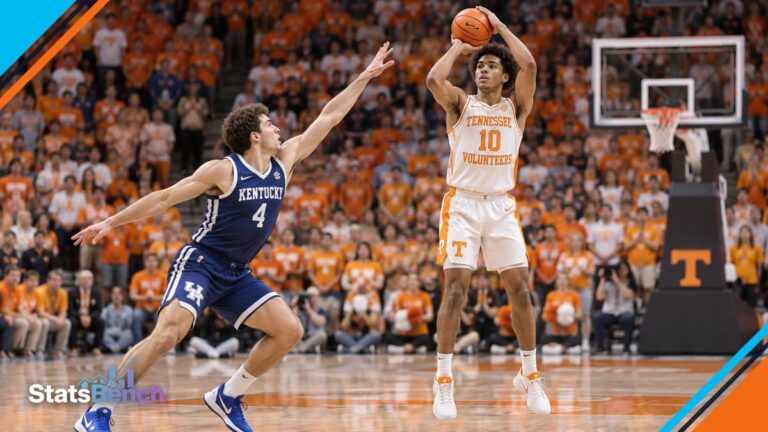
NCAAB consensus picks are a count of which side bettors are taking on a college basketball game or player prop. You usually see it as a percentage: 72% of tickets on the favorite, or 65% of entries on an over. It tells you where the crowd sits. It does not tell you whether the crowd is right.
That gap matters more in college basketball than in most markets. November and December slates pull enormous public volume toward brand-name programs, and the crowd is loudest exactly where it knows the least. So the useful question isn’t “what’s the consensus?” It’s “what did the price do after the consensus formed?”
What are NCAAB consensus picks, exactly?
Consensus picks are an aggregate of many individual bets on the same market, published as a split. A typical line reads like this: home team 74%, road team 26%, with the money split listed separately. For a player prop it’s the same idea on a thinner market, like the share of entries on a point guard’s over 2.5 turnovers.
Three flavors get mixed together, and they are not interchangeable:
- Ticket consensus: the share of individual bets on each side. It counts people.
- Handle consensus: the share of money on each side. It counts dollars.
- Expert consensus: how many tracked handicappers or models landed on a side. It counts opinions.
Only one of those is close to a market signal. The others are a popularity poll with better branding.
Where the numbers actually come from
Most published splits originate with sportsbook data feeds or third-party pick trackers. Nobody at the NCAA compiles them. Four common sources, roughly in order of usefulness:
- Sportsbook ticket and handle reports. Real bets, real money, but only from that book’s customers. A sharp-heavy book and a casual-heavy book will post very different splits on the same game.
- Pick’em app entry data. PrizePicks and Underdog entries are a huge slice of modern prop volume. They skew young, casual, and over-happy.
- Handicapper tracking sites. Useful for spotting which side the paid-pick crowd is on, though the sample is whoever those sites chose to track.
- Social polls. Free, entertaining, and the least reliable of the four by a wide margin.
Each of those samples is self-selected. None of them is random, so none of them is a survey of the true probability. Keep that in mind before you treat 80% as a forecast.
One distinction worth stating plainly: StatsBench does not publish a consensus feed. What it gives you is the other half of the ledger, real hit rates with full records, game logs, matchup data, and the best available price across 30+ sportsbooks, DFS apps and exchanges. Put a crowd number next to a price and you finally have a question worth answering.
Tickets vs money: why the two percentages disagree
When ticket percentage and handle percentage diverge, the smaller number is usually the more interesting one. Picture a game showing 78% of tickets on the home team but only 41% of the money. That means a lot of small bets on one side and a few large ones on the other.
Dollars are not smarter than tickets by default. But a bettor willing to put five figures on a November college game tends to have done more work than someone firing a $20 parlay leg. When the two splits point opposite directions, treat it as a flag, not an answer. Our breakdown of betting splits and what tickets versus money means goes deeper on the mechanics.
Before comparing any split to a price, convert the odds to implied probability so the two numbers speak the same language. The free implied probability calculator does it in a couple of clicks.
How to read agreement against line movement
A consensus number only becomes information when you set it beside the line’s behavior. The table below is the fastest way to do that comparison.
| What you see | What it usually means | What to do |
|---|---|---|
| Heavy consensus, line moved the same way | The market absorbed the money and repriced | Little left; the value was hours earlier |
| Heavy consensus, line held or moved the other way | Books are comfortable, or sharp money sits opposite | Slow down and study the matchup |
| Split consensus, line moved sharply | News: injury, lineup change, minutes limit | Find the news before you bet |
| Heavy consensus, price now worse than best available | You would be paying for popularity | Shop the number first |
Two rows deserve emphasis. A line that refuses to budge under heavy one-way action is a statement, because books do not eat liability for fun. And a price three cents worse than the best available number turns a decent read into a bad bet.
Why a lopsided consensus isn’t a reason to bet
Because consensus measures popularity, and popularity is not probability. A 75/25 split tells you what strangers did with their money. It says nothing about the matchup, the rotation, or whether the number is fair.
Four things a crowd number cannot see:
- Brand bias. Fans bet programs they can name. In college hoops that means the blue bloods and the ranked side, regardless of the price.
- Shaded prices. Books know public money clusters on favorites and overs, and they price accordingly. The crowd’s side is often the more expensive side.
- Role and minutes. A guard playing 34 minutes a night and a guard playing 22 look identical in a ticket count.
- The vig. You need a real reason to bet, not a 70/30 split. Two dollars of juice kills a lot of thin opinions.
Fading the public is also a crowd trade. “Always go contrarian” is a heuristic someone repeated, not an edge someone measured. What consensus genuinely helps with is identifying where the price is likely to be shaded, so you know which games to research first.
What hit rates add that consensus can’t
Consensus describes the market. It does not describe the player. That’s the piece StatsBench supplies, and a dated snapshot from a mid-November 2026 slate shows how the two fit together.
| Player | Market | Record | Best price |
|---|---|---|---|
| Jeremy Fears Jr. (MSU vs UNI) | Turnovers over 2.5 | 10/10 | +102 |
| Tomislav Buljan (MD vs UVA) | Rebounds over 6.5 | 10/10 | -141 |
| John Mobley Jr. (OSU at UConn) | Threes over 1.5 | 10/10 | -235 |
| James Scott (UGA at UNC) | Points + assists over 4.5 | 10/10 | -245 |
| Thomas Dowd (AUB vs ARIZ) | Rebounds over 7.5 | 9/10 | -114 |
| Darin Smith Jr. (RUTG vs BRY) | Pts + rebs + assists over 15.5 | 9/10 | -120 |
| Tomislav Buljan (MD vs UVA) | Rebs + assists over 8.5 | 8/10 | +100 |
| James Scott (UGA at UNC) | Pts + rebs + assists over 12.5 | 8/10 | -123 |
Look at the range. The same 10/10 record shows up at +102 on Fears and at -235 on Mobley, and those are completely different bets. Hitting 10 of 10 is a nice run. At -235 you need roughly seven of ten just to break even on the price, which is a far tougher ask than the record suggests.
That’s the lesson the crowd number never teaches. Hit rate is half the bet and the price is the other half. A split can tell you a market is crowded. Only the record and the number tell you whether anything is left after the crowd. Our piece on hit rate versus edge walks through where those two diverge.
When consensus gets louder and less useful
Timing changes the signal. Two stretches of the season make crowd numbers noisier and one makes them sharper.
November and December non-conference play is the worst of it. Casual money floods in, brand bias runs high, and a lot of these games have thin data on one side. Holiday tournament weekends are the extreme case, and the NCAA tournament and March schedule pushes the same effect to its peak, when millions of brackets and casual bets ride on name recognition alone.
Conference play is the opposite. The same teams meet twice, books have months of data, and fans have actually watched both rosters. If you plan to use consensus at all, January and February is when it carries the most information. Official numbers for team and player stats live at NCAA.com’s stats hub if you want to check a claim yourself.
Building a routine that uses consensus properly
Five steps, in this order. Most bets die at step three or four, and that is the point.
- Pull the split only on markets you already wanted. Scanning the whole slate for lopsided numbers is how you end up betting someone else’s opinion.
- Record ticket percentage and handle percentage separately, and note which book published them.
- Check whether the line moved before or after the crowd got heavy. If it moved first, you’re late.
- Compare the best available price across books and pick’em apps. The NCAAB prop board shows every prop with its price across 30+ sportsbooks, DFS apps and exchanges, plus the +EV % next to each side.
- Only then open the player’s game log, minutes trend, and matchup.
For a worked example of step five, the college basketball stats hub collects the matchup and hit-rate data in one place, and the daily NCAAB prop picks page shows how those numbers look when they’re applied to a live slate.
One last thing worth saying out loud. Betting should stay entertainment, sized to what you can afford to lose, 21+ where legal, and help is available at 1-800-GAMBLER if it stops being fun. A tested process still loses some nights. Variance does not care how good your reasoning was.
Consensus is a map of where the crowd walked. It’s not a map of where the value is. Use it to find the crowded spots, then do the work the crowd skipped: the price, the minutes, and the matchup.
Free preview
See today’s college basketball player props on StatsBench
Live lines, hit rates and the best price across 30+ books and pick’em apps. A free preview shows today’s first props; a free account shows more.
Open the college basketball player props board →
Prefer email? Get the daily picks newsletter.
Frequently Asked Questions
Are consensus picks the same as public betting percentages?
Mostly, yes. Public betting percentages are the ticket and money splits from sportsbook data feeds. Consensus picks can also refer to how many tracked handicappers landed on a side, which is a different number built from opinions rather than bets. Always check which one you’re looking at.
Does heavy consensus mean the line will move?
Usually the line moves before the split looks lopsided, not after. If a line has already shifted toward the popular side, the crowd’s money is priced in. A line that holds under heavy one-way action tells you more than a line that moved.
Should you fade the public in college basketball?
Not automatically. Fading the crowd is a popular heuristic, not a measured edge, and the juice on the other side is real. Treat a lopsided split as a hint that a market may be shaded, then research the matchup and the price before deciding anything.
Do consensus numbers matter for NCAAB player props?
Less than for game lines. Prop markets are thinner, so a few large bets can swing a percentage hard. The record and the price still carry more weight than the split, especially on short-priced overs like a 10/10 record sitting at -235.
Where can you find NCAAB consensus picks and hit rates together?
Splits come from sportsbook data feeds and pick-tracking sites. StatsBench handles the other side: hit rates with full records, game logs, matchup data, and the best available price across 30+ sportsbooks, DFS apps and exchanges for every listed prop.
 Today's NBA picks



 Today's NFL picks


 Today's NHL picks



 Today's College Football picks



 Today's College Basketball picks



 Today's CS2 picks



 Today's Valorant picks


 Today's Dota 2 picks



 PHI
 BOS
 DET
 MIA
 ATL
 NY
 CLE
 ORL
 TOR
 IND
 CHA
 WSH
 BKN
 CHI
 MIL
 SA
 LAL
 HOU
 MIN
 MEM
 POR
 OKC
 DEN
 GS
 DAL
 PHX
 NO
 LAC
 SAC
 UTAH
 BUF
 KC
 JAX
 CIN
 DEN
 PIT
 CLE
 NE
 LV
 BAL
 HOU
 IND
 NYJ
 LAC
 MIA
 TEN
 SF
 DET
 NYG
 CAR
 MIN
 CHI
 GB
 SEA
 LAR
 DAL
 WSH
 TB
 NO
 ATL
 ARI
 PHI
 CAR
 NJ
 TB
 OTT
 MTL
 BOS
 NYR
 FLA
 NYI
 WSH
 BUF
 DET
 TOR
 PHI
 PIT
 CBJ
 EDM
 MIN
 VGK
 COL
 NSH
 DAL
 ANA
 WPG
 UTA
 SJ
 STL
 SEA
 CGY
 LA
 CHI
 VAN
 UGA
 UTAH
 ND
 UCLA
 MIA
 IU
 ALA
 TEX
 TENN
 WAKE
 TTU
 BYU
 IOWA
 ORE
 BOIS
 OSU
 UK
 USC
 ARIZ
 HOU
 LOU
 LIB
 FLA
 MEM
 MISS
 MSU
 CONN
 UVA
 DUKE
 ILL
 KU
 SJU
 VAN
 MICH
 ARK
 GONZ
 NEB
 LSU
 Premier League table
 ARS
 BHA
 MCI
 LIV
 CHE
 EVE
 BOU
 BRE
 LEE
 AVL
 TOT
 NEW
 Hull City
 IPS
 FUL
 NFO
 Coventry
 MUN
 SUN
 CRY
 La Liga table
 BAR
 RMA
 ATM
 BET
 RSO
 SEV
 ATH
 VIL
 DEP
 RAC
 CEL
 ALA
 ESY
 RAY
 GET
 OSA
 LVT
 ELC
 VAL
 MAL
 Serie A table
 LAZ
 INT
 ROM
 MIL
 COM
 Frosinone
 JUV
 BOL
 CAG
 NAP
 TOR
 ATA
 GEN
 LEC
 FIO
 PRM
 SAS
 MON
 VEN
 UDI
 Bundesliga table
 FCB
 BVB
 SCF
 RBL
 B04
 SVW
 SV Elversberg
 VFB
 TSG
 SGE
 HSV
 M05
 SC Paderborn 07
 FCA
 KOE
 FCU
 FC Schalke 04
 BMG
 Ligue 1 table
 PSG
 LOSC
 PFC
 OM
 LYO
 NCE
 ASM
 REN
 B29
 LOR
 LEN
 TOU
 STR
 AUX
 Le Mans
 ANG
 Troyes
 LEH