
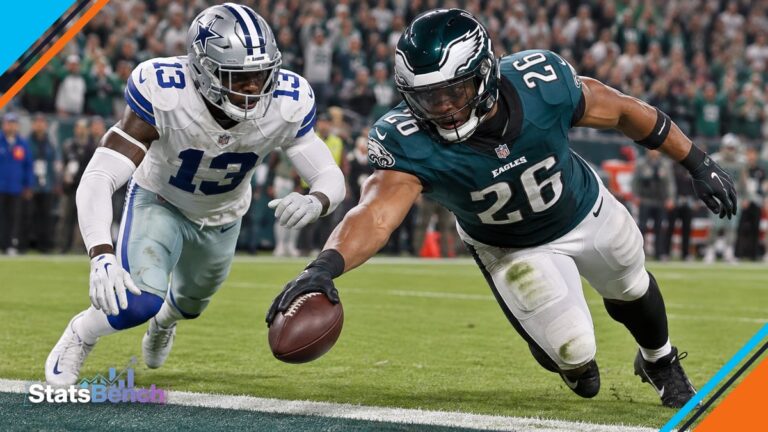
NFL public betting data shows where the crowd’s money sits: the share of tickets on each side and the share of dollars. Those two numbers disagree more often than people expect, and the disagreement is the part worth studying.
Books publish splits because they draw traffic. They also happen to be a real read on where a line might move next. The skill is knowing which number to trust, and when to ignore both.
How do you read NFL public betting splits?
Start with the gap, not the headline. A side drawing 70% of tickets but only 45% of the money means lots of small bets and a smaller number of bigger ones on the other side.
Four things are worth checking, in this order:
- Ticket percentage versus money percentage. Wide gap, more information. Near-identical numbers, almost none.
- Line movement since the split was posted. If the line moved toward the heavy-money side, the book agrees with the big bets.
- Timing. A split from Tuesday is a different animal from one 20 minutes before kickoff.
- Market type. Spreads and totals behave differently from player props, where there’s no single consensus line.
One caution: splits are self-reported by books and sampled by aggregators. They’re a snapshot, not a census. Treat them as one input next to injury news, matchup data and price.
Tickets vs money: why the gap is the signal
A ticket count is a count of bets. Money is a count of dollars. Ten $10 bets and one $1,000 bet are eleven tickets and $1,100, and only one of those numbers reflects conviction.
So when you see a lopsided ticket split with a modest money split, the crowd is loud and the wallets are quiet. When the two line up and the line still hasn’t moved, the book is comfortable with its position and probably likes its number.
The reverse case is the interesting one. Money heavy on one side, tickets split evenly, line nudging that way. That’s a book responding to size rather than volume, and it’s the closest thing splits give you to a sharp footprint.
Does the public actually lose?
Not on any given Sunday. The public wins plenty of individual games. The structural point is that everyone pays the vig, and the crowd tends to favor favorites, overs and recognizable names, which is where the tax sits heaviest.
You can measure that tax yourself instead of taking anyone’s word for it. Convert both sides of a line to implied probability with the implied probability calculator, add them up, and the excess over 100% is the hold. That number is the house’s edge, and it’s the number the public is actually fighting.
Public betting data doesn’t tell you the crowd is wrong. It tells you where the crowd is, and price is what tells you whether the other side is worth it. Betting should stay entertainment with money you can afford to lose. 21+.
NFL inactives: when are they announced?
Teams release their inactive list 90 minutes before kickoff, and that list is where late line movement is born. A starting receiver ruled out at 11:30 a.m. ET for a 1 p.m. game can move a spread in minutes, well after most public splits were posted.
That timing gap is why the last hour matters more than the previous six days. The practical routine:
- Track the official injury report through the week on NFL.com’s injury page, and note the difference between questionable and doubtful.
- Set an alarm for 90 minutes before the game you care about. Read the inactives before you read anything else.
- Recheck the price, not just the line. A backup stepping in often moves the number and the juice at different speeds.
If a split you saw this morning predates the inactive list, it’s history. Don’t anchor on it.
NFL weather report: does it actually move numbers?
Yes, and it moves totals more reliably than sides. Wind and precipitation hit the kicking game and the deep passing game first, so outdoor games in bad conditions usually see totals drop before spreads adjust.
Check the forecast at the stadium, not the city, and check it on game day. Start with the National Weather Service point forecast for the venue’s coordinates. A 12 mph difference between two forecasts is noise. Sustained wind above the mid-teens with gusts is not.
The betting angle is timing. Weather news arrives slowly and publicly, so the market usually gets there before you do. Where weather still pays is on player props tied to volume and accuracy (deep passing, field goals, return yards), because prop markets reprice slower than game markets. That’s the same edge the NFL picks against the spread guide covers from the spread side.
NFL pick’em: a different crowd entirely
Pick’em formats (season-long pools, weekly survivor-style contests, and player-prop pick’em apps) generate their own public lean, and it doesn’t always match the sportsbook splits. A contest where everyone picks five games rewards contrarian picks, so the “public” in a pick’em pool isn’t the same public as the one betting into a book.
Two practical notes. First, if you’re playing a pool, the useful question isn’t who covers, it’s who else in the pool is on this side, because ties are what kill you. Second, if you’re playing prop pick’em apps, the line is often set independently of the sportsbooks, which creates price differences worth checking.
StatsBench lists PrizePicks and Underdog prices next to 30+ sportsbooks, DFS apps and exchanges, so you can see where the pick’em number sits against the market on the NFL props board.
A dated example: the IND @ HOU prop board
Here’s a real snapshot from a mid-November 2026 Colts at Texans slate, pulled from StatsBench. It shows what a range of records and prices looks like side by side, which is the discipline splits can’t give you.
| Player | Prop | Hit rate | Best price |
|---|---|---|---|
| Jonathan Taylor | Rushing attempts o/u 12.5 | 9/10 (90%) | -108 |
| Daniel Jones | Interceptions o/u 0.5 | 9/10 (90%) | -154 |
| C.J. Stroud | Passing attempts o/u 32.5 | 7/10 (70%) | -111 |
| Nico Collins | Receiving yards o/u 69.5 | 4/10 (40%) | -110 |
| Xavier Hutchinson | Receiving TDs o/u 0.5 | 3/10 (30%) | +226 |
Read the prices, not just the percentages. Two rows clear at the same 9/10 rate, but the interception under costs -154 while the rushing attempts line sits at -108. Same recent record, very different amount of risk baked into the number.
Down the board, the receiving yards line at 4/10 pays only -110, which tells you the market already prices that as roughly a coin flip. The touchdown prop at 3/10 pays +226 because it fails most weeks. A crowd piling onto a recognizable name at a short price is paying for comfort, not for an edge.
Putting the three inputs in order
Splits, late news and price are three different clocks. Here’s the sequence that keeps them straight:
- Monday to Friday: read the matchup and the injury report. Note which side the tickets are on, and whether money agrees.
- 90 minutes out: read the inactives before you read any split. Kill any lean that depended on a player who’s out.
- Game day weather: confirm the stadium forecast. Adjust prop volume expectations, not just the total.
- At the price: de-vig the market with the devig calculator and compare the best available number across books before you commit.
That’s the whole point of tracking public action. You’re not fading the crowd for sport. You’re checking whether the crowd’s lean has already been priced in, and if the number you can still get is better than the one the market is telling you it should be.
For the daily numbers, the weekly NFL prop board runs through the live slate, and tickets vs money goes deeper on how to read a split at all. Track what you bet, too. Without a record, you’re guessing about your own results as much as anyone else’s.
Free preview
See today’s NFL player props on StatsBench
Live lines, hit rates and the best price across 30+ books and pick’em apps. A free preview shows today’s first props; a free account shows more.
Open the NFL player props board →
Prefer email? Get the daily picks newsletter.
Frequently Asked Questions
What does it mean when the public is heavy on one side?
It means most bettors are on that side, which is information about crowd behavior rather than about the game. Check whether the money percentage agrees with the ticket percentage and whether the line has moved. A loud ticket split with quiet money is usually just small bets.
Is NFL public betting data free?
Mostly, yes. Sportsbooks publish their own splits for some games, and third-party sites aggregate them. The catch is that each source samples a different group of books, so the percentages rarely match exactly.
When are NFL inactives announced?
Teams release their inactive list 90 minutes before kickoff, per league rule. That’s late enough to move a line, so any split you read in the morning can be stale by the time the list drops.
Do weather reports actually change NFL betting lines?
Yes, totals tend to move first when wind or heavy rain is forecast at an outdoor stadium. Game-day forecasts at the venue are more useful than a city forecast, and player props tied to passing volume often reprice slower than the game line.
Where can I check NFL prop prices across books?
StatsBench lists NFL props with hit rates and the best available price across 30+ sportsbooks, DFS apps and exchanges. The free preview shows a sample of the board before you create an account.
 Today's NBA picks


 Today's NFL picks
 Today's NHL picks



 Today's College Football picks


 Today's College Basketball picks



 Today's CS2 picks



 Today's Valorant picks


 Today's Dota 2 picks



 PHI
 BOS
 DET
 MIA
 ATL
 NY
 CLE
 ORL
 TOR
 IND
 CHA
 WSH
 BKN
 CHI
 MIL
 SA
 LAL
 HOU
 MIN
 MEM
 POR
 OKC
 DEN
 GS
 DAL
 PHX
 NO
 LAC
 SAC
 UTAH
 BUF
 KC
 JAX
 CIN
 DEN
 PIT
 CLE
 NE
 LV
 BAL
 HOU
 IND
 NYJ
 LAC
 MIA
 TEN
 SF
 DET
 NYG
 CAR
 MIN
 CHI
 GB
 SEA
 LAR
 DAL
 WSH
 TB
 NO
 ATL
 ARI
 PHI
 CAR
 NJ
 TB
 OTT
 MTL
 BOS
 NYR
 FLA
 NYI
 WSH
 BUF
 DET
 TOR
 PHI
 PIT
 CBJ
 EDM
 MIN
 VGK
 COL
 NSH
 DAL
 ANA
 WPG
 UTA
 SJ
 STL
 SEA
 CGY
 LA
 CHI
 VAN
 UGA
 UTAH
 ND
 UCLA
 MIA
 IU
 ALA
 TEX
 TENN
 WAKE
 TTU
 BYU
 IOWA
 ORE
 BOIS
 OSU
 UK
 USC
 ARIZ
 HOU
 LOU
 LIB
 FLA
 MEM
 MISS
 MSU
 CONN
 UVA
 DUKE
 ILL
 KU
 SJU
 VAN
 MICH
 ARK
 GONZ
 NEB
 LSU
 Premier League table
 ARS
 BHA
 MCI
 LIV
 CHE
 EVE
 BOU
 BRE
 LEE
 AVL
 TOT
 NEW
 Hull City
 IPS
 FUL
 NFO
 Coventry
 MUN
 SUN
 CRY
 La Liga table
 BAR
 RMA
 ATM
 BET
 RSO
 SEV
 ATH
 VIL
 DEP
 RAC
 CEL
 ALA
 ESY
 RAY
 GET
 OSA
 LVT
 ELC
 VAL
 MAL
 Serie A table
 LAZ
 INT
 ROM
 MIL
 COM
 Frosinone
 JUV
 BOL
 CAG
 NAP
 TOR
 ATA
 GEN
 LEC
 FIO
 PRM
 SAS
 MON
 VEN
 UDI
 Bundesliga table
 FCB
 BVB
 SCF
 RBL
 B04
 SVW
 SV Elversberg
 VFB
 TSG
 SGE
 HSV
 M05
 SC Paderborn 07
 FCA
 KOE
 FCU
 FC Schalke 04
 BMG
 Ligue 1 table
 PSG
 LOSC
 PFC
 OM
 LYO
 NCE
 ASM
 REN
 B29
 LOR
 LEN
 TOU
 STR
 AUX
 Le Mans
 ANG
 Troyes
 LEH