

Every number on this page comes from the StatsBench home run model, and the page is refreshed daily rather than republished, so today’s MLB home run picks always reflect the current slate. Today is October 7, 2026, and the board carries seven HR-favorable setups across four games.
One honesty note before the names. Those percentages are calibrated model estimates, not predictions, and the home run is the longest longshot on any board. Even an elite setup usually lands somewhere between 10% and 20%, which means the single most likely outcome on any of these is a flyout.
Today’s MLB home run picks: seven setups the model likes
Munetaka Murakami (CWS) to hit a home run vs Daniel Espino
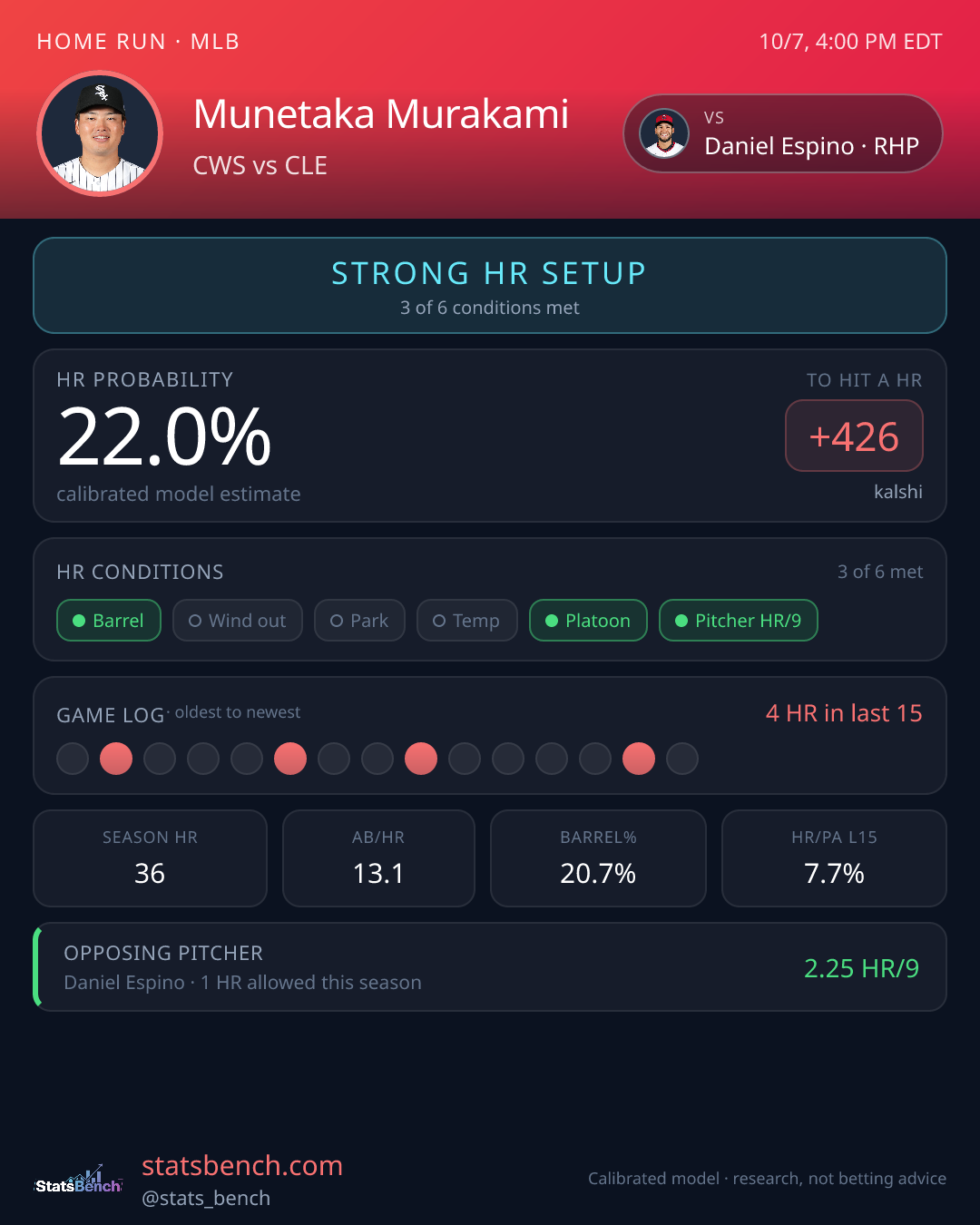
Murakami owns the top calibrated estimate on the slate at 22.0%, and the model tags it STRONG on 3 of 6 conditions: barrel rate at or above 10%, the platoon advantage, and an opposing pitcher with a HR/9 of at least 1.3. Espino clears that last bar at 2.25 HR/9, and Murakami’s 20.7% barrel rate is the loudest in this group. He has 36 homers this season, one every 13.1 at-bats, with 4 in his last 15 games. The catch is the park, where the HR factor is 96 for left-handed bats. Kalshi prices the homer at +426.
Ben Rice (NYY) to hit a home run vs Nick Martinez
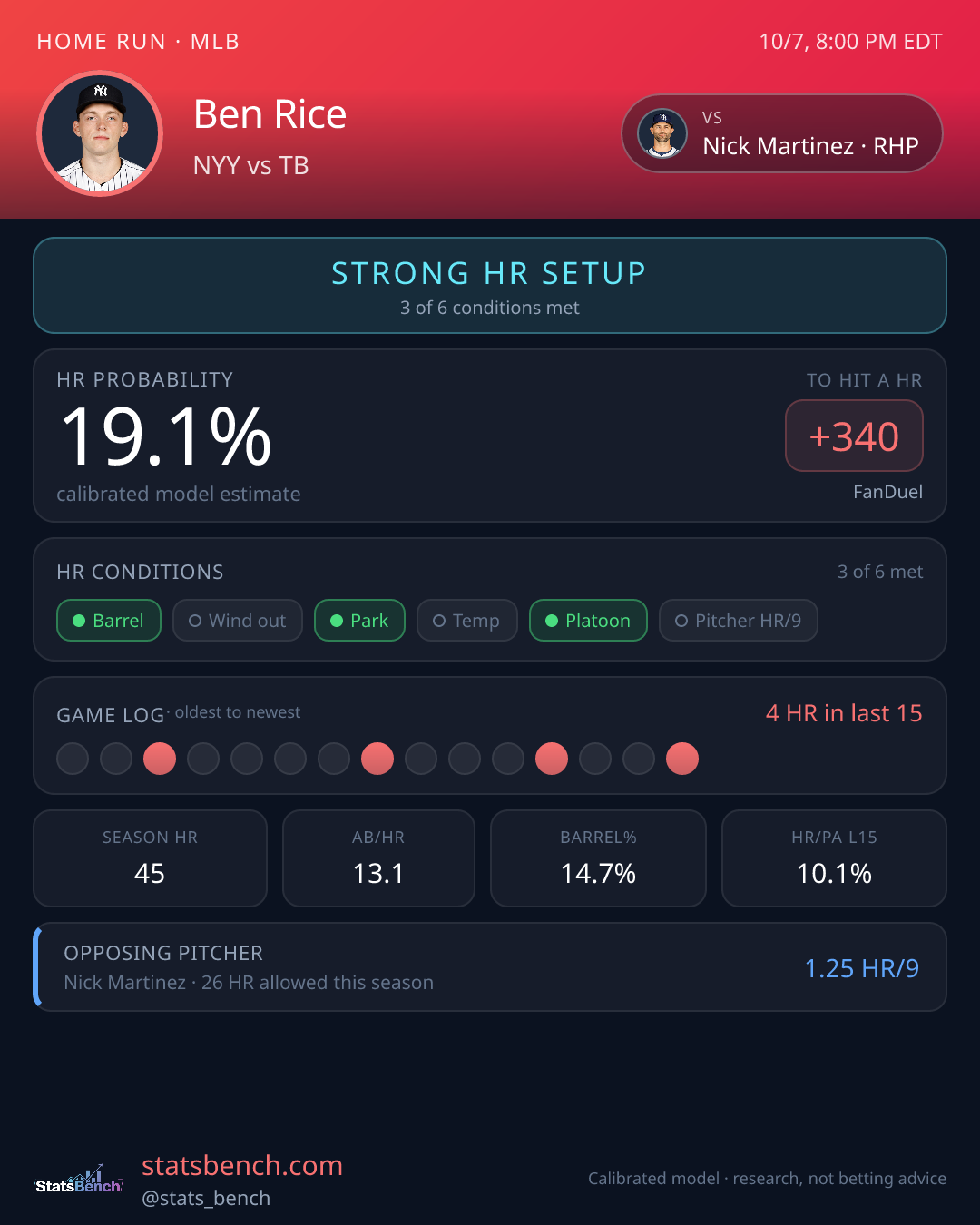
Rice sits at 19.1%, second on the page, with the same three conditions behind his STRONG tag: barrel at or above 10%, a park factor of 105 or better, and the platoon edge. He brings 45 home runs this season (one per 13.1 at-bats) and a 14.7% barrel rate into a park that plays at 119 for left-handed hitters. Martinez is the softer side of this matchup at 1.25 HR/9, and Rice has 4 homers in his last 15 games. FanDuel has him at +340.
Matt Olson (ATL) to hit a home run vs Tyler Glasnow
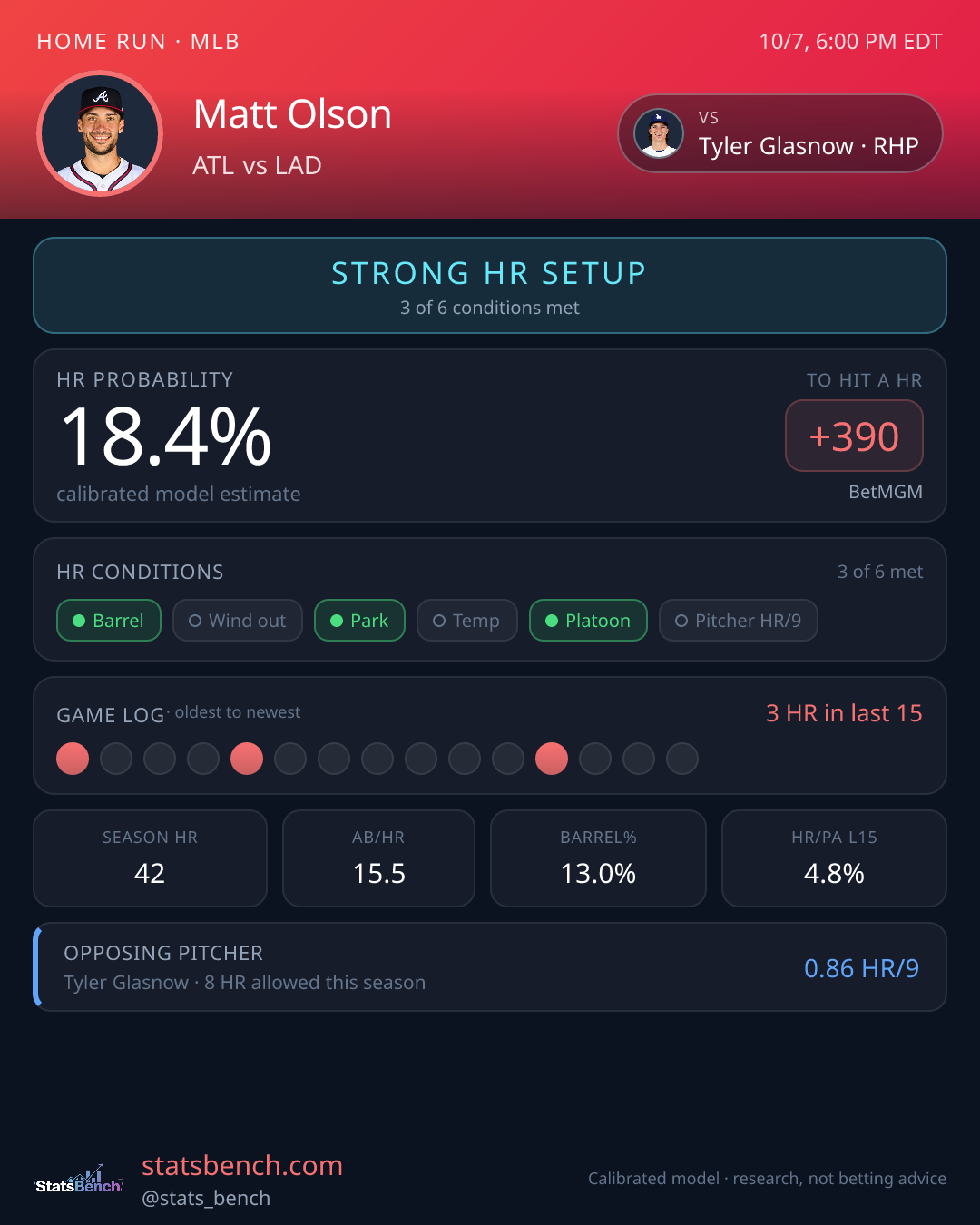
Olson lands at 18.4% with a STRONG setup built on barrel rate, a park factor of 105 or better and the platoon side. His 42 homers this season come at one per 15.5 at-bats with a 13.0% barrel rate, and the park plays at 110 for left-handed bats. The number working against him is Glasnow’s 0.86 HR/9, the lowest any pitcher on this page carries. He has 3 homers in his last 15 games, and BetMGM lists him at +390.
Shohei Ohtani (LAD) to hit a home run vs Tyler Mahle
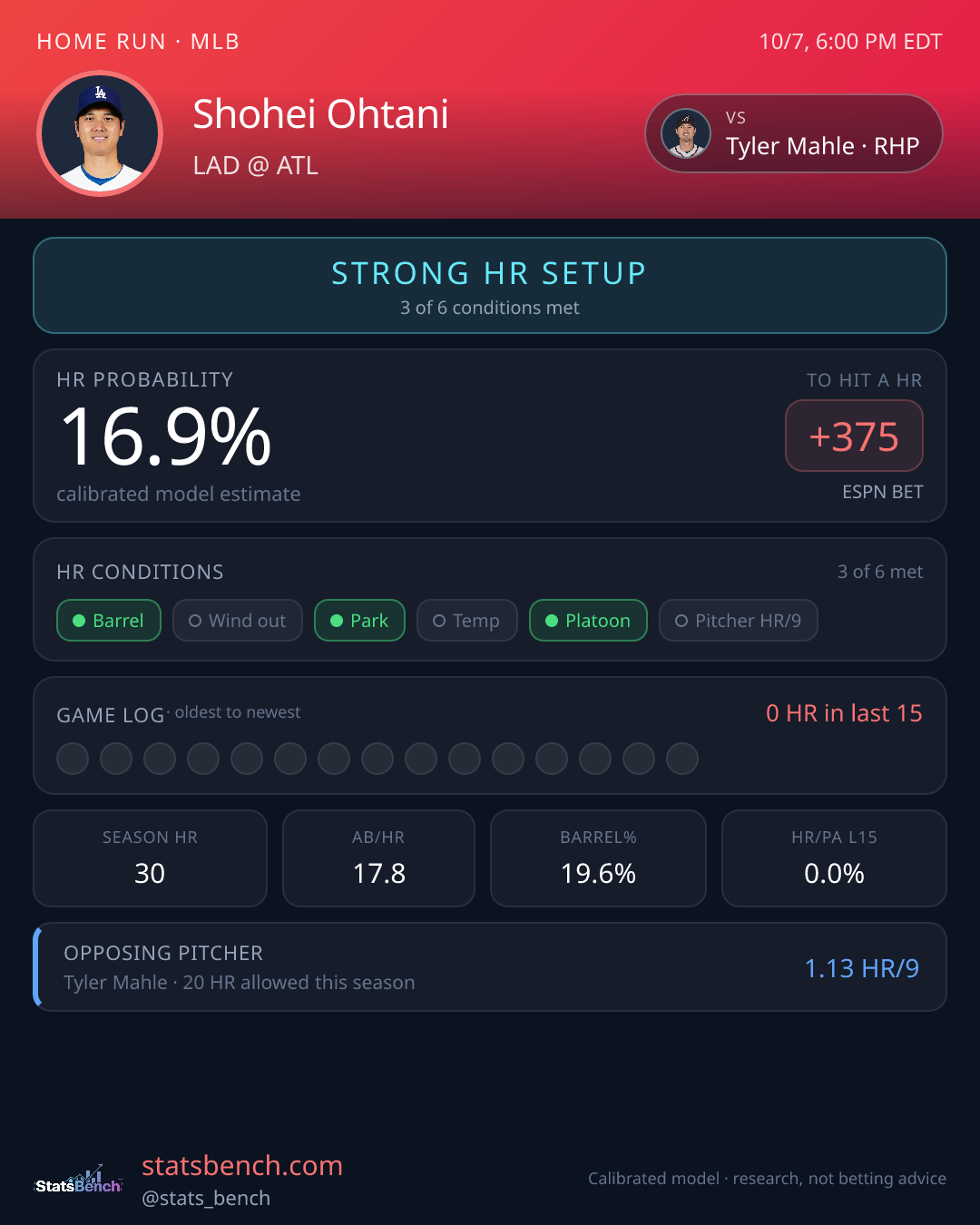
Ohtani checks in at 16.9% with a STRONG tag on barrel rate, park factor and platoon advantage. His 19.6% barrel rate is nearly as loud as Murakami’s, and he has 30 home runs on the year, one every 17.8 at-bats. The recent form cut is ugly though: 0 homers in his last 15 games. Mahle gives him a workable 1.13 HR/9, the park sits at 110 for left-handed hitters, and ESPN BET lists him at +375.
Colson Montgomery (CWS) to hit a home run vs Daniel Espino
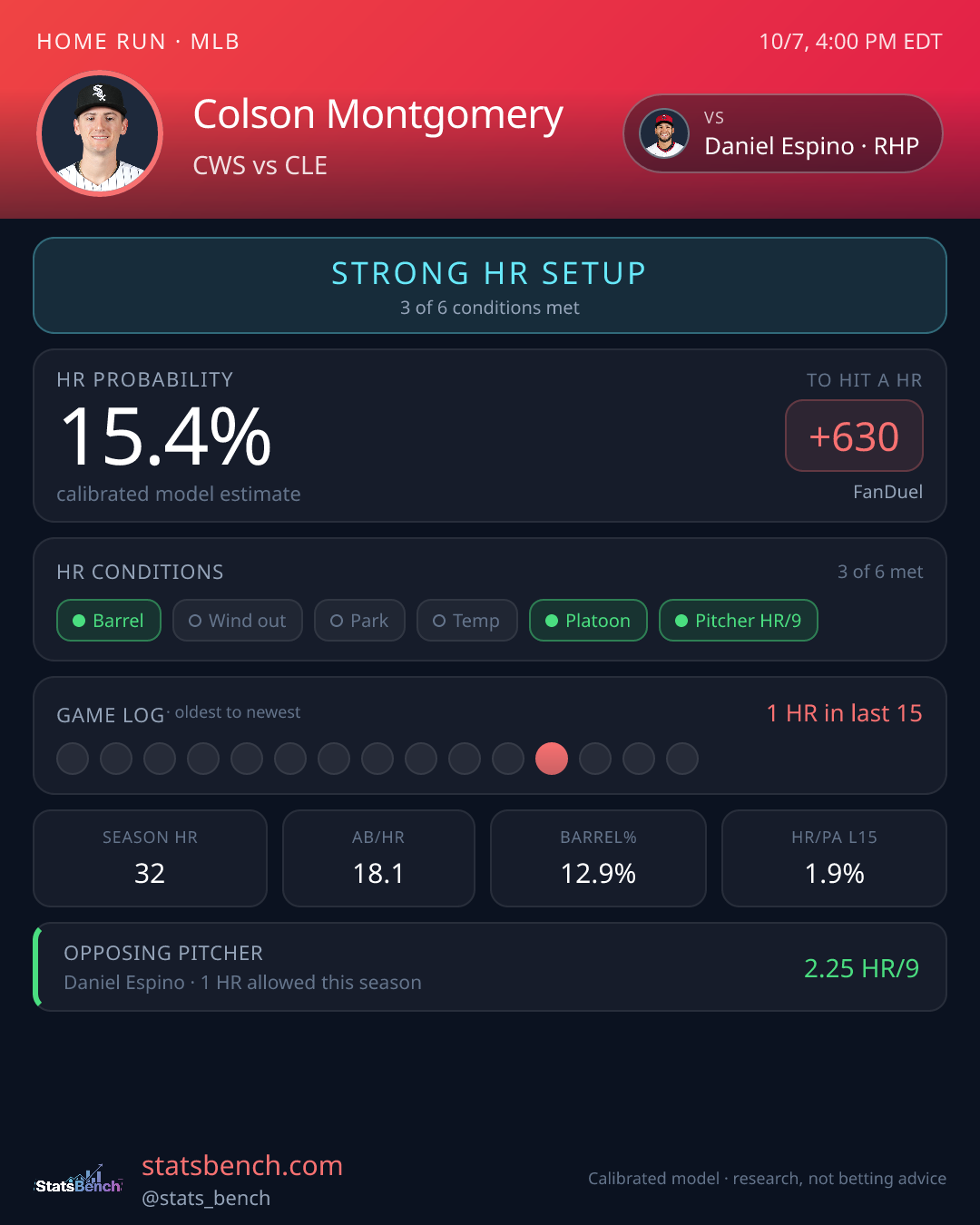
Montgomery comes in at 15.4%, and his setup reads a little differently: barrel rate, the platoon edge, and a pitcher with a HR/9 of 1.3 or better. Espino’s 2.25 HR/9 is the whole reason he appears here, since Montgomery’s 32 homers (one per 18.1 at-bats) arrive with a 12.9% barrel rate. A 96 park factor for lefties and just 1 homer in his last 15 games are why he ranks below the first two names. FanDuel has the longest price of this mini-cluster at +630.
Jake Bauers (MIL) to hit a home run vs Walker Buehler
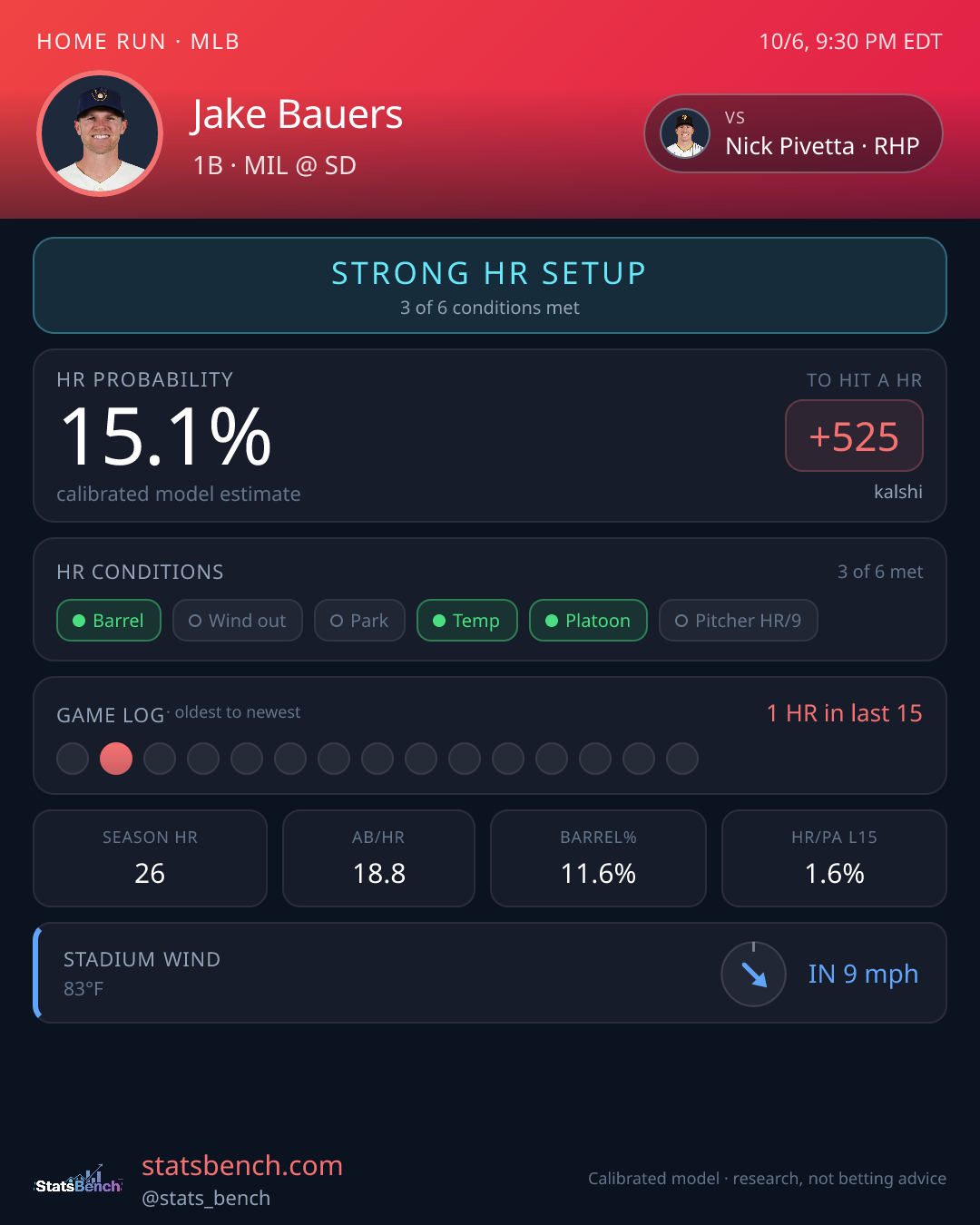
Bauers lands at 14.8% on the strength of barrel rate, platoon advantage and Buehler’s 1.49 HR/9. His 26 home runs come at one per 18.8 at-bats with an 11.6% barrel rate, and he has 1 homer across his last 15 games. The ballpark is the problem here: an 89 HR factor for left-handed hitters is the most pitcher-friendly number on this page. bet365 prices him at +525.
Jackson Chourio (MIL) to hit a home run vs Walker Buehler
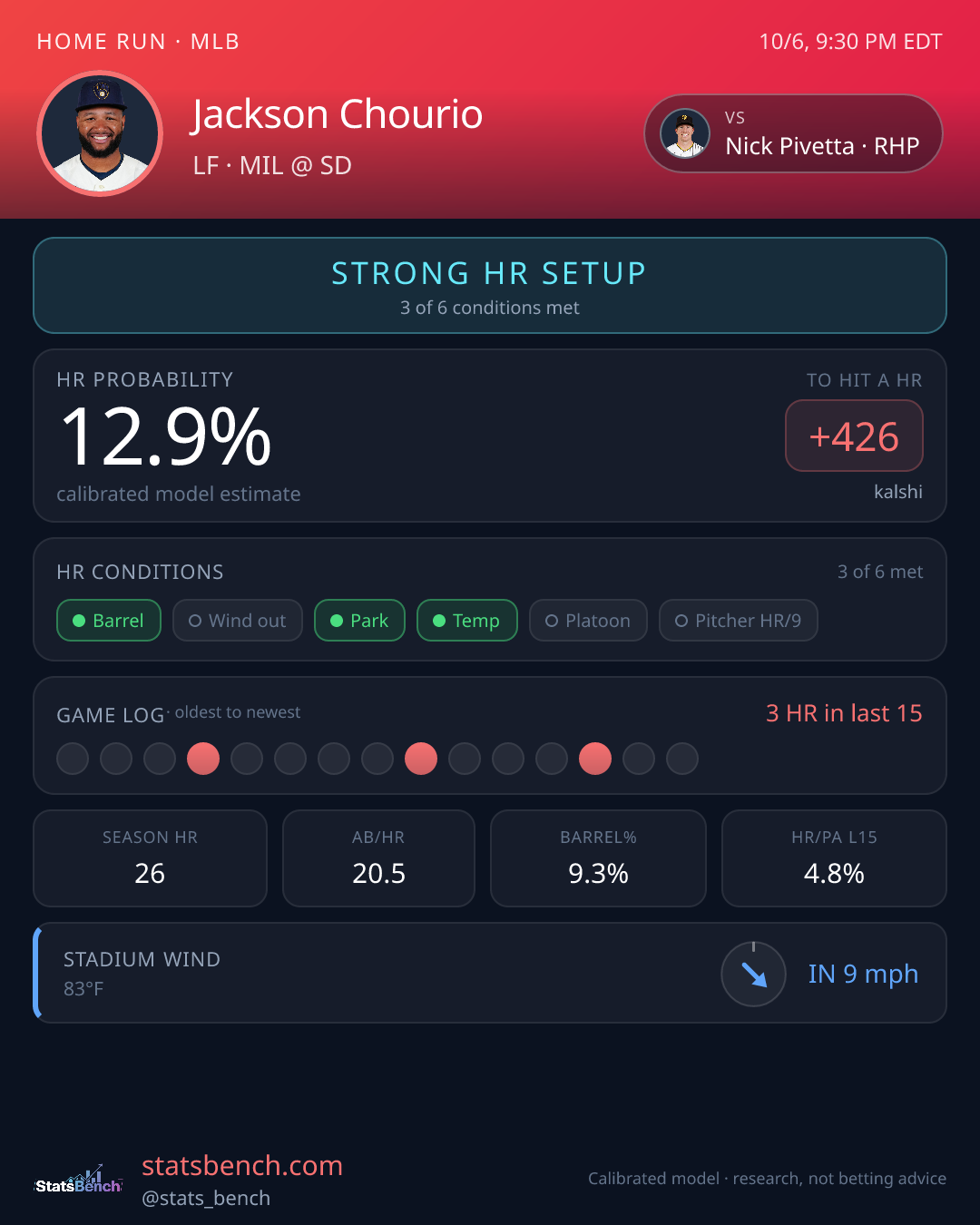
Chourio is the shortest estimate of the group at 12.6%, but the model still marks the matchup STRONG on barrel rate, a park factor of 105 or better and Buehler’s 1.49 HR/9. He plays the same building as Bauers, only from the right side, where the HR factor is 112 instead of 89. He has 26 homers this season, one per 20.5 at-bats, and 3 in his last 15 games. BetParx lists him at +540.
How StatsBench builds each HR setup
Every setup starts with a mandatory barrel-rate floor. From there the model weighs platoon advantage, opposing pitcher HR/9, park HR factor and recent form, then calibrates all of it into the probability shown next to each name. The STRONG label counts how many of six HR-favorable conditions are present, and it describes the matchup rather than a bet signal.
The conditions doing the work on today’s board:
- Barrel rate at or above 10% (the mandatory floor)
- A platoon advantage for the hitter
- Park HR factor of 105 or better
- Opposing pitcher HR/9 of 1.3 or higher
Prices above come from Kalshi, FanDuel, BetMGM, ESPN BET, bet365 and BetParx at the time of writing. Odds move, so check the live number before you do anything else. StatsBench is a research platform, meaning the data is here and the judgment stays yours.
Responsible gambling: what these percentages do not promise
Nothing on this page is a guarantee. A 22.0% estimate means the ball leaves the yard roughly once in five tries, and the other four are outs. Inside a single night, variance decides everything; across a large sample, the number you paid is what matters.
Bet only what you can afford to lose, and treat it as entertainment rather than income. Must be 21+ or of legal age in your jurisdiction, since sports betting rules vary by region. If betting stops being fun, call 1-800-GAMBLER.
Frequently Asked Questions
How accurate are the HR probabilities on this page?
They are calibrated model estimates, not predictions and not locks. The model blends barrel rate, platoon splits, pitcher home run rates, park factors and recent form, then outputs a percentage. Treat it as a well-reasoned starting point, not a result.
What does a STRONG setup actually mean?
It counts how many of six HR-favorable physical conditions are present, with a barrel-rate floor required. Today’s setups each hit 3 of 6. It describes the matchup, not a recommended stake or a bet signal.
Is a 22.0% home run probability good?
It is the best estimate on today’s board and still means the batter fails to homer about 78% of the time. Home run props are longshots by nature, so even elite setups miss far more often than they connect.
Does this page change every day?
Yes. The page is refreshed daily with the new slate rather than republished as a separate post, so the numbers you see always match the current date. Nothing carries over from yesterday.
Should I bet every setup listed?
No. The list is ranked research, not a card of stakes. Pick what fits your own read, check the live price first, and size it inside a bankroll you can afford to lose.