
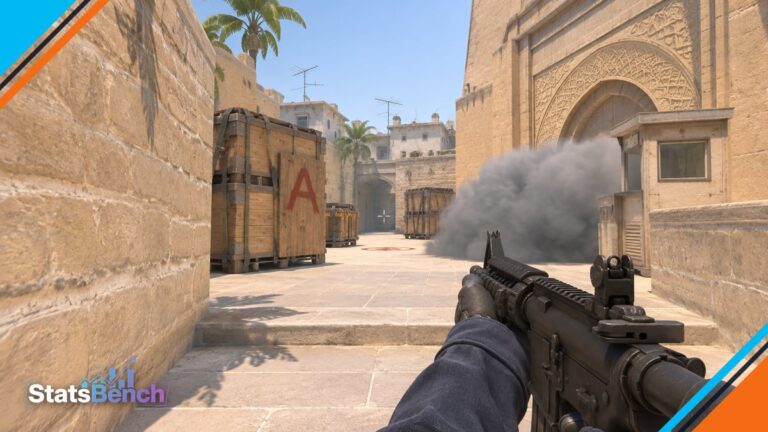
CS2 betting means wagering on Counter-Strike 2 matches and the numbers inside them, from the series winner to how many kills a rifler racks up on map one. What separates it from betting a sport with fixed halves is structure: nearly every market is tied to a single map, and a best-of-one or best-of-three series decides how many maps you actually get.
Get that structure right and the rest is arithmetic and research. Get it wrong and you’ll wonder why your “match” bet settled after 40 minutes.
The CS2 betting markets worth learning first
Start with markets that have one clear settlement rule. Match winner, map winner, map handicap and total maps are the backbone. Round and player markets come second, because they need more context before the price makes sense.
| Market | Settles on | The usual trap |
|---|---|---|
| Match winner | Which team takes the series | A Bo3 isn’t three coin flips, the map pool decides |
| Map winner | One named map | Prices move on the veto, not the roster |
| Map handicap (-1.5) | A 2-0 in a Bo3 | A strong map-one team isn’t a 2-0 team |
| Total maps over/under | Usually 2.5 in a Bo3 | Needs the veto read, not the form read |
| Pistol round winner | Round one of a map | Zero-sum market: research both sides |
| Player kills / headshots | One player on one map | Map length and role move the line |
Why the map pool decides more than the roster
Counter-Strike runs on a rotating map pool, and teams are rarely equal across all of it. A lineup that looks ordinary on paper can be genuinely strong on Ancient and shaky on Nuke. Nuke plays slower and more vertical, Ancient is utility-heavy around mid, Mirage rewards clean executes. That spread is the whole game for a bettor.
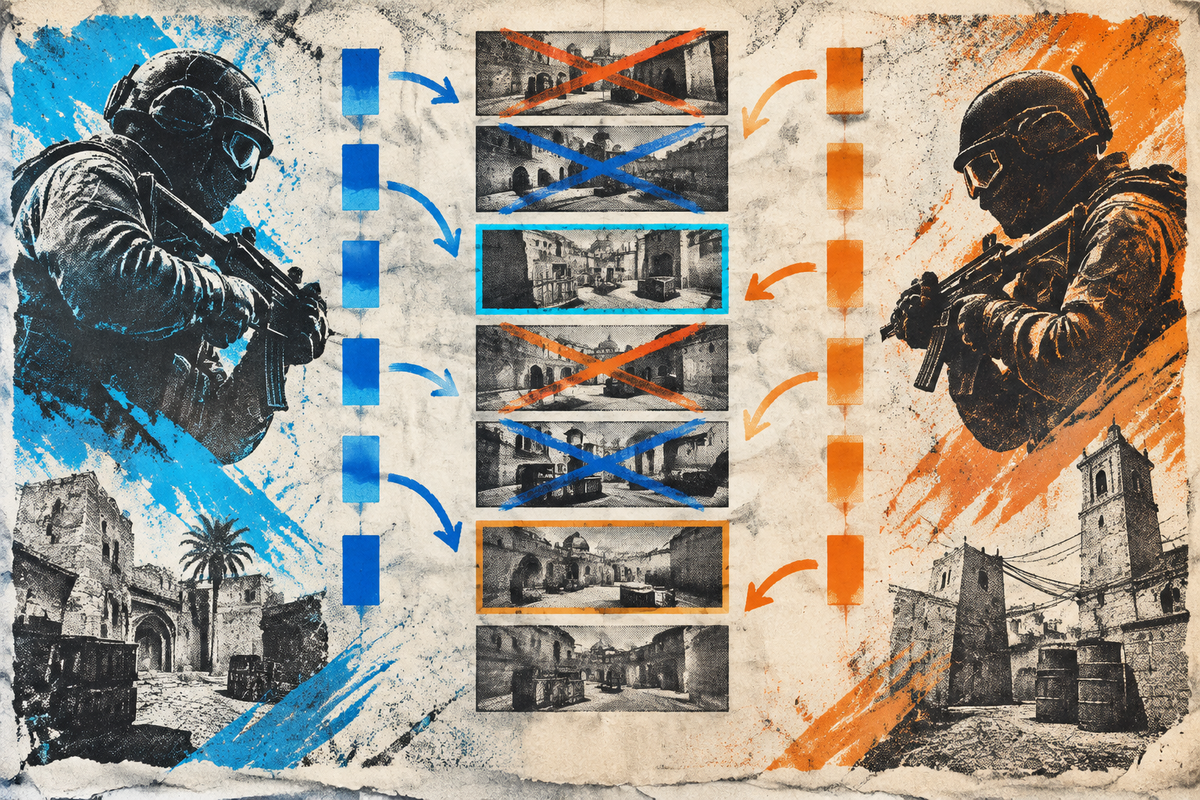
Before you look at any price, find the veto. Which map does each team ban first? Which map is the underdog leaving in the pool hoping to steal? In a best-of-three you usually get three maps, and the third is often settled by the ban phase rather than by form.
Per-map samples are smaller than people assume. Ten maps on one map is a reasonable read. Three is noise. When a site flashes a 100% record on a single map, check the denominator before you treat it as a pattern.
Bo1 vs Bo3: the format changes every number
In a best-of-one, one map decides everything. There is no map two, no tactical reset, no room to lose a slow opener. That makes Bo1 the format where preparation and the veto matter most, and it’s why map-one props are so common: on a Bo1, map one is the whole match.
A best-of-three works differently. You get a longer veto, a map order, and often a momentum swing after the opener. A team can lose map one and still win the series. It cannot undo the individual stat line you already bet on that map.
Three practical consequences:
- Heavy favourites are usually priced tighter in a Bo1, because one bad map ends the bet.
- Map-one player props exist in both formats, but the map is more predictable in a Bo1 since the veto is shorter.
- Series handicaps like -1.5 only exist in Bo3 and above, and they need a team that wins 2-0, not just a team that wins.
If you want the read on how a specific series price gets built, the CS2 betting predictions write-up walks through it map by map.
Pistol rounds and the economy snowball
Round one of a CS2 map is its own market. Everyone starts on equal money, so the pistol is decided by the buy, the setup and a slice of luck. Win it and you normally get two or three rounds of better equipment before the other side can full-buy.
That snowball is what makes the market interesting and what makes it dangerous. It is zero-sum: one team wins the round. StatsBench’s CS2 Pistol Lab shows both teams’ rates side by side with their samples, and there is no graded record attached to it. Use it as research on both sides of the duel, not a signal to fire on.
Watch the sample carefully. Ten pistols is a fair read on a settled lineup. Three, or ten spread across four roster changes, tells you very little.
Round markets: totals, handicaps and first blood
Round-based markets settle on the shape of a map rather than the result. Round totals ask whether two teams will trade enough to push past a number. Round handicaps ask for a margin. First blood asks which side draws the opening kill, and that one is more about economy and map control than raw aim.
These markets are thinner and more volatile than the match winner. If you haven’t watched the two teams’ recent maps, you’re guessing at pace. A fast, aggressive side manufactures more engagements and more rounds; a slow, utility-first side can drain a map of duels and kill an over on total rounds.
Player kill props: read the role, then the line
Kill props are the most popular CS2 player market, and the line is almost always set on map one. That dodges the “what if it goes three maps” question, but it inherits every question about the veto, the opponent and how long that single map runs.
Three things move a kill line:
- Role. An AWPer taking early duels sees more kill chances than a support player throwing utility and trading. Entry fraggers get looks. Anchors get fewer.
- Map length. Regulation runs to 24 rounds, so a 13-2 blowout hands everyone fewer chances than a 16-14 grind.
- Opponent pace. A fast team creates more engagements. A patient side can turn a map into a slow, low-duel affair.
Here is a real slice of the kill and headshot board, pulled from StatsBench in early November 2026. It’s a selection of the strongest rows rather than a full market sample, so read it for how the numbers sit together, not as a list to copy.
| Player (match) | Market | Line | Hit rate | Best price |
|---|---|---|---|---|
| molodoy (FURIA vs BetBoom) | Map 1 headshots | Over 5.5 | 7/10 (70%) | 1.78 (-128) |
| makazze (Natus Vincere vs PARIVISION) | Map 1 headshots | Over 7.5 | 7/10 (70%) | 1.75 (-133) |
| YEKINDAR (FURIA vs BetBoom) | Map 1 kills | Over 14.5 | 6/10 (60%) | 1.92 (-109) |
| xiELO (PARIVISION vs Natus Vincere) | Map 1 kills | Over 14.5 | 6/10 (60%) | 1.85 (-118) |
| s1ren (BetBoom vs FURIA) | Map 1 kills | Over 13.5 | 6/10 (60%) | 1.72 (-139) |
| b1t (Natus Vincere vs PARIVISION) | Map 1 headshots | Over 9.5 | 5/10 (50%) | 1.90 (-111) |
| iM (Natus Vincere vs PARIVISION) | Map 1 kills | Over 14.5 | 4/10 (40%) | 1.93 (-108) |
| FL1T (PARIVISION vs Natus Vincere) | Map 1 kills | Over 12.5 | 3/10 (30%) | 1.77 (-130) |
Look at the range. A 7/10 record sits next to a 3/10 record at almost the same price. Same juice, very different histories. That gap between the record and what the price demands is the first thing to weigh, and it’s the reason a bare hit rate on its own never settles an argument.
For the mechanics of how these lines are built and graded, see CS2 map 1 kills props and CS2 player props.
How to price a CS2 bet in decimal odds
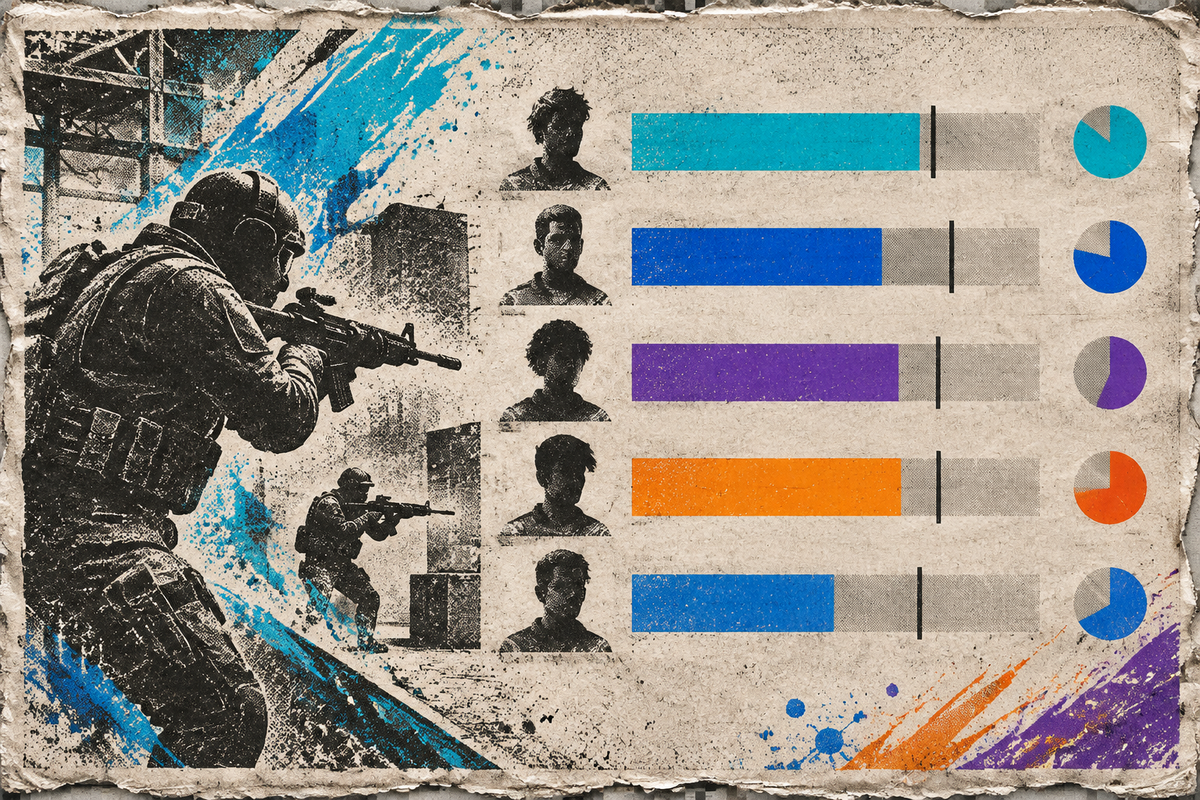
Most books outside the US quote decimal odds, so learn to convert. Decimal odds give you the total return per unit staked, including the stake. At 1.85 (-118), one unit comes back as 1.85 if it lands.
To get the implied probability, divide 1 by the price. 1.85 becomes about 54%. That’s your break-even rate, before you’ve thought about the matchup. The 1.78 (-128) row above breaks even at roughly 56%, while the 1.92 (-109) row breaks even at about 52%.
Add both sides of a market and you’ll pass 100%. The extra is the book’s margin. Price a two-way market at 1.85 and 1.95 and you get 54% plus 51%, so about 105%, or a 5% hold. Shopping across books shrinks that margin. StatsBench shows the best available price across 30+ sportsbooks, DFS apps and exchanges on the props it covers, so the comparison takes a click instead of a spreadsheet.
Two free tools handle the math: the odds converter and the implied probability calculator.
What to check before you place a CS2 bet
Five minutes of checking kills most bad bets before they happen.
- Format. Bo1, Bo3 or Bo5? It changes how much the veto and the opener matter.
- Veto. Which maps are left, and in what order?
- Roster. Stand-ins, new signings, a coach change. A stand-in can shift role and kill share.
- Sample. How many maps on that map, and with which five players?
- Price. Is this the best number across the books and pick’em apps you can access?
If a price looks generous for the record behind it, one of those five is usually the reason. Find it before you stake anything.
Where to do the research
For raw CS2 data, HLTV and Liquipedia cover results, map scores and tournament formats, and the official Counter-Strike 2 site is the reference for the game itself. For pricing and prop research in one place, the CS2 Prop Finder carries the board: kill and headshot lines, hit rates with the record attached, and the best price across books. You can see a free preview, and a free account opens up more.
Still choosing where to place bets? CS2 betting sites covers what to compare. The day’s numbers live on the CS2 prop board, and there’s more esports coverage across StatsBench esports.
One last thing. CS2 markets are volatile. A single pistol round or a lucky 1v3 can flip a map and every stat line with it. Bet only where it’s legal, at the legal age where you live, and with money you can afford to lose.
Free preview
See today’s CS2 player props on StatsBench
Live lines, hit rates and the best price across 30+ books and pick’em apps. A free preview shows today’s first props; a free account shows more.
Open the CS2 player props board →
Prefer email? Get the daily picks newsletter.
Frequently Asked Questions
What does map 1 mean in CS2 betting?
It means the first map of the series, whether the series is a best-of-one, best-of-three or best-of-five. Most CS2 player props are written for map one only, so the stat has to land in that specific map, not across the whole series.
Is Bo1 or Bo3 better for betting?
Neither is better, they just behave differently. A Bo1 has no recovery, so the veto and the opening map carry more weight. A Bo3 gives you map order and momentum swings, but individual map props still settle on the single map you bet.
How are CS2 kill props settled?
The prop settles on the player’s kills in the specified map, so you need the map to be played for the bet to have action. Check your book’s rules on overtime, since extra rounds can move a player past the line.
Why do two players with the same decimal price have different hit rates?
Because the price reflects the book’s view of the matchup, not just the player’s history. A 7/10 record at 1.78 and a 3/10 record at 1.77 cost you the same, but the record behind each one is very different, so the price has to be judged against the sample.
Do I need an account to see CS2 prop data?
You can see a free preview of the CS2 board, and a free StatsBench account opens up more of it, including hit rates with the underlying record and the best available price across books.
 Today's NBA picks



 Today's NFL picks


 Today's NHL picks



 Today's College Football picks



 Today's College Basketball picks


 Today's EPL picks


 Today's La Liga picks


 Today's Serie A picks



 Today's Bundesliga picks



 Today's Ligue 1 picks



 Today's MLS picks



 Today's EFL Championship picks



 Today's CS2 picks


 Today's Valorant picks



 Today's Dota 2 picks


 PHI
 BOS
 DET
 MIA
 ATL
 NY
 CLE
 ORL
 TOR
 IND
 WSH
 CHA
 CHI
 BKN
 MIL
 SA
 LAL
 HOU
 MEM
 MIN
 POR
 DEN
 OKC
 DAL
 GS
 PHX
 NO
 LAC
 UTAH
 SAC
 BUF
 KC
 JAX
 CIN
 DEN
 PIT
 CLE
 NE
 HOU
 LV
 BAL
 IND
 NYJ
 LAC
 MIA
 TEN
 SF
 DET
 NYG
 CAR
 MIN
 CHI
 GB
 SEA
 LAR
 DAL
 WSH
 TB
 NO
 ATL
 ARI
 PHI
 CAR
 TB
 MTL
 OTT
 NJ
 BOS
 NYR
 FLA
 NYI
 BUF
 PHI
 WSH
 DET
 TOR
 CBJ
 PIT
 MIN
 EDM
 VGK
 DAL
 COL
 NSH
 UTA
 WPG
 STL
 ANA
 SJ
 SEA
 CGY
 LA
 CHI
 VAN
 UGA
 UTAH
 ND
 UCLA
 MIA
 IU
 ALA
 TEX
 TENN
 WAKE
 TTU
 BYU
 IOWA
 ORE
 BOIS
 OSU
 UK
 USC
 ARIZ
 HOU
 LOU
 LIB
 FLA
 MEM
 MISS
 MSU
 CONN
 UVA
 DUKE
 ILL
 KU
 SJU
 VAN
 MICH
 ARK
 GONZ
 NEB
 LSU
 ARS
 BHA
 MCI
 LIV
 CHE
 EVE
 BOU
 BRE
 LEE
 AVL
 TOT
 NEW
 Hull City
 IPS
 FUL
 NFO
 Coventry
 MUN
 SUN
 CRY
 BAR
 RMA
 ATM
 BET
 RSO
 SEV
 ATH
 VIL
 DEP
 RAC
 CEL
 ALA
 ESY
 RAY
 GET
 OSA
 LVT
 ELC
 VAL
 MAL
 LAZ
 INT
 ROM
 MIL
 COM
 Frosinone
 JUV
 BOL
 CAG
 NAP
 TOR
 ATA
 GEN
 LEC
 FIO
 PRM
 SAS
 MON
 VEN
 UDI
 FCB
 BVB
 SCF
 RBL
 B04
 SVW
 SV Elversberg
 VFB
 TSG
 SGE
 HSV
 M05
 SC Paderborn 07
 FCA
 KOE
 FCU
 FC Schalke 04
 BMG
 PSG
 LOSC
 PFC
 OM
 LYO
 NCE
 ASM
 REN
 B29
 LOR
 LEN
 TOU
 STR
 AUX
 Le Mans
 ANG
 Troyes
 LEH
 Champions League table
 Como
 BRU
 SCP
 Real Betis
 Lask Linz
 Manchester United
 GAL
 FEN
 AS Roma
 SHK
 Viking
 PSV
 BOD
 FC Porto
 AEK Athens FC
 Sabah FA
 FEY
 Lens
 SLA
 SLV