
StatsBench refreshes this page every day with the LoL first blood markets we’re tracking, and today is October 9, 2026. Two fixtures make the cut: Galions vs Kaufland Hangry Knights at EMEA Masters 2026 Summer, and Fuego vs Disguised in the LCS 2027 Promotion Tournament. First blood is a zero-sum market, so we show both teams’ rates and the split, then explain which side the numbers lean toward and what argues against it.
LoL first blood leans for October 9, 2026
Kaufland Hangry Knights first blood vs Galions (EMEA Masters 2026 Summer, 12:00 PM EDT)
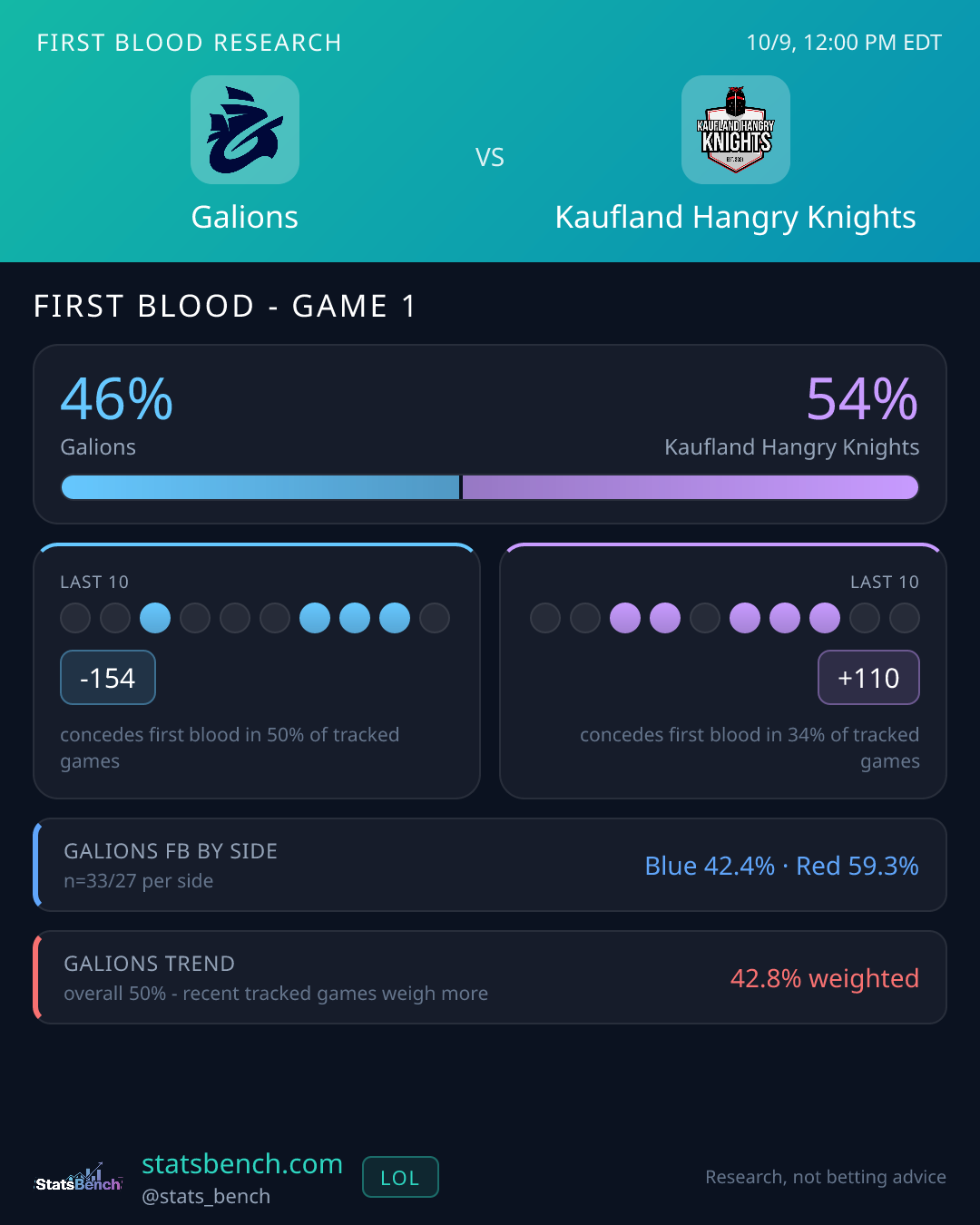
The matchup split leans Kaufland Hangry Knights at 54% to Galions’ 46%, and the underlying rates agree: KHK take first blood in 66% of tracked games (weighted recent 62.4%) and in 5 of their last 10, while Galions sit at 50% overall but just 42.8% weighted recent with 4 of their last 10. The counter-number is real, though. Galions take first blood 59.3% of the time on red side (n=27), so the lean thins out fast if they land on red. KHK concede first blood in only 34% of tracked games, and their own side splits run 61.5% on blue (n=26) and 70.8% on red (n=24). Game 1 is posted at home -154 / away +110.
Disguised first blood vs Fuego (LCS 2027 Promotion Tournament, 5:00 PM EDT)
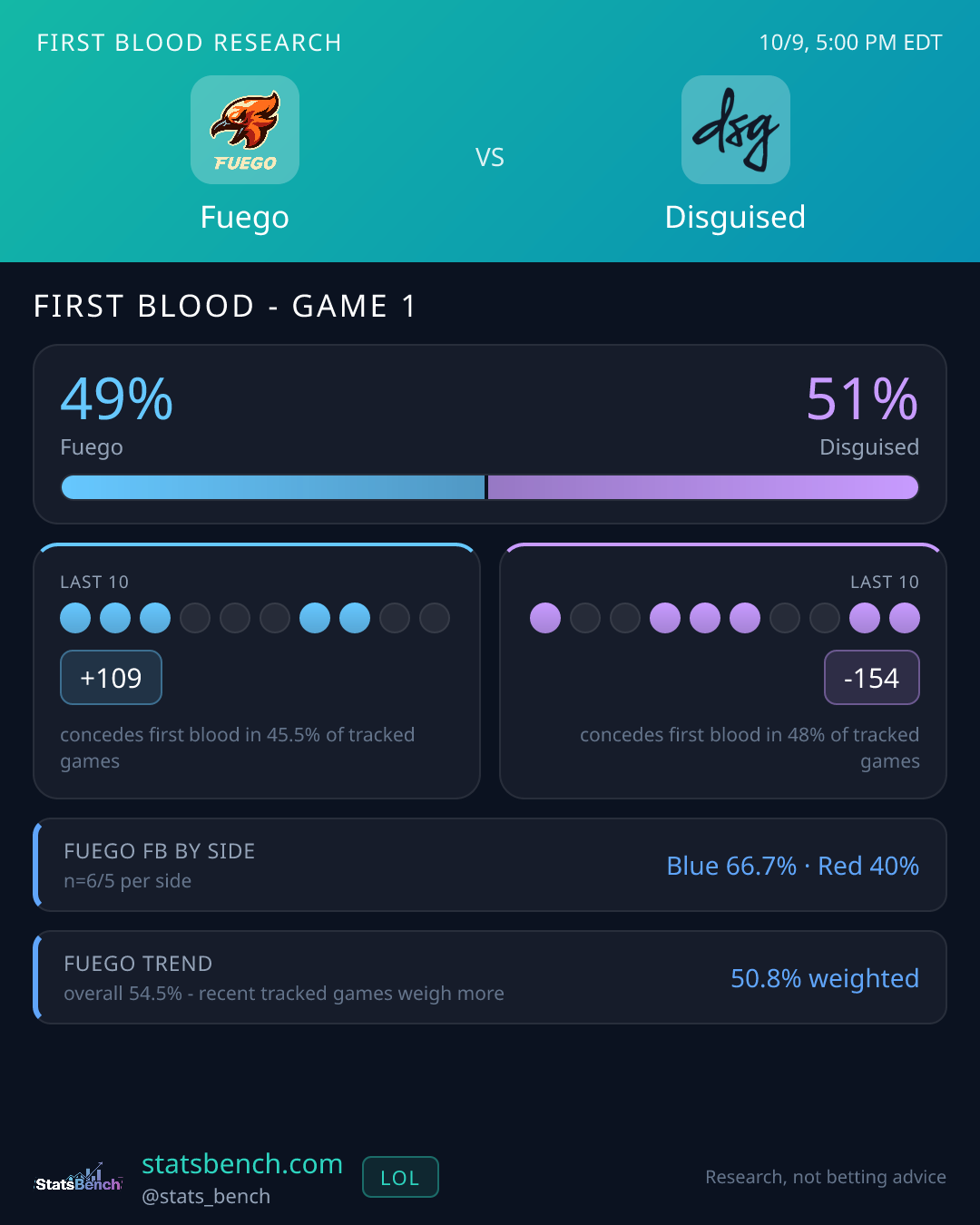
The split reads 49% Fuego / 51% Disguised, which is about as close to even as this market gets. Disguised take first blood in 52% of tracked games (weighted recent 54.9%) and in 6 of their last 10, while Fuego are at 54.5% overall but 50.8% weighted recent with 5 of their last 10. Fuego’s side splits look loud, 66.7% on blue (n=6) and 40% on red (n=5), but those samples are small enough to discount; Disguised run 62.5% on blue (n=8) and 47.1% on red (n=17). Concede rates are nearly level (45.5% for Fuego, 48% for Disguised), and game 1 is posted at home +109 / away -154.
How the first blood split is built
The split is a log5 head-to-head estimate, built from each team’s first-blood rate and the rate at which they concede it. The two sides always sum to 100. Treat it as an estimate, not a certainty: a 54/46 lean loses plenty of single games, which is exactly why the counter-number gets its own sentence in every writeup.
Side splits (blue and red) come from tracked games only, and every one is listed with its sample so you can weight it yourself. StatsBench publishes no EV or edge figures on esports surfaces, and there is no graded record for this market. What you get is the rate, the sample, and the posted price.
Bet within your means. Nothing here is a guarantee, and short samples swing hard in both directions. These rates describe what has happened in tracked games, not what will happen tonight. If you do bet, that’s 21+ (or the legal age in your jurisdiction), and help is available at 1-800-GAMBLER. Sports betting legality varies by region.
Frequently Asked Questions
What does the first blood matchup split actually mean?
It’s a log5 head-to-head estimate built from each team’s first-blood rate and the rate at which they concede it. The two sides sum to 100, so it tells you which side the tracked numbers lean toward, not who wins the game.
Does StatsBench show an EV or edge percentage for LoL first blood?
No. StatsBench publishes no EV or edge figures on any esports surface. These pages show rates, sample sizes, side splits, and the posted price, nothing more.
Is there a graded record for these first blood calls?
No, there’s no graded record for this market. The daily page is research, so treat the split as context for your own read rather than a result sheet.
Why do blue and red side splits matter so much in first blood?
Side changes how teams approach early skirmishes, and the tracked rates often diverge between them. Galions, for example, take first blood 42.4% of the time on blue (n=33) and 59.3% on red (n=27), a gap wide enough to change how you read the matchup.
How often is this page updated?
Every day. The URL stays the same and the fixtures, splits, and posted prices are refreshed each morning, so you can bookmark it instead of hunting for a new post.