

The StatsBench first basket model runs every WNBA game day, and this page is updated daily with the newest numbers. Today is October 9, 2026, and there are two games on the board: Atlanta at New York (7:30 PM EDT) and Golden State at Las Vegas (9:30 PM EDT).
One framing note before the numbers. Everything below is a calibrated model estimate, not a historical hit rate. First basket is a longshot market, every price you see is a big payout for a reason, and most first basket bets lose. The model’s job is to tell you where it thinks the posted number is wrong, not to promise a winner.
Tonight’s tip-off picture
The opening jump decides half of this market, so start there. Here’s who’s jumping and how often each team wins it.
- Atlanta at New York: Jonquel Jones against Angel Reese. New York wins the tip 53% of the time, and Jones leads the head-to-head 3-2 over 5 tips. Jones also scored first the last time these teams met.
- Golden State at Las Vegas: Kiah Stokes against A’ja Wilson. Golden State wins the tip 54% of the time, which leaves Las Vegas at 46%. Kayla Thornton scored first in the last meeting.
WNBA first basket picks for October 9, 2026
Two plays cleared the model’s conditions tonight. Two more showed up high on the probability list and still got passed at the current price, which is a different thing entirely.
Cecilia Zandalasini (Golden State) to score first, GS @ LV
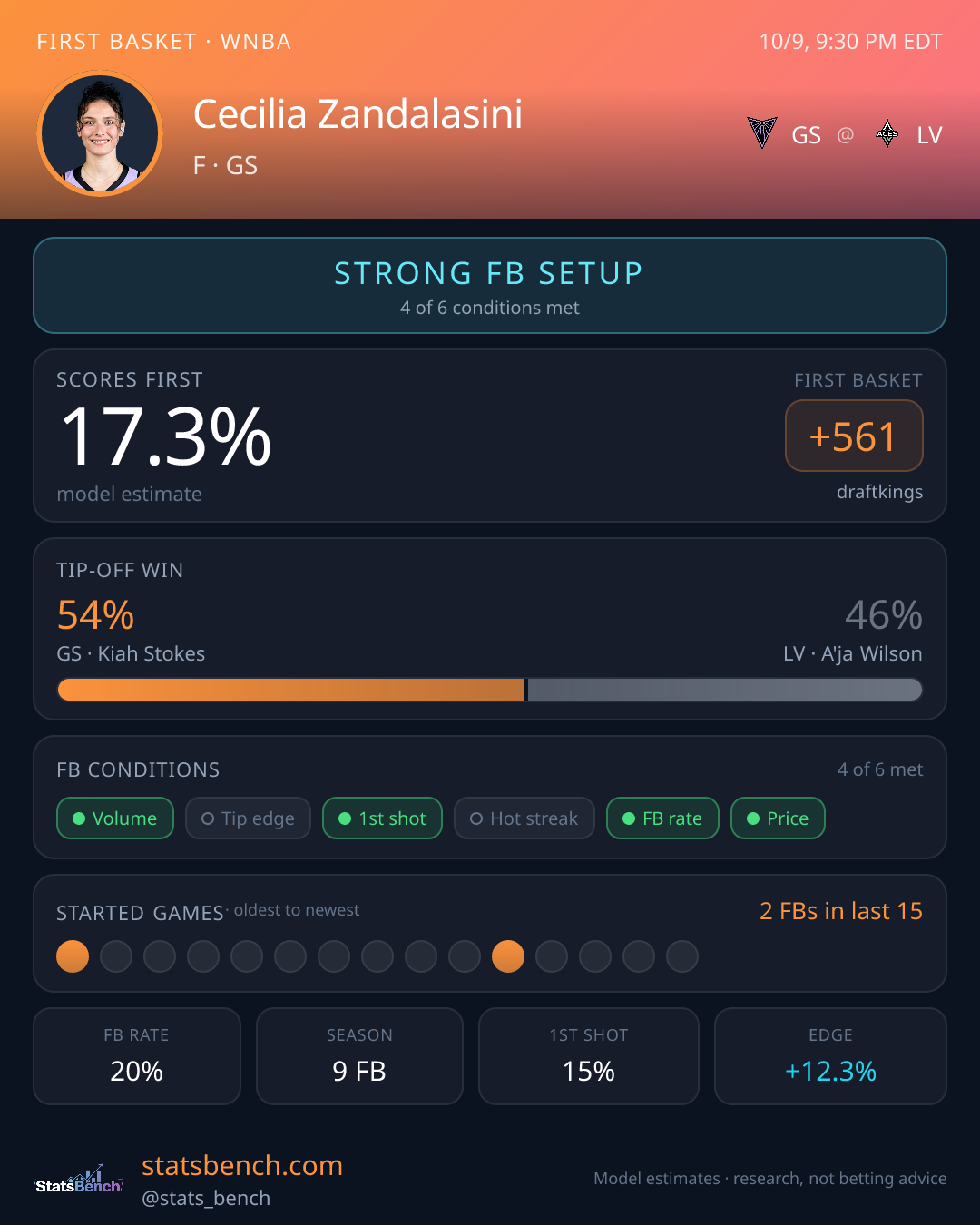
Golden State wins the tip 54% of the time with Kiah Stokes jumping, and Zandalasini has been the first shot-taker on 15% of her starts. That combination gives her a 17.3% chance to score first, a fair price of +479, against a DraftKings number of +561. The difference is a +12.3% model edge, and she clears 4 of 6 conditions (volume floor, first-shot taker, FB rate, price) to land in the STRONG tier. Her season first-basket rate is 20% (9 FB in 51 starts) with 1 in her last 5 starts, and her home/away first-basket split is 35%/11%, so the road setting is the one honest caveat here.
Rhyne Howard (Atlanta) to score first, ATL @ NY
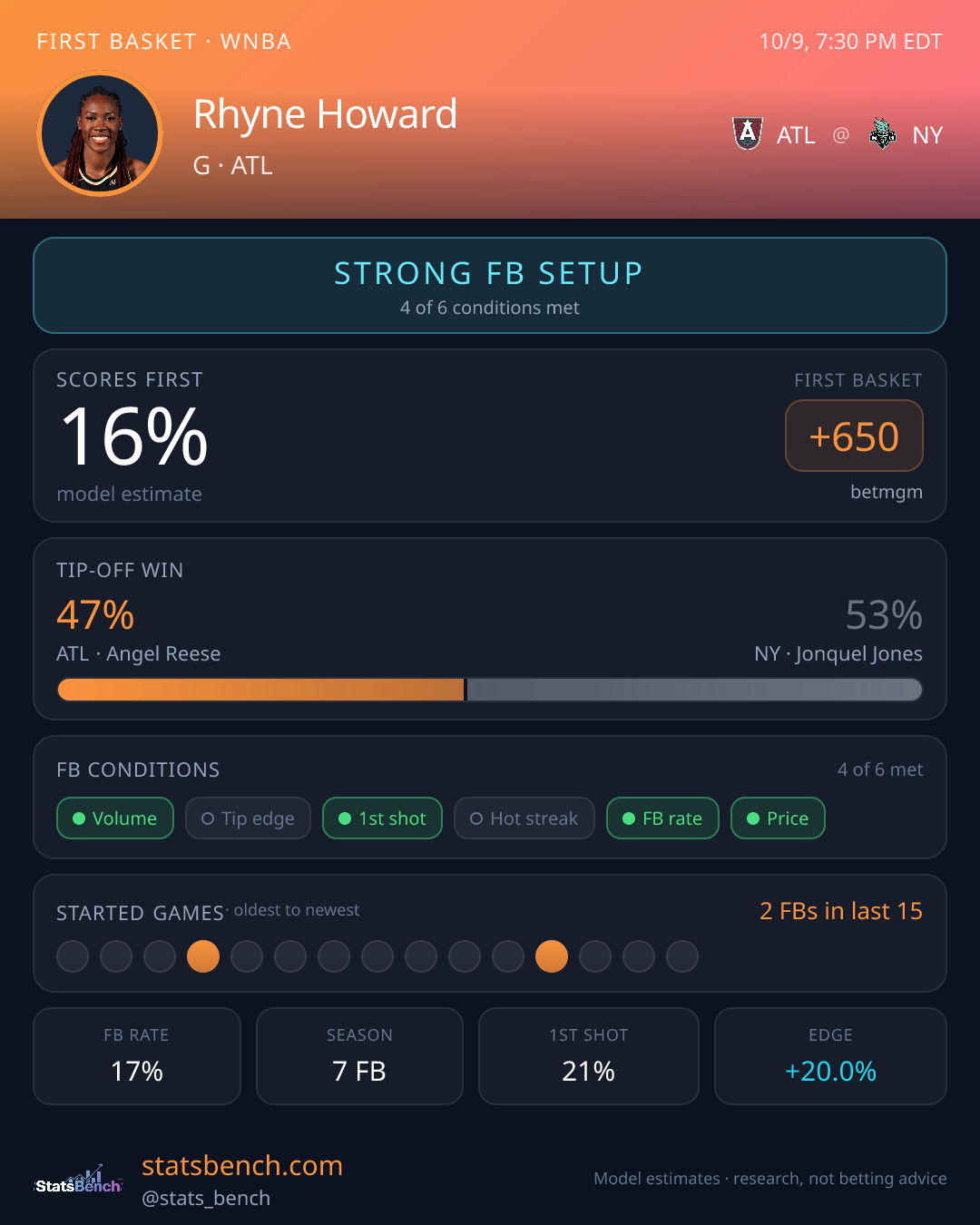
Howard carries the biggest edge on the page. The model gives her 16%, which converts to a fair +525, and BetMGM has her at +650 for a +20.0% model edge. She takes the first shot on 21% of Atlanta’s possessions, the highest first-shot rate among the four players listed here, and that’s the engine behind the play. The tip works against her, since Atlanta wins it just 47% of the time with Angel Reese on the jump. Her season first-basket rate is 17% (7 FB in 187 starts) with 1 in her last 5 starts, and her split runs 17%/13% home and away. At +650, you’re paid for that uncertainty.
A’ja Wilson (Las Vegas) to score first, GS @ LV
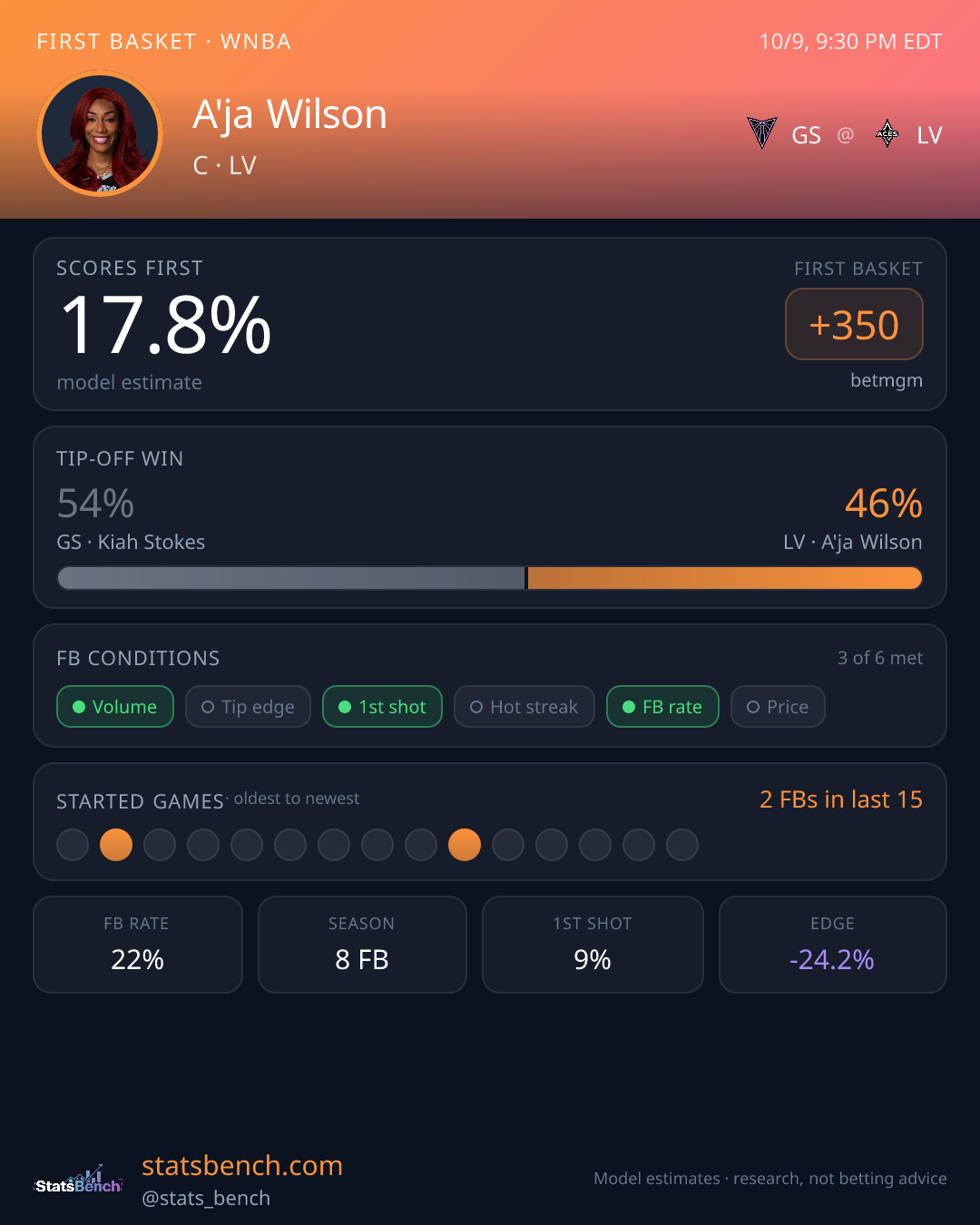
Wilson owns the highest raw probability on the board at 17.8% (fair +461), and the model still passes. BetMGM lists her at +350, well shorter than fair, and that’s a -24.2% model edge. She’s her own jumper and Las Vegas wins the tip 46% of the time, but she takes the first shot on only 9% of possessions and has 0 first baskets in her last 5 starts, against a 22% season rate (8 FB in 282 starts). That’s a watchlist name at this price, not a bet.
Jonquel Jones (New York) to score first, ATL @ NY
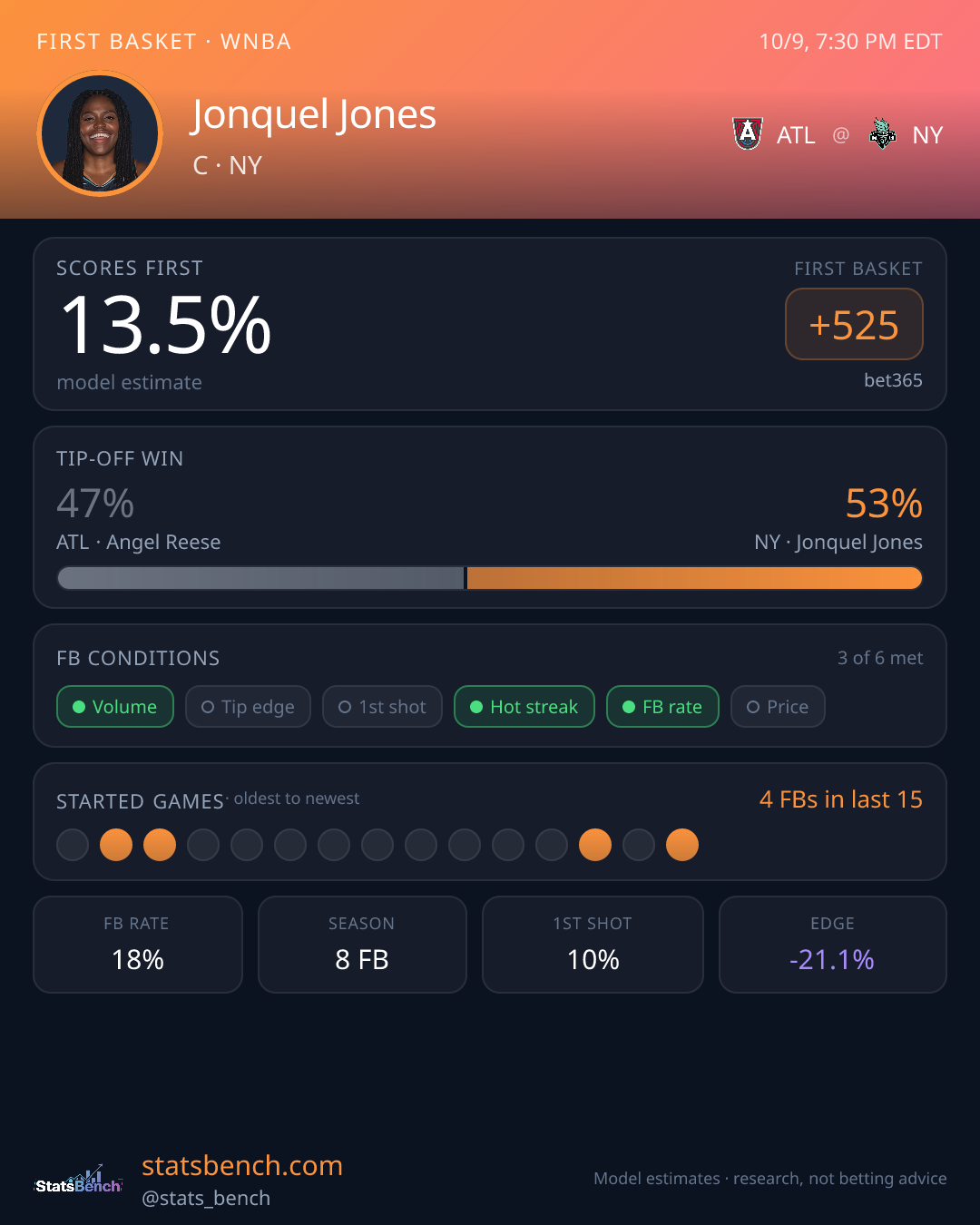
Jones leads the early game by probability at 13.5% (fair +640), and the model passes anyway because bet365’s +525 is shorter than fair, a -21.1% edge. The setup itself is fine: New York wins the tip 53% of the time with Jones jumping, and she’s taken 3 of the 5 career tips against Reese. Her first-shot rate is 10% and her season first-basket rate is 18% (8 FB in 263 starts), though she does show 2 first baskets in her last 5 starts, which the model tags as a hot streak. She scored first in the last meeting between these teams, but +525 already bakes that story in.
How the StatsBench first basket model works
The model runs in two stages. An ELO-style tip-off rating estimates who wins the opening jump, then that feeds a player-level estimate built on first-shot share and first-basket rate. Every probability above converts into a fair price, and the model compares that fair price to the posted number to produce the edge. No posted price means no edge, which is why the label is missing on some rows you’ll see elsewhere.
Two habits keep this honest. First, the model’s number is a probability, not a record, so a 17% play can lose five nights in a row and still be a good bet. Second, we track the graded results. Across 440 graded predictions, the model has hit 71 times, 16%, which is what a market full of longshots looks like. That number is a reminder, not a selling point.
Bet within your means
First basket is a lottery-ticket market, and a model edge only shows up over a large sample of bets. Nothing here is guaranteed, and one bad night can erase weeks of good decisions. Bet only what you can afford to lose, treat it as entertainment rather than income, and keep it 21+. If betting stops being fun, call 1-800-GAMBLER. Sports betting availability also varies depending on where you live, so check your local rules.
Frequently Asked Questions
What is a WNBA first basket bet?
You’re betting on which player scores the first field goal of the game. It’s a longshot market, so prices typically sit between +350 and +700, and most tickets lose. The payout is large because the probability is small.
How does the StatsBench first basket model pick players?
It works in two stages: an ELO-style rating estimates who wins the tip-off, then that estimate combines with each player’s first-shot share and first-basket rate. The result is a probability, which we convert to a fair price for comparison against the posted market number. It’s a calibrated estimate, not a hit rate.
Why does the model pass on A’ja Wilson when she has the highest probability?
Her 17.8% is the top raw number on the board, but BetMGM’s +350 is shorter than the fair price of +461. That works out to a -24.2% model edge, so the model doesn’t recommend betting it at that price. She’s a watchlist name tonight.
Do first basket bets win often?
No. Even the model’s strongest play is usually somewhere in the 10% to 18% range, so most first basket bets lose by design. Across 440 graded predictions, the model has hit 71 times, which is 16%.
What’s the difference between the model’s probability and a hit rate?
A hit rate describes what already happened over a set of past bets. The model’s probability is a forward-looking estimate for tonight’s game, built from tip-off win chances and first-shot share. They measure different things, and mixing them up is how people overrate longshot markets.